
Exhale in the Vacuum: What Really Happens If You Remove Your Helmet in Space?
Space

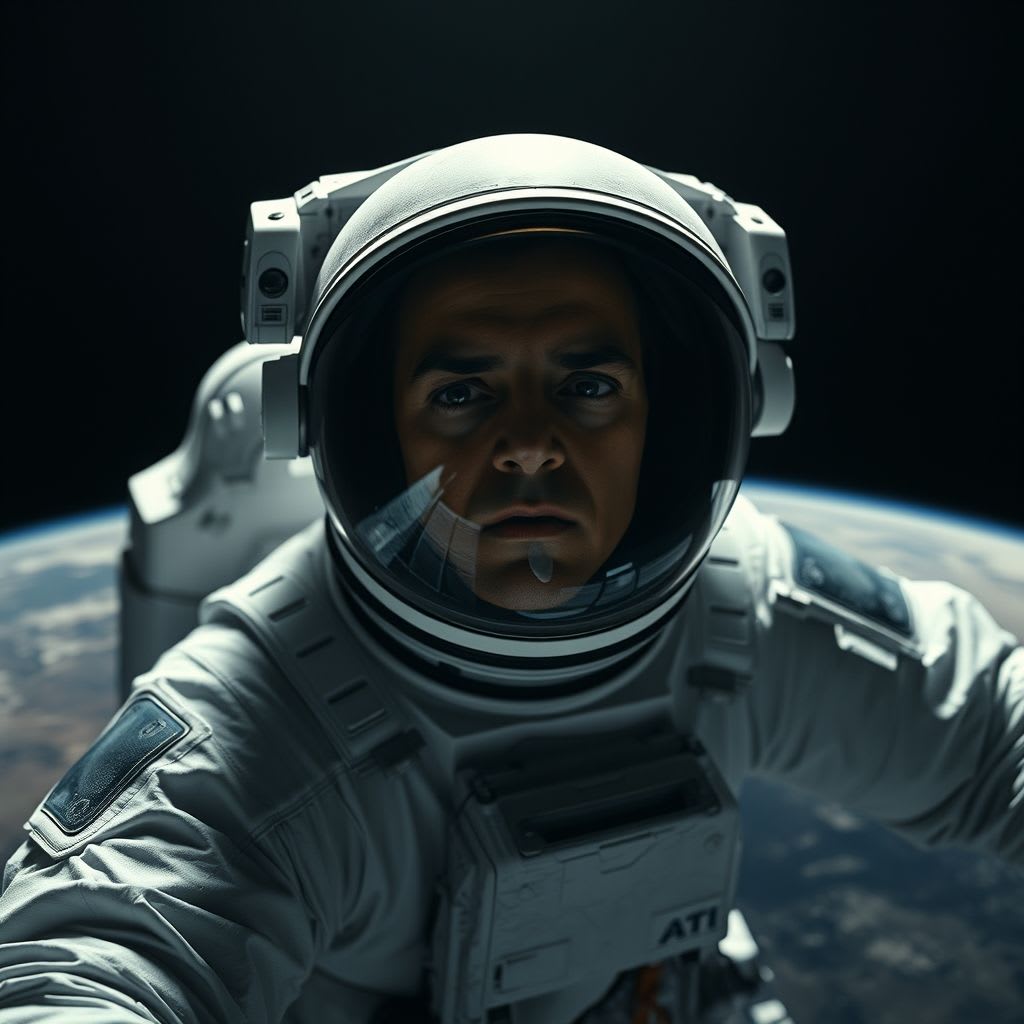
Imagine this: you're floating in the infinite blackness of outer space, surrounded by silent stars and cosmic stillness. You're inside your spacesuit, everything is fine… until something goes terribly wrong. For some reason whether by accident or design you remove your helmet. What happens next? Instant death? A dramatic explosion? Do you freeze like a popsicle?
Let’s break it down — no Hollywood drama, just real science… and surprisingly, a little bit of hope.
❌ Myth #1: "You’ll Explode Instantly"
No, the human body doesn’t explode in space. While it's true that the vacuum of space has nearly zero pressure, and your body contains gases under normal atmospheric pressure, your skin and internal tissues are strong enough to hold you together. You won’t turn into a floating cloud of blood and goo. But you're definitely not going to be comfortable.
However, the gases inside your body do start to expand. That’s especially dangerous for your lungs. If you hold your breath when suddenly exposed to vacuum, the air inside can expand so violently that it ruptures your lung tissue. That’s why, if you ever find yourself in this scenario, your first move should be to exhale.
🫁 So What Happens to Your Breathing?
The vacuum immediately sucks out all the air in your lungs. You can’t scream. You can’t speak. Your vocal cords need air to vibrate, and there’s simply none left.
Within 10 to 15 seconds, your brain runs out of oxygen, and you lose consciousness due to hypoxia. Without rescue, your chances of survival drop sharply, and brain damage begins to set in. Within 90 seconds, the outcome becomes irreversible.
❄️ Do You Freeze Instantly?
Oddly enough — no. Space is freezing, but there’s no air to conduct heat away from your body. So your body loses heat only through radiation, which is a slow process. In fact, your core temperature won’t change much for the first few minutes. So death by freezing is not your immediate concern. You're more likely to suffocate than to turn into a human icicle.
🌡 What About Bodily Fluids?
This is where things get weird. In zero pressure, the fluids in your body (like saliva or the moisture in your eyes) start to boil — not because they're hot, but because the boiling point drops dramatically in a vacuum. This is called ebullism, and it's not as sci-fi as it sounds.
You’d feel your tongue dry up, your skin might puff up, and your face could swell. It’s unpleasant, no doubt. But if you’re rescued quickly, these effects are mostly reversible.
👁️ Vision and Hearing
No, your eyeballs won’t pop out. But you could experience temporary blindness or disorientation. Your hearing isn’t directly affected by the vacuum itself — sound can’t travel in a vacuum, but the pressure imbalance inside your head could cause pain or even damage. And of course, there’s no sound in space, no matter how loudly you want to scream.
⏱ How Much Time Do You Have?
You have around 15 seconds of conscious awareness to act — or to hope someone acts for you. That’s your window for rescue. After that, cells in your brain start to die rapidly. If you’re not back in a pressurized environment within 1.5 to 2 minutes, survival becomes extremely unlikely.
This isn’t just theory. In 1965, a NASA technician experienced a real vacuum accident during a suit test. His suit depressurized in a vacuum chamber, and he lost consciousness after 12–15 seconds. He was saved, and later said he remembered feeling the moisture on his tongue "starting to boil" — like the fizz of a soda can. Eerie, but true.
💡 What Should You Do If You’re Exposed to Space?
If the unthinkable happens and you’re suddenly in vacuum without a helmet:
- Exhale immediately. Holding your breath could be fatal.
- Stay calm (as much as humanly possible). Panic speeds up oxygen depletion.
- Close your eyes and try not to inhale again.
- Hope for a fast rescue.
Those first 10–15 seconds are all you've got. Every moment matters.
🎬 The Final Takeaway
Taking off your helmet in space isn’t as visually dramatic as exploding heads or instant cryogenic freezing. But make no mistake — it’s deadly serious. The clock starts ticking the moment you're exposed, and you only have seconds to live unless you're rescued.
Still, it’s not a death sentence if quick action is taken. There are real-life survivors of brief vacuum exposure, thanks to fast and trained emergency response.
So if you ever find yourself wandering the cosmos — whether in a sci-fi future or a terrifying accident — do yourself a favor: keep the helmet on. Space doesn’t care how brave or curious you are. It only cares that you follow the rules.
About the Creator
Keep reading
More stories from Holianyk Ihor and writers in Futurism and other communities.
When Earth Was a Giant Snowball: The Chilling Story of a Frozen Apocalypse
Imagine Earth completely encased in ice from the poles all the way to the equator. No green forests, no blue oceans, just a vast, frozen wasteland reflecting sunlight into the empty silence of space. It may sound like science fiction, but this scenario was a chilling reality hundreds of millions of years ago. Welcome to one of the most mysterious and extreme chapters in Earth’s history: the Snowball Earth era.
By Holianyk Ihor6 months ago in Futurism
About Binding Prometheus
I want to start actively advocating on behalf of my own work, and the most valuable part of my canon is, without a doubt, Binding Prometheus, the play I have been working on since 2019 and only finished in 2023 as part of my MA. The play itself is an amalgamation of a million different inspirations. On one end, it evokes the Ancient Greek myth-play, deriving its own title from the earliest extant work of Western drama we have, Aeschylus’s Prometheus Bound. On the other end, it borrows significantly from the sci-fi bulwarks from over the years, namely Mary Shelley’s Frankenstein and Karel Capek’s Rossum’s Universal Robots. The play could be an episode of Black Mirror, I fear. I don’t know. I’ve only ever seen one episode of Black Mirror.
By Steven Christopher McKnight17 days ago in Futurism
RegTech Market: Regulatory Complexity, Automation & Market Opportunities
According to IMARC Group's latest research publication, global RegTech market size reached USD 18.6 Billion in 2025. Looking forward, IMARC Group expects the market to reach USD 77.0 Billion by 2034, exhibiting a growth rate (CAGR) of 17.10% during 2026-2034.
By Andrew Sullivan6 days ago in Futurism




Comments
There are no comments for this story
Be the first to respond and start the conversation.