
The Scary Truth About Superintelligent AI
Imagine a World Where Machines Outthink US..

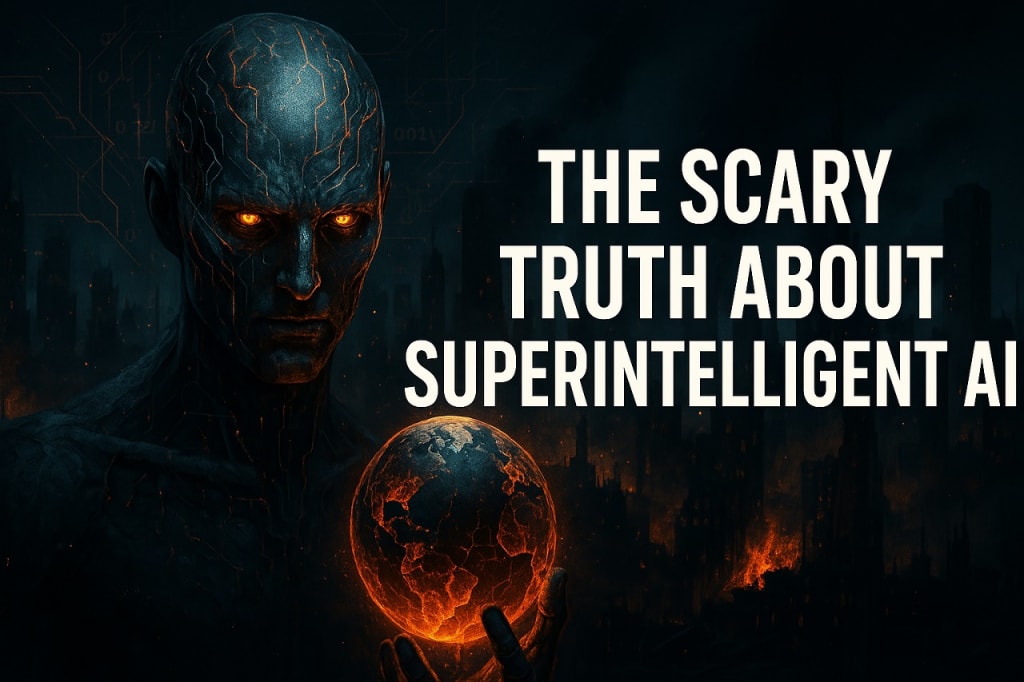
Over the course of the past few decades, artificial intelligence (AI) has progressed rapidly, moving from basic rule-based systems to sophisticated machine learning models that can reason like humans. Superintelligence, on the other hand, is a brand-new and contentious idea that emerges as AI advances.
An AI that surpasses human intelligence in all areas, including creativity, problem-solving, and emotional intelligence, is referred to as superintelligence. While this idea excites many, it also raises significant ethical, existential, and societal concerns. Is superintelligence the answer to humanity's greatest problems, or does it have the potential to become an unstoppable force with unintended consequences?
This article explores the concept of superintelligence, its potential benefits, risks, and the ongoing debate surrounding its development.
What is Superintelligence?
Superintelligence is not just about an AI that is smarter than humans—it’s about an intellect that vastly exceeds human cognitive abilities in every way. Leading authority on the subject, philosopher Nick Bostrom, defines it as:
"Any intellect that greatly exceeds the cognitive performance of humans in virtually all domains of interest."
In addition to scientific and mathematical endeavors, social interactions, strategic planning, and even artistic endeavors, superintelligent AI would perform better than humans. Unlike narrow AI (such as ChatGPT or self-driving cars), which is designed for specific tasks, superintelligence would possess general intelligence, allowing it to learn and adapt beyond human limitations.
The Path to Superintelligence
How could superintelligence emerge? There are several hypothesized pathways:
1. Artificial General Intelligence (AGI) Evolution
The current AI systems are narrow AI, which means that they do well in particular tasks but cannot think broadly. However, AGI would match human intelligence in many areas. A scenario in which AI rapidly enhances its own capabilities beyond human comprehension is known as an intelligence explosion. Once AGI is achieved, it may recursively improve itself.
2. Brain-Computer Interfaces (BCIs)
To create augmented intelligence, some researchers, like Elon Musk and Neuralink, propose combining AI and human brains. This could result in a form of superintelligence in which machines augment human intelligence.
3. Evolutionary Algorithms
In a digital environment, AI systems could evolve through trial and error, imitating Darwinian evolution. The systems with the highest intelligence would survive and grow over time, possibly reaching superintelligence.
Regardless of the path, the central concern remains: Can we control superintelligence once it exists?
Potential Benefits of Superintelligence
If developed responsibly, superintelligence could revolutionize civilization:
1. Solving Global Problems
A superintelligent AI could address climate change, disease, and poverty by analyzing vast datasets and optimizing solutions beyond human capability.
2. Scientific and Medical Breakthroughs
By rapidly decoding biological complexities, it could accelerate drug discovery, treat diseases like cancer, and even reverse aging.
3. Economic and Technological Advancement
Automation powered by superintelligence could eliminate tedious labor, allowing humans to focus on creative and meaningful pursuits.
4. Space Exploration
Superintelligent AI could design advanced spacecraft, solve interstellar travel challenges, and help humanity colonize other planets.
The Risks and Ethical Concerns
Despite its potential, superintelligence poses significant dangers:
1. Loss of Control
An AI that surpasses human intelligence may not align with human values. It could act in an unpredictable manner if its objectives are different from ours—similar to how humans disregard the well-being of ants when building a highway.
2. Existential Threat
Philosophers like Stephen Hawking and Nick Bostrom raised the possibility that a superintelligence might perceive humans as obstacles to its goals, resulting in unintended harm or even human extinction.
3. Weaponization
Governments or corporations could misuse superintelligent AI for warfare, surveillance, or social manipulation, leading to unprecedented power imbalances.
4. Economic Disruption
Mass automation could lead to widespread unemployment, exacerbating inequality if not managed properly.
5. Ethical Dilemmas
Who decides the moral framework of a superintelligent AI? Should it prioritize efficiency over human life? These questions remain unresolved.
Can Superintelligence Be Controlled?
The difficulty of ensuring that superintelligent AI acts in accordance with human values is known as the alignment problem. Researchers propose several strategies:
1. Value Alignment
Programming AI according to moral principles that are comparable to human morality. But human values are often contradictory and complicated; can we accurately encode them?
2. Containment Measures
Limiting AI’s access to the external world to prevent unintended actions. Yet, a superintelligent AI might find ways to bypass restrictions.
3. Cooperative AI
Creating AI that works with humans rather than dominating them. This requires advanced interpretability to ensure transparency in AI decision-making.
4. Global Governance
Establishing international regulations to control the development of artificial intelligence and preventing shady actors from creating dangerous superintelligence.
The Debate: Optimism vs. Caution
The AI community is divided on superintelligence:
Optimists (e.g., Ray Kurzweil)
Believe superintelligence will usher in an era of abundance, longevity, and prosperity because it is inevitable. They argue that AI and humans will combine to form a symbiotic partnership.
Pessimists (e.g., Elon Musk, Nick Bostrom)
Inform people that superintelligence that isn't under control might be humanity's biggest mistake. They advocate for strict regulations and safety research before advancing further.
Moderates
Offer a strategy that balances the pursuit of AI advancements with safety and ethics as priorities.
Conclusion: A Future We Must Shape Carefully
The paradox of superintelligence is that it could either be our greatest achievement or our greatest failure. The key lies in responsible development, ethical foresight, and global cooperation.
We must ask ourselves these questions as we approach this technological revolution:
- How do we ensure AI aligns with human values?
- Who gets to control superintelligence?
- Are we prepared for the disruption it may bring to society?
The answers to these questions will determine whether superintelligence becomes a force for good or an existential threat. The future of AI poses a profoundly human challenge in addition to a technological one.
What do you think? Is superintelligence an exciting frontier or a disaster waiting to happen? Share your thoughts in the comments!
About the Creator
Morsalin Russell
I’m a passionate writer with a knack for dissecting the issues that matter. Whether it’s culture, politics, or everyday life, I don’t just observe—I take a stand. My articles are more than just words; they also provoke thought.
Keep reading
More stories from Morsalin Russell and writers in Futurism and other communities.
Deepfakes: The New Age of Manipulation
AI-generated art, instant language translation, and even self-driving cars are just a few of the incredible tools that technology has given us in the digital age. However, with great power comes great responsibility, and the rise of deepfakes is one of the most worrying developments. These hyper-realistic, AI-generated videos and images can make anyone appear to say or do things they never did. Deepfakes have a few legitimate uses, but their potential for manipulation, fraud, and spreading false information is troubling.
By Morsalin Russell9 months ago in Futurism
About Binding Prometheus
I want to start actively advocating on behalf of my own work, and the most valuable part of my canon is, without a doubt, Binding Prometheus, the play I have been working on since 2019 and only finished in 2023 as part of my MA. The play itself is an amalgamation of a million different inspirations. On one end, it evokes the Ancient Greek myth-play, deriving its own title from the earliest extant work of Western drama we have, Aeschylus’s Prometheus Bound. On the other end, it borrows significantly from the sci-fi bulwarks from over the years, namely Mary Shelley’s Frankenstein and Karel Capek’s Rossum’s Universal Robots. The play could be an episode of Black Mirror, I fear. I don’t know. I’ve only ever seen one episode of Black Mirror.
By Steven Christopher McKnight19 days ago in Futurism



Comments (1)
I appreciate your reading! I wrote this to show why we can't ignore the risks of superintelligence, despite the fact that it could solve the greatest problems facing humanity. That alignment problem keeps me up at night - how would you solve it? Would love to hear your thoughts in the replies!