
THE ROLE OF AI IN AUTONOMOUS VEHICLES: REVOLUTIONIZING ROAD SAFETY AND EFFICIENCY
From Lane Line Detection to Real-Time Decision-Making: How AI Powers the Future of Self-Driving Cars
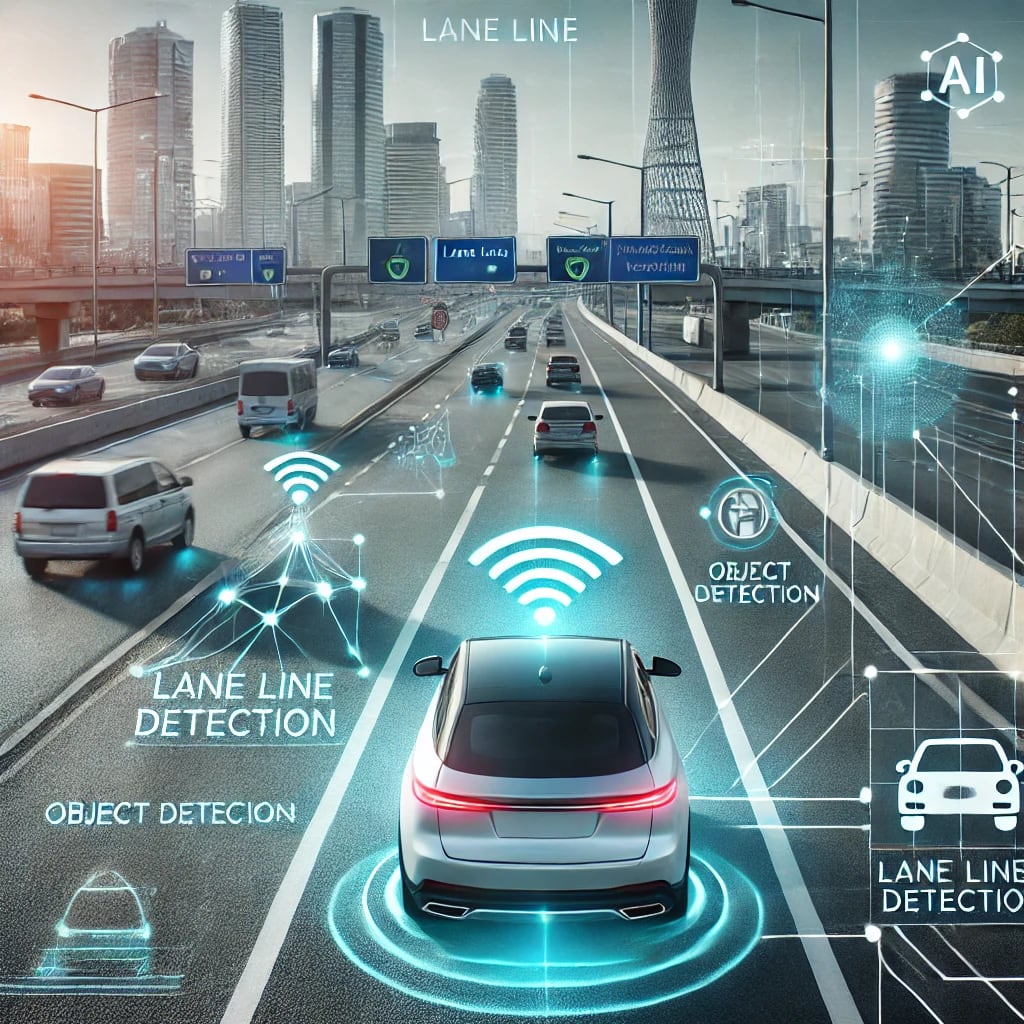
Artificial Intelligence (AI) is revolutionizing the transportation industry, particularly in the development of autonomous vehicles. As technology advances, self-driving cars are becoming increasingly sophisticated, relying on AI to navigate roads, avoid obstacles, and ensure the safety of passengers. One of the critical applications of AI in autonomous vehicles is lane line detection, a technology that helps self-driving cars stay in their lanes and prevent accidents. However, AI's role extends far beyond lane line detection, with its applications enabling self-driving cars to perform complex tasks, such as real-time decision-making, object recognition, and route optimization. In this report, we explore how AI contributes to lane line detection, as well as other key functions that enable autonomous vehicles to operate safely and efficiently.
Introduction to Autonomous Vehicles and AI
Autonomous vehicles, or self-driving cars, use a combination of sensors, cameras, radar, and AI algorithms to detect their surroundings, make decisions, and drive without human intervention. The AI system processes the vast amount of data collected by these sensors and makes split-second decisions that allow the vehicle to navigate in real time. As a result, autonomous vehicles have the potential to reduce traffic accidents, enhance mobility, and improve road safety.
One of the most essential aspects of autonomous driving is keeping the car safely in its designated lane. Lane line detection is a critical task that involves detecting the lines on the road, allowing the vehicle to understand its position within the lane and ensure that it does not veer off course. By accurately detecting lane lines, AI helps prevent lane departures, which can lead to serious accidents.
AI-Powered Lane Line Detection
AI-based lane line detection relies on computer vision and deep learning algorithms to recognize and interpret lane markings. These systems typically use cameras mounted on the vehicle to capture images or video frames of the road ahead. The AI processes these images in real time, detecting lane markings and determining their positions relative to the vehicle.
The main steps involved in lane line detection include:
1. Image Preprocessing: The camera captures raw images of the road, which may contain noise, shadows, or varying lighting conditions. The AI system preprocesses these images by applying techniques such as image filtering and edge detection to enhance the clarity of lane markings. Filters remove unwanted noise, while edge detection algorithms highlight the boundaries of the lane lines.
2. Lane Line Detection: Using computer vision techniques, the AI system identifies lane lines in the preprocessed images. It does this by analyzing the geometrical patterns and contrasts in the road markings. Popular techniques include the Hough Transform and Canny edge detection, which help detect straight and curved lines on the road.
3. Lane Tracking: Once the lane lines are detected, the AI tracks their movement as the vehicle drives. This is done using techniques like Kalman filtering and particle filters, which estimate the vehicle's trajectory and adjust its position to ensure that it stays within the lane. This tracking process is essential for handling lane changes and detecting deviations caused by road curves.
4. Decision-Making and Control: The AI system constantly monitors the lane position and makes real-time decisions to adjust the steering, speed, or braking of the vehicle. If the car begins to drift from the lane, the system can issue corrective actions, such as gently steering the car back into the center of the lane.
By combining these techniques, AI-powered lane line detection systems provide accurate and reliable lane guidance, even in challenging conditions such as poor visibility or complex road layouts. This significantly enhances the safety and stability of autonomous vehicles, reducing the risk of accidents caused by lane departures.
AI Beyond Lane Line Detection: Enhancing Autonomous Vehicle Capabilities
While lane line detection is a crucial function for self-driving cars, AI plays a much broader role in enabling autonomous driving. Here are some other ways AI contributes to the overall performance and safety of autonomous vehicles:
1. Object Detection and Recognition
In addition to detecting lane lines, AI enables autonomous vehicles to identify and recognize various objects on the road, including pedestrians, cyclists, other vehicles, traffic signs, and obstacles. Using deep learning algorithms, such as Convolutional Neural Networks (CNNs), the AI system processes input from cameras, radar, and LiDAR sensors to classify objects in the environment.
By accurately detecting objects in real-time, the vehicle can avoid collisions by adjusting its speed, changing lanes, or braking when necessary. AI-based object detection is particularly important in urban environments where there are many dynamic elements, such as crossing pedestrians and moving vehicles.
2. Traffic Sign and Signal Recognition
AI also helps autonomous vehicles recognize traffic signs and signals. Using image recognition algorithms, the vehicle can identify stop signs, speed limits, yield signs, and traffic lights. The AI system then interprets these signals to make informed decisions, such as slowing down at a red light or adjusting speed based on the posted limit.
Traffic sign recognition is critical for ensuring that self-driving cars comply with road rules and navigate safely through intersections, pedestrian crossings, and other regulated areas.
3. Route Planning and Navigation
AI plays a central role in optimizing the route planning and navigation of autonomous vehicles. By analyzing real-time traffic data, road conditions, and weather information, AI algorithms determine the most efficient routes for the vehicle to follow. Autonomous vehicles use reinforcement learning and predictive algorithms to adjust their routes dynamically, avoiding traffic jams and taking alternate routes when necessary.
Moreover, AI helps the vehicle predict the behavior of surrounding drivers and anticipate potential hazards, such as vehicles suddenly changing lanes or braking. This predictive capability allows the self-driving car to make proactive adjustments to its driving strategy, improving both safety and efficiency.
4. Adaptive Cruise Control and Autonomous Braking
AI is also responsible for controlling advanced driver assistance systems, such as adaptive cruise control (ACC) and autonomous emergency braking (AEB). ACC uses sensors and AI to maintain a safe distance from the vehicle in front by adjusting the car’s speed. Similarly, AEB automatically applies the brakes if the AI system detects an imminent collision, reducing the likelihood of accidents.
Both of these systems rely on AI to make real-time decisions based on input from radar, cameras, and LiDAR. The AI must evaluate the speed, distance, and trajectory of other vehicles and obstacles to ensure that the self-driving car reacts appropriately in various situations.
5. Environmental Awareness and Weather Adaptation
Driving in adverse weather conditions, such as rain, snow, or fog, presents significant challenges for both human drivers and autonomous vehicles. AI enables self-driving cars to adapt to these conditions by analyzing sensor data and adjusting the vehicle's behavior accordingly. For example, if rain is detected, the AI system may reduce speed, increase the following distance, or engage the vehicle’s automatic wipers.
In addition to weather adaptation, AI systems help self-driving cars recognize and react to different road surfaces and terrains. By analyzing traction and tire performance, the vehicle can adjust its driving style to ensure optimal safety and handling.
Challenges and Future Prospects of AI in Autonomous Vehicles
While AI has made significant strides in autonomous driving, several challenges remain. One of the primary challenges is ensuring the safety and reliability of AI systems in all driving scenarios, especially in complex and unpredictable environments. Additionally, the high computational power required for real-time AI processing can be a limitation, as vehicles need advanced hardware to support AI algorithms.
As AI continues to evolve, we can expect further improvements in the capabilities of autonomous vehicles. Enhanced AI systems may enable self-driving cars to navigate more effectively in urban areas, manage complex traffic situations, and even communicate with other vehicles and infrastructure. The development of 5G networks and V2X (Vehicle-to-Everything) communication will further support AI-driven vehicles, allowing them to share real-time data and collaborate for safer and more efficient transportation.
Conclusion
AI plays a pivotal role in the development and operation of autonomous vehicles. From lane line detection and object recognition to route planning and adaptive cruise control, AI enhances the safety, efficiency, and overall performance of self-driving cars. As technology advances, AI will continue to drive innovation in the automotive industry, bringing us closer to a future where autonomous vehicles are a common sight on roads worldwide. The potential benefits of autonomous driving—improved road safety, reduced traffic congestion, and enhanced mobility—are within reach, thanks to the transformative power of AI.
About the Creator
PETER J
Driven by a passion to inspire and uplift, Peter. J is a motivational story writer who weaves tales of resilience, personal growth, and triumph over adversity.
About Binding Prometheus
I want to start actively advocating on behalf of my own work, and the most valuable part of my canon is, without a doubt, Binding Prometheus, the play I have been working on since 2019 and only finished in 2023 as part of my MA. The play itself is an amalgamation of a million different inspirations. On one end, it evokes the Ancient Greek myth-play, deriving its own title from the earliest extant work of Western drama we have, Aeschylus’s Prometheus Bound. On the other end, it borrows significantly from the sci-fi bulwarks from over the years, namely Mary Shelley’s Frankenstein and Karel Capek’s Rossum’s Universal Robots. The play could be an episode of Black Mirror, I fear. I don’t know. I’ve only ever seen one episode of Black Mirror.
By Steven Christopher McKnight19 days ago in Futurism
Saudi Arabia Grinding Wheels Market Analysis: Key Players and Market Forecast
According to IMARC Group's latest research publication, Saudi Arabia grinding wheels market size was valued at USD 48.3 Million in 2025 and is projected to reach USD 77.3 Million by 2034, exhibiting a growth rate (CAGR) of 5.35% during 2026-2034.
By Abhay Rajputabout 6 hours ago in Futurism


Comments
There are no comments for this story
Be the first to respond and start the conversation.