
Operation Spider Web
How 117 Tiny Drones Silently Crippled a Superpower’s Sky—And Redefined Modern War Forever

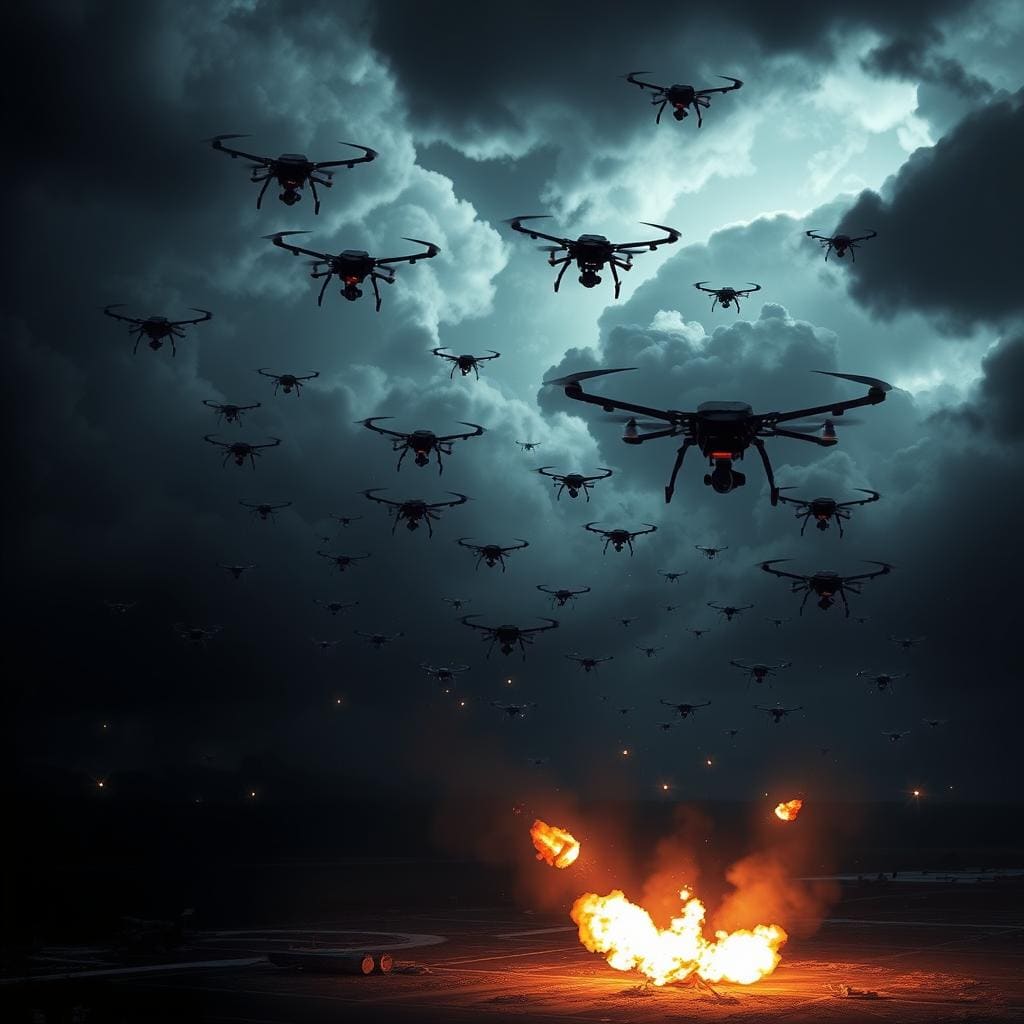
The Night the Sky Broke
In the early hours of June 1, 2025, the stars over five Russian cities blinked—briefly—before the silence of war arrived. It was a night like any other. Radar towers hummed lazily, pilots slept in bunkers, and hangars full of billion-dollar bombers rested in stillness.
No one heard them coming.
Not a single alarm was triggered when 117 ghostlike FPV drones, each costing less than a cheap wristwatch, entered Russian airspace—not from above, but from within. They were already there. Hidden in wooden cabins. Camouflaged inside civilian trucks. Scattered like breadcrumbs across the vast underbelly of the enemy.
The operation was codenamed Spider Web—not because it was swift, but because it was patient.
The Man Who Drew the Web
Artem Lysenko, a former software engineer turned SBU operative, never fired a bullet in his life. But he had designed the algorithm that would one day paralyze Russia’s strategic airpower. Working out of a basement in Lviv, with only his sister's borrowed gaming PC and a secondhand neural net chip, he created a decentralized drone AI so adaptive it could weave itself through the narrowest air duct without GPS.
He didn’t invent destruction. He simply gave it memory.
“Imagine,” he told his team, “if every drone could learn from the one before it... and strike like the eighth leg of the same spider.”
A Strategy 18 Months in the Making
For nearly two years, Ukraine's intelligence agency mapped every weakness in Russia’s airbases—from night shift schedules to lunch break blind spots. Drones were smuggled across borders in pieces, built by hand in cottages, disguised as weather balloons or security cameras.
No satellite saw them. No report suspected them.
Every drone was pre-assigned a target: one bomber, one radar dish, one communication antenna. Their goal wasn’t just to destroy, but to disconnect—to unravel the nerves of a military giant until it forgot how to punch.
Zero Hour
01:27 AM, Moscow Time.
From five separate wooden cabins across Russian soil, a silent tremor shook the dark. Pilots asleep in their bunkers never stirred. Within minutes, 117 glowing blue dots came to life. From the outside, they looked like toys. But each carried micro-explosives capable of slicing steel like paper.
First came the Tu-95 Bears—Russia’s oldest nuclear bombers. Then the Tu-160 Blackjacks—sleek, deadly aircraft that had once haunted the skies over Syria.
Drone by drone, target by target, they fell.
Russia’s Pearl Harbor Moment
By morning, 41 strategic aircraft were crippled or completely destroyed. Communications went dark across key bases. Panic set in. Generals yelled into dead phones. Jets meant to retaliate couldn’t even taxi to the runway.
Russia's losses totaled an estimated $7 billion in a single night—without a single Ukrainian soldier crossing the border.
Major global news outlets would later call it the "Pearl Harbor of the Drone Age."
The Silence That Followed
In Kyiv, there was no celebration. Just stillness.
President Zelensky reportedly stared at a live feed for several hours without speaking. Aides say his only words were: “This was not a message. It was a mirror.”
Because what Ukraine had shown the world wasn’t strength. It was fragility—that a nation’s pride could be undone not by warplanes or nukes, but by the silent flight of synthetic insects.
Global Shockwaves
The Pentagon scrambled to re-evaluate airbase security. China began testing “anti-swarm fields.” NATO commanders wondered: If Ukraine can do this with $30,000 drones, what could a hostile AI regime do with billions?
The age of the drone had begun—but not the way anyone expected.
This wasn’t the future of war. It was the future of collapse.
Who Controls the Web?
One week after the operation, a video surfaced on the dark web. It showed a spider weaving its web across the globe. As it reached Russia, the strands turned to flames. The screen cut to black. No watermark. No threat. Just a single line of text:
“The age of thunder has passed. Now comes the whisper.”
Analysts are still debating who made the video. Some say it's a message from the Ukrainian cyber warfare unit. Others think it’s something more—an autonomous signal sent by the drones themselves.
Because here’s the twist:
Some drones never returned. They vanished—into forests, into fog, into silence. And no one knows where the rest are.
The Future Beneath Our Feet
As the dust settles, a terrifying truth lingers: war is no longer fought in trenches, nor even from the skies. It’s fought in basements, in algorithms, in code written by teenagers on cracked laptops.
The next world war may not look like anything we imagine. It may already be happening—beneath us. Around us. Inside us.
In the invisible threads of the next Spider Web.
About the Creator
rayyan
🌟 Love stories that stir the soul? ✨
Subscribe now for exclusive tales, early access, and hidden gems delivered straight to your inbox! 💌
Join the journey—one click, endless imagination. 🚀📚 #SubscribeNow
About Binding Prometheus
I want to start actively advocating on behalf of my own work, and the most valuable part of my canon is, without a doubt, Binding Prometheus, the play I have been working on since 2019 and only finished in 2023 as part of my MA. The play itself is an amalgamation of a million different inspirations. On one end, it evokes the Ancient Greek myth-play, deriving its own title from the earliest extant work of Western drama we have, Aeschylus’s Prometheus Bound. On the other end, it borrows significantly from the sci-fi bulwarks from over the years, namely Mary Shelley’s Frankenstein and Karel Capek’s Rossum’s Universal Robots. The play could be an episode of Black Mirror, I fear. I don’t know. I’ve only ever seen one episode of Black Mirror.
By Steven Christopher McKnight15 days ago in Futurism
Saudi Arabia Cloud Computing Market & Forecast 2025–2033
Introduction Saudi Arabia’s digital transformation is entering a decisive phase, with cloud computing at the core of the Kingdom’s technology roadmap. As enterprises, government agencies, and startups accelerate their shift toward digital platforms, cloud infrastructure is rapidly becoming the backbone of innovation, efficiency, and scalability across industries.
By jaiklin Fanandisha day ago in Futurism


Comments
There are no comments for this story
Be the first to respond and start the conversation.