
The “Planet Y” Hypothesis: A Hidden World at the Edge of Our Solar System
Space

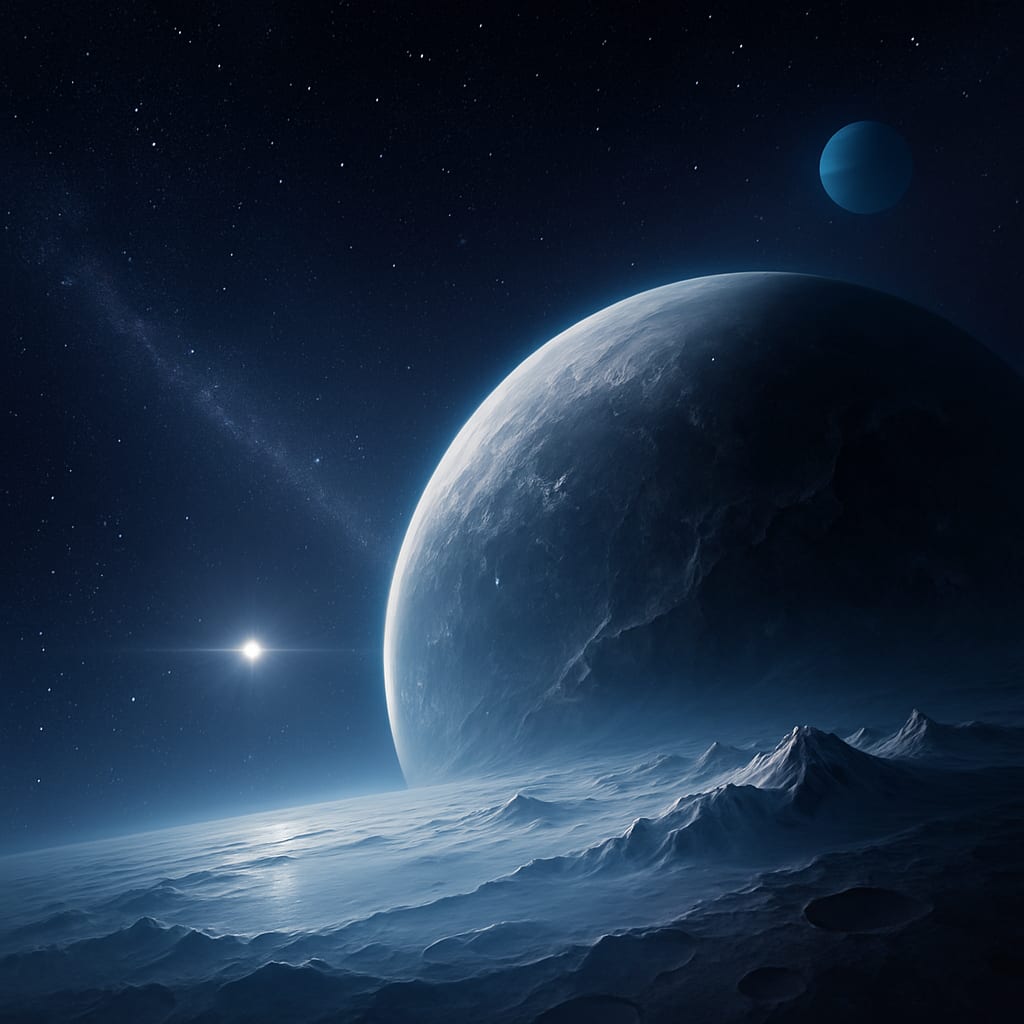
For decades, astronomers have known that the Solar System doesn’t end with Neptune. Beyond it stretches the Kuiper Belt — a vast, icy frontier filled with dwarf planets, comets, and frozen remnants from the early days of planetary formation. Yet, recent discoveries suggest that something strange is happening out there.
Some of the objects in this distant region, known as Kuiper Belt Objects (KBOs), are moving in ways that defy expectations — as if they’re being tugged by an unseen gravitational force.
That mysterious influence has inspired an intriguing new theory: the Planet Y hypothesis — the idea that a hidden, Earth-sized planet could be lurking on the inner edge of the Kuiper Belt, closer than the much-debated “Planet Nine.”
The Origins of the Idea
The story begins with data. As astronomers mapped the orbits of dozens of KBOs, they noticed peculiar patterns: certain objects had clustered orbital tilts and aligned perihelia (the points where their orbits come closest to the Sun). Statistically, this clustering seemed too organized to be random.
At first, many suspected the influence of a massive, faraway planet — something perhaps five to ten times the mass of Earth, orbiting hundreds of astronomical units (AU) from the Sun. That theory became famous as “Planet Nine.”
But newer simulations have pointed to another possibility: maybe the gravitational anomalies aren’t caused by one gigantic planet in the farthest reaches, but by a smaller world — roughly Earth’s size — orbiting much closer in. This hypothetical body has been nicknamed “Planet Y”, or sometimes “Planet Ten,” depending on whether you still count Pluto among the official planets.
What Might Planet Y Be Like?
If it exists, Planet Y would be a fascinating world. Based on orbital dynamics models and gravitational clues, researchers estimate:
- Mass: Between 0.5 and 2 times the mass of Earth
- Distance: Roughly 200–300 AU from the Sun (five to seven times farther than Neptune)
- Orbital Shape: Slightly elongated, tilted compared to the Solar System’s main plane
- Composition: Likely a rocky-icy hybrid, similar to a “super-sized” Pluto or a mini Neptune’s core
In other words, Planet Y wouldn’t be a gas giant or a frozen snowball — it could be a true terrestrial-type planet, an Earth-like body surviving in the frozen darkness of the outer Solar System.
If confirmed, it would be the first Earth-class planet discovered beyond Neptune — a mind-bending expansion of what we thought possible in our own cosmic backyard.
Why Haven’t We Seen It Yet?
The short answer: it’s really, really far away.
Even an Earth-sized planet would reflect very little sunlight at that distance. Imagine trying to spot a black marble illuminated by a flashlight from several miles away — that’s roughly the scale of the challenge.
Adding to the difficulty, the search area is enormous. The Kuiper Belt spans a massive portion of the sky, and a planet that far out would move incredibly slowly, shifting just a few arcseconds per year. Detecting such motion requires years of patient, high-precision observation.
Still, hope is on the horizon. The upcoming Vera C. Rubin Observatory, set to revolutionize sky surveys in the late 2020s, will scan the entire visible sky repeatedly and with unprecedented sensitivity. Its powerful Legacy Survey of Space and Time (LSST) could finally reveal slow-moving objects in the deep Solar System — including, perhaps, Planet Y itself.
Why It Matters
Discovering Planet Y would be far more than another entry in a list of planets. It would fundamentally reshape our understanding of how the Solar System formed.
Planetary scientists believe the outer planets didn’t always stay where they are now — they likely migrated, pushing and pulling smaller bodies as they went. Finding a hidden Earth-sized planet in the Kuiper Belt could prove that the Solar System’s history is even more chaotic and dynamic than we imagined.
It might also help explain:
- Why certain distant comets follow strange, elongated paths;
- Why some planetary axes (like Uranus’s) are oddly tilted;
- And even whether other “hidden families” of planets might exist beyond Neptune, still unseen.
The Allure of the Unknown
Astronomy thrives on mystery, and Planet Y embodies that spirit perfectly. Whether the orbital anomalies of the Kuiper Belt come from real hidden worlds or just from statistical quirks, the search itself drives innovation and curiosity.
In the 19th century, similar gravitational “oddities” led to the discovery of Neptune. Later, the hunt for another anomaly revealed Pluto. History may yet repeat itself.
Somewhere in the silent, frozen reaches of the Kuiper Belt, there might be a new neighbor — a pale, distant Earth slowly circling the Sun, waiting for our telescopes to find it.
Until then, the Planet Y hypothesis remains one of the most captivating scientific mysteries of our time — a reminder that even in our own cosmic neighborhood, there are still worlds left to discover.
About the Creator
Keep reading
More stories from Holianyk Ihor and writers in Futurism and other communities.
Augmented Reality in Space Training: How AR Is Redefining the Way Astronauts Learn
For decades, astronaut training has been a blend of cutting-edge science, engineering precision, and pure human endurance. From massive simulators to underwater training tanks mimicking zero gravity, preparing for spaceflight has always required an intense and costly mix of physical and mental conditioning.
By Holianyk Ihor3 months ago in Futurism
About Binding Prometheus
I want to start actively advocating on behalf of my own work, and the most valuable part of my canon is, without a doubt, Binding Prometheus, the play I have been working on since 2019 and only finished in 2023 as part of my MA. The play itself is an amalgamation of a million different inspirations. On one end, it evokes the Ancient Greek myth-play, deriving its own title from the earliest extant work of Western drama we have, Aeschylus’s Prometheus Bound. On the other end, it borrows significantly from the sci-fi bulwarks from over the years, namely Mary Shelley’s Frankenstein and Karel Capek’s Rossum’s Universal Robots. The play could be an episode of Black Mirror, I fear. I don’t know. I’ve only ever seen one episode of Black Mirror.
By Steven Christopher McKnight18 days ago in Futurism
Miss Persephone's Manual to a Seemingly Ordinary Life
Miss Persephone was found at the dining table, her blue eyes swollen, her tears arriving and retreating like the tides of the ocean. Earlier that day, her family had visited her in the retirement home where she had lived for eight years. It was her eightieth birthday.
By Imola Tóth3 days ago in Fiction


Comments
There are no comments for this story
Be the first to respond and start the conversation.