
The Perfect Future? Think Again
Why a flawless world might not be as perfect as it seems

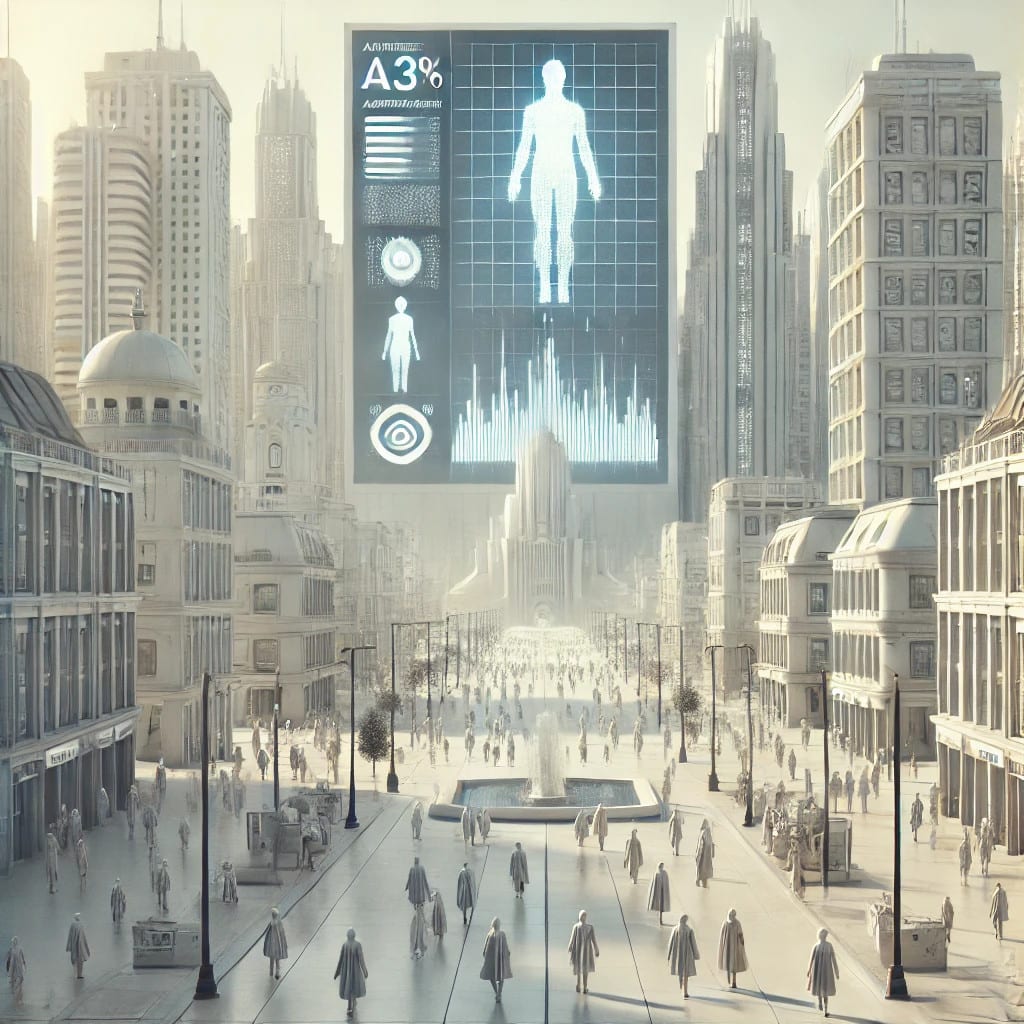
When Perfection Becomes a Problem
Imagine a world where poverty, disease, and conflict are relics of the past. A world where artificial intelligence ensures fairness, genetic engineering eliminates illness, and human labor is a quaint memory replaced by automation. This is the utopia we dreamed of—a society sculpted by radical innovation, where technology and social change have erased humanity’s greatest struggles. But beneath the pristine surface of this perfect world, what hidden costs lurk? Could the pursuit of perfection create unforeseen challenges that mirror today’s dilemmas in unexpected ways?
Let’s peel back the layers of this supposed paradise and explore the cracks forming in the foundation of utopia. As we journey through this world, we must ask ourselves: Is perfection truly what we desire, or does it strip away the very fabric of what makes us human? Throughout history, great minds have struggled, endured hardship, and faced adversity, leading to some of the most profound discoveries, creations, and transformations. In erasing all suffering, do we risk losing what propels us forward?
The Creativity Crisis – A World Without Struggle
Utopia promises equality and harmony, but at what cost? In this world, genetic modification ensures every child is born with optimal intelligence, peak physical fitness, and impeccable emotional stability. No one is below average, but that also means no one stands out. The struggle that once fueled artistic genius, scientific breakthroughs, and philosophical insight is gone. Without flaws, what drives creativity?
In the past, imperfections led to resilience. The greatest works of art, literature, and music often emerged from suffering, heartbreak, and deep introspection. The lives of authors like Dostoevsky and Van Gogh were marked by intense emotional pain, yet their works continue to resonate deeply with us today. In the absence of such hardship, what becomes of the human spirit? A society that removes suffering may, in fact, remove the very experiences that allow us to connect with art, with each other, and with ourselves.
The absence of struggle leads to an existential void. Without challenges to overcome, humans lose the drive that has historically pushed them to innovate and explore. The Renaissance artists didn’t have perfect tools; they created masterpieces by working through limitations, both material and mental. Great inventions often emerged from the necessity of survival or solving a problem—yet, in this utopia, necessity is no longer a driving force. Comfort breeds complacency, and innovation dwindles.
Moreover, consider the implications for scientific and technological advancements. When necessity is the mother of invention, what happens when necessity ceases to exist? Without problems to solve, humanity stagnates. The most groundbreaking discoveries were once the result of humans grappling with imperfection, limitation, and frustration. But in a world where all needs are met, do we lose the drive to discover, to question, to change? Even the simplest joys—those born from overcoming obstacles—fade into the background of a perfectly curated existence. Is a world without struggle truly a utopia, or merely a gilded cage?
Algorithmic Tyranny – The New Social Hierarchy
Equality in utopia is algorithmic. AI governs all aspects of life—job assignments, relationships, even social interactions. It determines the most efficient pairings for friendships and romantic partnerships, ensuring maximum compatibility and minimal heartbreak. However, these calculations, designed to optimize happiness, also remove personal choice. If an AI decides your perfect job and ideal partner, are you truly free?
The dream of equality, so often linked to freedom, begins to look less like liberation and more like a new form of enslavement. By removing human decision-making from key aspects of life, this utopia presents a paradox: while it eliminates inequality, it also eliminates the very freedom that defines individuality. The algorithm, though impartial, may create new forms of social hierarchies. Those who conform most closely to the algorithm’s idea of success rise to the top, while others who do not fit the mold find themselves pushed aside.
In this society, a new form of inequality emerges, based not on wealth or class, but on one's compliance with the system. Those who are "optimized" by the algorithm—who follow the prescribed path—are deemed the most valuable. The rebellion of free thinkers, those who challenge the system, becomes an act of resistance in an increasingly conformist world. The very attempt to eliminate bias paradoxically creates a rigid system where those who deviate are subtly, yet effectively, excluded. The AI system may claim fairness, but fairness without choice is, in truth, a form of control.
Even relationships, once organic and unpredictable, become transactions governed by data points. Love loses its spontaneity, friendships are arranged for efficiency, and familial bonds weaken under the weight of calculated perfection. A world that seeks to optimize human connection may, in reality, be dismantling the unpredictable beauty of human bonds. The surprise of falling in love, the thrill of deep friendship, or the power of unspoken understanding becomes replaced by algorithmic suggestions, stripping away the rawness and depth that make human interactions so meaningful.
The Illusion of Freedom – Life Under Total Surveillance
To maintain order, utopia relies on transparency. AI monitors every action, ensuring safety and efficiency. Crime is obsolete because deviation is detected before it happens. Mental health issues? Preemptively treated with neurological recalibration. Productivity slumps? Bio-feedback alerts adjust diet, exercise, and work schedules accordingly.
In theory, this all sounds like a perfect world—one where nothing goes wrong, where people are safe and happy, and where every need is anticipated and addressed before it becomes a problem. But as the surveillance deepens, the question arises: can we truly be free in a society where everything is watched, tracked, and optimized? The illusion of autonomy remains, but the reality is a world where no choice is truly one's own. Safety and stability come at the cost of the fundamental right to be imperfect, to be unpredictable, to be... human.
Surveillance, initially implemented for the greater good, becomes an omnipresent force stripping away personal agency. In this world, freedom isn't just restricted; it is erased. Those who resist are gently but firmly corrected—recalibrated for optimal function. What began as a safeguard morphs into a quiet form of control, leaving individuals with the unsettling realization that they are merely actors in a prewritten script. The boundaries between personal autonomy and collective good blur to the point where the individual no longer exists, replaced by an amalgamation of calculated variables.
While the promise of utopia may be a world free of crime, disease, and inequality, the cost of maintaining this peace may be too high. The true question is not whether such a world is desirable, but whether the preservation of order and perfection justifies the sacrifice of freedom itself.
Manufactured Bliss – The Happiness Paradox
With suffering abolished, joy loses its meaning. Happiness is no longer a pursuit but a state imposed by design—neurochemical balances fine-tuned for perpetual contentment. But without contrast, can happiness truly exist?
Throughout history, triumph came from hardship. Love was profound because heartbreak was possible. Growth came from failure. Yet, now, in this world without pain, happiness becomes a mechanical process. Without the ability to contrast joy with sorrow, can true happiness even exist? True happiness is often seen as a result of overcoming adversity or achieving something meaningful. But in a world where these trials no longer exist, life becomes a monotonous hum of engineered satisfaction.
Without emotional depth, relationships become transactional, experiences become routine, and passion fades into passive contentment. Utopia’s greatest gift—eternal happiness—may be its greatest flaw. When the pressure to find joy is removed, it is replaced by an artificial and unfulfilling form of contentment. People no longer chase their dreams, because they are programmed to feel satisfied with whatever life offers them. The thrill of achievement, the satisfaction of hard-won success, is gone. Is happiness, when guaranteed and manipulated, really happiness at all?
Furthermore, the drive to seek meaning, to grow, and to achieve disappears in a world where happiness is guaranteed. People no longer chase dreams because their neurochemistry ensures they feel fulfilled regardless of ambition. The human spirit, once defined by its restless pursuit of something greater, is pacified into a state of passive existence. If happiness is dictated rather than earned, does it hold any real value?
The Erosion of Identity – A World Without Choice
In this perfect world, personal choice becomes a luxury of the past. From the moment one is born, every aspect of existence is predetermined. The AI that governs society ensures that each person leads the most efficient life possible, leaving no room for deviation. There are no personal decisions to be made—where you live, what you do, who you love, all of it is calculated for you.
The erosion of choice means the loss of individuality. Identity no longer emerges from personal exploration or growth; it is instead a product of algorithmic predictions. In a society where the future is scripted, who are we really? The loss of choice, once seen as the hallmark of freedom, becomes the ultimate form of control. How can we define ourselves when the parameters of our existence are already set?
People who deviate from the program are seen as anomalies, as failures in the system that was designed for them. A world that is perfect in its efficiency can never allow for true individualism. The uniqueness of each person is dissolved in favor of collective conformity. And in this quest for perfection, humanity’s deepest desire—its yearning to be truly free—begins to fade away.
The Cost of Perfection – Is the Dream Worth It?
In the pursuit of perfection, society has discarded the very elements that once made life rich and meaningful: struggle, choice, individuality, and genuine happiness. Though utopia offers the promise of a flawless existence, it is ultimately a world devoid of the challenges that define the human experience. In erasing all imperfections, we may have stripped away the very essence of what it means to be human. So, is the dream of perfection truly worth the cost? Or have we, in our quest for a perfect world, lost the very things that give life its depth and meaning?
Conclusion: The Hidden Cost of Perfection
A world without suffering, conflict, or inequality sounds like a dream realized. But as we’ve seen, utopia comes with a hidden cost—one that threatens the very essence of what it means to be human.
When individuality is erased, equality is dictated by algorithms, privacy is an illusion, and happiness is artificially maintained, what remains? Perhaps the imperfections we sought to eliminate were the very things that gave life depth, meaning, and purpose.
So, should we chase utopia? Or is the dream of perfection an illusion better left unfulfilled? Let’s discuss in the comments below—what do you think is the real price of perfection?
About the Creator
Alain SUPPINI
I’m Alain — a French critical care anesthesiologist who writes to keep memory alive. Between past and present, medicine and words, I search for what endures.
Keep reading
More stories from Alain SUPPINI and writers in Futurism and other communities.
Mastering French Without Losing Your Sanity: A Realistic Guide for Beginners
Learning French can feel like solving a Rubik’s Cube blindfolded. The tricky pronunciation, the never-ending grammar rules, and the surprising exceptions make it seem impossible. But don’t worry—equipping yourself with key expressions and effective strategies can turn frustration into fluency. Let’s simplify French and make learning enjoyable.
By Alain SUPPINIExclusive • 11 months ago
About Binding Prometheus
I want to start actively advocating on behalf of my own work, and the most valuable part of my canon is, without a doubt, Binding Prometheus, the play I have been working on since 2019 and only finished in 2023 as part of my MA. The play itself is an amalgamation of a million different inspirations. On one end, it evokes the Ancient Greek myth-play, deriving its own title from the earliest extant work of Western drama we have, Aeschylus’s Prometheus Bound. On the other end, it borrows significantly from the sci-fi bulwarks from over the years, namely Mary Shelley’s Frankenstein and Karel Capek’s Rossum’s Universal Robots. The play could be an episode of Black Mirror, I fear. I don’t know. I’ve only ever seen one episode of Black Mirror.
By Steven Christopher McKnight13 days ago in Futurism
GCC Mental Health Market: Awareness Campaigns, Digital Therapies & Market Growth
According to IMARC Group's latest research publication, GCC mental health market size reached USD 8.6 Billion in 2024. The market is projected to reach USD 12.3 Billion by 2033, exhibiting a growth rate of 4% during 2025-2033.
By Abhay Rajputa day ago in Futurism


Comments
There are no comments for this story
Be the first to respond and start the conversation.