

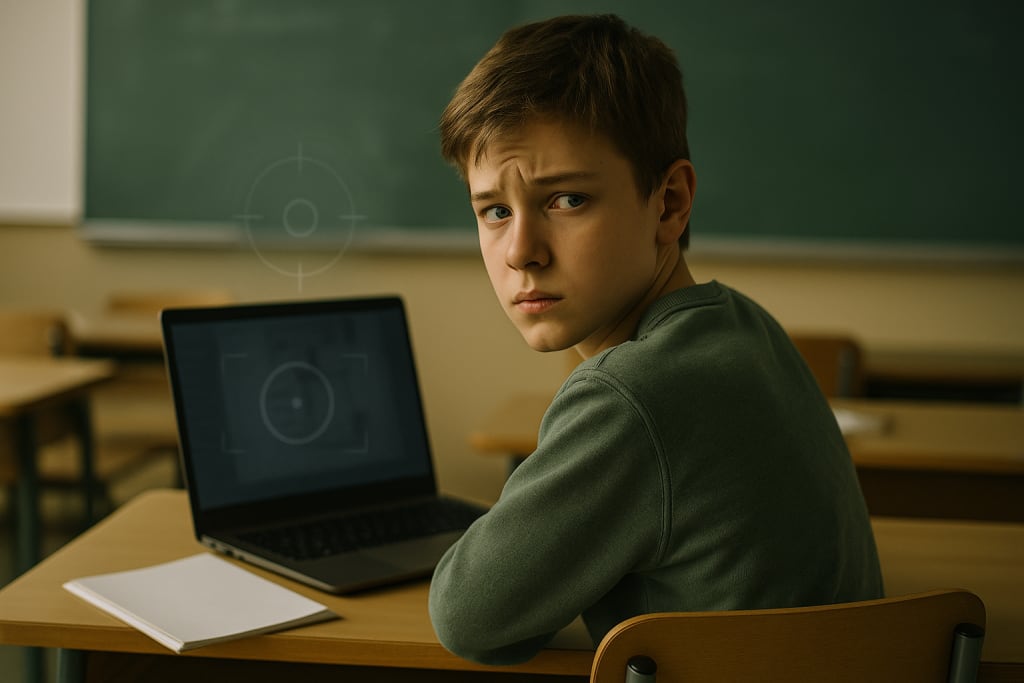
Pt 2: Reveal the emotional, psychological, and social damage inflicted by school surveillance. This part focuses on the kids — the ones censored, outed, profiled, or traumatized by the system.
Flagged and Forgotten
The first time they flagged her; it was for a poem. A few lines about sadness, typed into a school Google Doc. By lunch, the counselor had called her in. She hadn’t shared it with anyone. She didn’t have to.
Because the system saw everything.
By 2025, millions of students live under a digital microscope they didn’t ask for. Algorithms scan their thoughts, flag their feelings, and sometimes trigger school or police interventions , all without the students ever knowing what line they crossed.
They’re not just watching. They’re logging millions of student thoughts, daily , then sorting them by risk.
They call it “student safety.” But for the kids inside the system, it feels like being watched for the crime of feeling anything at all.
The Silence of Self-Censorship
“I don’t talk to the school counselor anymore,” one teen wrote in a private message to a friend. “I know Gaggle reads it.”
Surveillance has done more than catch red flags. It’s trained an entire generation to stay silent. In schools using tools like Gaggle and Bark, over half of students say they’ve stopped expressing themselves online. They don’t journal in Docs. They don’t email for help. They don’t say what they’re really feeling , not when the algorithm is always listening.
This isn’t safety. It’s suppression.
In one case, a school flagged a student for typing “I hate everything about myself” into a private document. The student wasn’t self-harming , she was venting. But that line triggered an alert. She was called out of class, pulled into an office, and told her parents would be contacted. No warning. No context. Just a system that turned her moment of pain into a disciplinary event.
Some students now write in code. Others use separate devices to avoid being “Gaggled.” The result? The kids who need help the most go silent. The machine doesn’t stop suicides. It just pushes the pain underground.
Punished for Feeling
The systems are built to detect key phrases: “I want to die.” “Kill myself.” “Gun.” But they can’t tell the difference between a genuine threat, a dark joke, or a fiction assignment.
One student wrote a story about a school shooting , not as a plan, but as part of a writing prompt. Gaggle flagged it. He was pulled from class, interrogated, and suspended. There was no weapon. No threat. Just words.
Another student shared a personal essay about struggling with gender identity. The AI flagged it for “sexual content.” The principal called home.
And in perhaps the cruelest irony, students who open up in school-provided mental health journals , the very tools meant to help them , are sometimes flagged by those same journals and reported to administration.
This isn’t prevention. It’s punishment.
They did everything we told them to: speak up, share, be honest. And the system treated their honesty like a threat report.
Outed, Profiled, Misread
LGBTQ+ students are among the most vulnerable. In dozens of districts, searches like “Am I gay?” or “support for trans teens” have triggered red flags. Some systems still categorize these as “explicit content.”
A 15-year-old in Kansas searched for local LGBTQ centers on a school device. Within 24 hours, his parents were contacted. He wasn’t out. Now he was , because a machine decided curiosity was misconduct.
Black students are flagged at disproportionate rates. The slang they use, the lyrics they quote, the topics they write about , all more likely to be interpreted as threatening.
Special ed students face their own nightmare. One autistic student was flagged for repetitive phrases that matched “harm” keywords, despite having no intent or understanding of the trigger. He was pulled into an emergency meeting with school police.
This is how the system sees them: not as students, but as potential threats to be neutralized.
Collateral Damage
Teachers are being collateralized, too. Some avoid giving writing assignments that deal with depression, violence, or family trauma , fearing students will get flagged and parents will blame them.
Counselors now operate under surveillance. A student might reach out in a moment of vulnerability , and that outreach gets intercepted by an AI before a human can respond. In some cases, students stop confiding in staff altogether.
Every flagged word doesn’t just go to a counselor , it goes through a system that someone’s billing by the scan.
The people who are supposed to help are no longer seen as safe.
The Moderators and the Burnout
Gaggle’s content moderators have described their work as a psychological meat grinder, processing up to 300 flagged incidents per hour. Some are benign. Some are disturbing. Many are misfires. The volume never stops.
One former moderator described reading suicide notes, explicit images, and cries for help with no time to process anything. The job wasn’t about empathy. It was about speed. Flag. Sort. Escalate. Repeat.
"It felt like reading suicide notes for a living , with a stopwatch ticking."
When the people reviewing your child’s darkest thoughts are overworked, underpaid, and desensitized, what happens when they miss something real? Or worse, when they treat trauma like paperwork?
Final Thought
We told kids to speak up. To express themselves. To write it down. To reach out.
Then we built machines that punished them for doing exactly that.
We built machines to detect pain, then punished the kids for showing it.
Next: In Part 3, we follow the money. The investors. The lobbying. The billion-dollar engine behind student surveillance, and what happens when the watchers aren’t just protecting kids but profiting from them.
About the Creator
MJ Carson
Midwest-based writer rebuilding after a platform wipe. I cover internet trends, creator culture, and the digital noise that actually matters. This is Plugged In—where the signal cuts through the static.
Cooking Oil Market: AI-Driven Innovation Transforming Global Edible Oil Demand
AI Overview of the Cooking Oil Market The cooking oil market includes a wide range of edible oils derived from plant and seed sources such as soybean, palm, sunflower, olive, coconut, and canola. These oils are essential ingredients in households, restaurants, food processing industries, and the HoReCa (Hotel, Restaurant, and Catering) sector.
By James Smitha day ago in Futurism
Saudi Arabia Industrial Sand Market 2026–2034: Construction Expansion, Foundry Demand & Energy Sector Applications
Saudi Arabia's industrial sand sector is moving fast, and the numbers back it up. Steady demand from mega-construction projects, expanding domestic glass production, and a push into unconventional gas development are all pulling the market in the same direction — upward. According to IMARC Group's latest research, the Saudi Arabia industrial sand market was valued at USD 81.82 Million in 2025 and is projected to reach USD 122.1 Million by 2034. The Eastern region leads with a 36% market share in 2025, anchored by oil and gas operations and major industrial infrastructure around Jubail. With Vision 2030 pumping over USD 1.3 trillion into economic transformation, this market shows no signs of slowing down.
By Kishan Kumar5 days ago in Futurism



Comments
There are no comments for this story
Be the first to respond and start the conversation.