
The origin of the universe to be rewritten? Webb looked into the deepest part of the universe and saw that the Big Bang didn't seem to happen
With the launch of the most powerful space telescope ever built, the James Webb Space Telescope (JWST), astronomers are eagerly awaiting new observations. The space telescope, which is 1.5 million kilometers above Earth, can peer directly into the deepest part of the universe without interfering with the Earth's atmosphere.
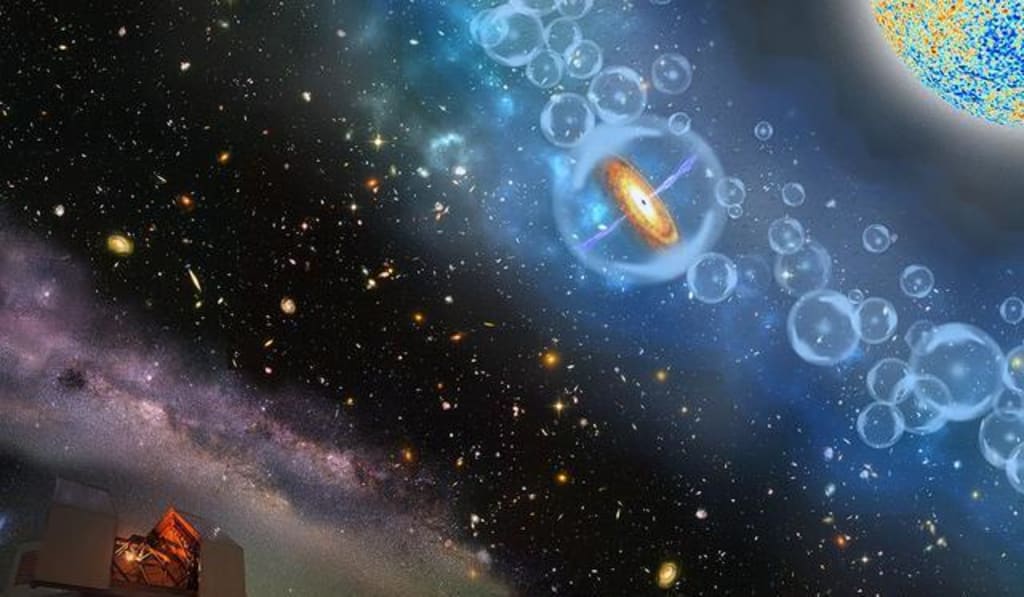
Although light is fast, it is finite, and if you can see farther in distance, you can go farther back in time. Astronomers hope the Webb Space Telescope will be seen into the deepest parts of the universe and pick up some of the first starlight to study what the universe was like in the beginning.
After analyzing Webb's latest observations, the results came as a complete surprise to astronomers. The Big Bang, 13.8 billion years ago, Doesn't seem to have happened! A new research paper published in the reprint arXiv even begins with the headline "Panic
Astronomer Allis Kirkpatrick went further: "Now I find myself lying awake at three in the morning wondering if everything I did be wrong."
So what did Weber see? Why did astronomers react this way?
In the past, astronomers generally believed that the universe was static and existed for an infinite amount of time. A hundred years ago, after creating the general theory of relativity, Einstein used the gravitational field equation to describe the universe. It turned out that the universe was not stable, so he introduced the cosmological constant into the equation to describe a stationary universe.
But more than a decade after general relativity was born, astronomer Edwin Hubble made a startling discovery. Hubble observed that most galaxies in the universe exhibit a red shift, and the more distant galaxies are, the more significant the red shift effect is, and the two are positively correlated.
According to the Doppler effect, the spectrum is red-shifted, meaning galaxies are getting away from the Milky Way, causing the wavelength of light to be stretched. And a higher red shift means the galaxy is moving away faster. Thus Hubble came up with the famous Hubble Law:
V = H0 · D
Where V is the galaxy's regression speed, H0 is Hubble's constant, and D is the galaxy's distance
The discovery of Hubble's Law meant that the universe could not be static, so Einstein soon realized he was wrong and dropped the cosmological constant from the gravitational field equation. Hubble's law can only be accounted for by the expansion of the cosmic structure, which forces galaxies to move away from each other.
Since space has been expanding over time, there is little doubt that the universe was smaller in the past. If we go back in time to a point in the distant past, which is speculated to be 13.8 billion years ago, the universe is infinitely small, then this "cosmic singularity" can be considered as the origin of time and space in the universe.
In the beginning, all the matter and energy in the universe was allocated to a singularity, and then the universe was born from the Big Bang, which is the Big Bang theory. Depending on this theory, in the first three minutes of the universe, the ratio of hydrogen to helium was 3:1, and almost nothing else.
As the universe was developed and cooled, hydrogen and helium pooled to form clouds of gas, which gravitatively collapsed into stars and galaxies. In the process of nuclear fusion, supernovae and neutron star collisions, heavier elements such as carbon, oxygen, nitrogen, silicon, iron and gold were gradually synthesized, which provided the elemental basis for the birth of life.
Depending on the Big Bang theory, when galaxies first formed, they were very small, irregular and primitive, and looked very different from galaxies today. After billions of years of evolution, the structure of the galaxy continues to develop, gradually forming spiral galaxies, elliptical galaxies and other obvious structure of the Galaxy.
However, when Webb looked into the deepest reaches of the universe, trying to peer into the galaxies of the original universe, he seemed to see something that did not belong there. , according to another new study [2] 13.4 billion years ago in a galaxy Numbers for GHz2, its diameter is estimated only about 600 light-years (more than 100000 light years across the Milky Way), but consider the light go up to 134 light years also can be seen, can calculate the surface brightness is 600 times the brightest galaxies in the universe, galaxies density is now tens of thousands of times.
Moreover, Weber's observations showed that galaxies in the distant universe did not seem to have irregular shapes. Nor did they collide in large numbers. Most of them seemed to have smooth disks and distinct spiral structures, just as we see galaxies today.
According to another paper to be published in Nature [3], at a red shift of more than 10, or a travel distance of more than 13.3 billion light years, there are at least 100,000 times more galaxies than theory predicts.
In other words, there appear to be plenty of fully developed galaxies in the early universe, including galaxies the size of our own Milky Way. In such a short period of time, there was obviously no time to form so many galaxies of such size. Eric j. Lerner, the author of TheBigBangNeverHappened, believes that the big bang did not happen
Such a conclusion was unacceptable to the mainstream astronomy community, which believed that EricJ.Lerner had misread the research results of these papers. The Big Bang theory remains by far the best description of the origin of the universe, supported by multiple independent lines of evidence.
The most crucial piece of evidence is one that even the rest of us can find. Do you remember watching the black and white TV as a child? If there was not any signal, or if you switched to a channel without a channel, the TV would appear full of black and white and irregular "snowflakes", which could prove the Big Bang, what exactly happened?
The universe started out very dense, very hot, and all matter was in a state of pure energy. As the universe was developed and cooled, there were conditions in the universe to form matter, and unbound photons. According to speculation, about 380,000 years after the universe was born, the temperature of the universe became cold enough for photons to decouple from charged particles and the universe emitted its leading light.
After 13.8 billion years, these oldest photons are still traveling through the present-day universe. Nevertheless, because of the expansion of space, the energy of these photons has been greatly attenuated, and their wavelengths have been stretched to become microwaves, filling the universe. No matter which direction we look into the deepest part of the universe, we end up seeing these microwaves, called the cosmic microwave background.
These microwaves can be picked up by the TV's antenna, resulting in a snowflake screen. It's estimated that 1% of the snow screen came from the primary light of the Big Bang, so we're seeing the Big Bang in a sense.
About the Creator
Keep reading
More stories from jiandanjizhi and writers in Futurism and other communities.
NASA recorded black hole "roar", as if from hell, light can not escape why the sound?
In an excerpt released directly to the media platform by NASA, we can hear bursts of roaring sound waves that are defined as synthesised from pressure waves from a black hole in the constellation Perseus, 200 million light-years away.
By jiandanjizhi3 years ago in Futurism
About Binding Prometheus
I want to start actively advocating on behalf of my own work, and the most valuable part of my canon is, without a doubt, Binding Prometheus, the play I have been working on since 2019 and only finished in 2023 as part of my MA. The play itself is an amalgamation of a million different inspirations. On one end, it evokes the Ancient Greek myth-play, deriving its own title from the earliest extant work of Western drama we have, Aeschylus’s Prometheus Bound. On the other end, it borrows significantly from the sci-fi bulwarks from over the years, namely Mary Shelley’s Frankenstein and Karel Capek’s Rossum’s Universal Robots. The play could be an episode of Black Mirror, I fear. I don’t know. I’ve only ever seen one episode of Black Mirror.
By Steven Christopher McKnight19 days ago in Futurism
How AI is switching from a skilled tortious to a creative playful in case of video making in 2026
I see that the digital landscape has always been a place. In 2026 the digital landscape faces more stakes than before. People no longer just live in a world. People now live in a world where attention's the most valuable currency. For years the barrier to entry for high‑quality video production was high. The barrier required cameras, complex editing software and hundreds of hours of labor.
By Muhammad Hanzlaabout 19 hours ago in Futurism


Comments
There are no comments for this story
Be the first to respond and start the conversation.