
NASA recorded black hole "roar", as if from hell, light can not escape why the sound?
For human beings have never stopped the exploration of outer space, whether Shenzhou spacecraft, or starships, are exploring the vast and boundless universe. In the history of exploration, it seems that humans have ever heard the sound of the universe, but what about the roaring sound waves coming from a black hole in space? Why does darkness, from which light cannot get away, produce sound?
In an excerpt released directly to the media platform by NASA, we can hear bursts of roaring sound waves that are defined as synthesised from pressure waves from a black hole in the constellation Perseus, 200 million light-years away.
And it is the sound audio from NASA's camera X-ray observatory, in media platform, NASA caption content means roughly: in many people's eyes, there is no sound to space, because it belongs to the vacuum environment cannot make sound better pass out, this is actually a misunderstanding.
Although there is no medium for sound to go through, there is a lot of gas in the cluster surrounding the black hole, which provides a medium for sound to travel through.
And that's not the only kind of sound that NASA found. It picked up another kind of pressure wave from a black hole in the Perseus galaxy cluster. Because the sound waves travel through the gas near the black hole, they are difficult to hear by ear alone.
Because even the highest pitched sound waves produced in supermassive black holes are always well below the limits of human hearing. The black hole roar can be heard clearly in this audio, mainly because NASA used a new technique to raise the acoustic notes collected in the black hole at a synthetic pitch of 57-58, so we can hear them.
The sound from the black hole is as piercing as the roar of a lion in an empty forest. It is deafening. "A black hole can't even emit light, so how can it emit sound?" one netizen commented.
"What I understand meaning is that if you go at the speed of sound you can just escape the black hole? People are just a drop in the ocean of the vast universe." "It's like a sports car starting its engine. It's really scary." "Hearing the sound of a black hole is like a call from hell. It's really penetrating."
Why is it that even light cannot get away from a black hole? How do people see black holes?
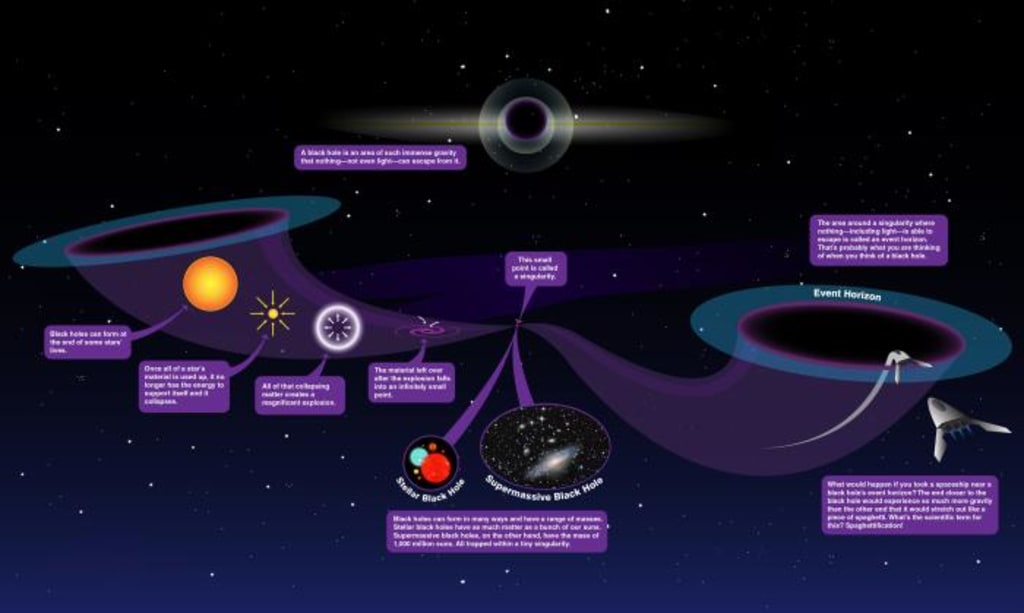
But before we figure that out, speak of what a black hole is. A black hole is, in fact, a weighty enough star that collapses when it burns out of fuel for nuclear fusion.
Black hole is not a dark cave that we see in our everyday life. It can be said that it is a mysterious celestial body. Whatever is sucked into it will not come out again. It has so much mass that the gravitational field it creates is so strong that we can't imagine, for example, that it pulls in all the heavy stuff.
Take light, for example. We all need to know that light travels very fast, but in a black hole, even light can't escape. Why is that?
In fact, black holes are invisible because they are linked by a ring of gas. This region of space in a black hole is so intense that nothing, not even light, can escape. We all know how light refracts in the real world, like when a beam of light hits a glass, it's reflected back to the ground by refraction.
But every possible path that light can take in a black hole will eventually bend and come back inside the black hole, and it won't be refracted using a medium, which means that once light gets inside the black hole, it can't get out.
So why can humans see black holes?
When we put an astronomical telescope to galaxies, is found around the black can't see anything, the reason is mainly because it is in itself a black hole of the original color - black, the gravity of the black hole is a very powerful, even is not far from its star will run around him, and these stars to light will illuminate to the earth.
When scientists looked at the Milky Way with telescopes. They found that the stars were orbiting a black spot. What is this blank spot? After studying it, the researchers found that the vacant spot was actually where the black hole was. It has to be recognised that we are indeed much luckier than our ancestors, because we are the first humans to see a black hole.
The black hole that reveals itself is at the center of M87, a giant elliptical galaxy in the constellation Virgo, about 55 million light-years from Earth and about 6.5 billion times the mass of our Sun. So how do you capture the authentic face of this black hole?
Take photos for it equipment is actually a diameter, such as the size of the earth "virtual" telescope, is about more than two hundred researchers eight radio telescopes on earth at different sites into observation arrays, the so-called array is a cluster, it's like we see in the film and television works to catch demon master array, a few catch demon set from different azimuth circle, Then gather strength, will take the monster at one fell fall, scientific research personnel arranged observation array, in fact, and this truth is about the same, are gathering strength.
Then using eight radio telescopes. They finally took a picture of the black hole. When we magnify this black hole a thousand times, it looks like the briquettes we burned when we were young, glowing red. At this point, one can't help but ask: "Isn't neutral from a black hole unable to come out? Why do you see a red light in it?"
The reason we actually see the red light is because of the light from the huge plasma jets produced by the super massive black hole. As the plasma gets closer and closer to the black hole, it moves faster and faster. At the same time, space for plasma is getting smaller and smaller.
As a result of this high speed and crowding, some of the plasma bounce away from the black hole. As the plasma jets, it forms two huge beams of light. This process is called astrophysical jets, and the red light we see in this zoomed in image is actually because the plasma in the jets is never inside the black hole, and the light from the jets is outside.
How do black holes make sound?
From the moment that human beings explore outer space, the impression left to the world is "space is silent", because the space images we get through the astronomical telescope are still images, and the outer space is hushed in the recorded history. Regardless of the fact that scientists have found the universe to be changing through countless hypothetical experiments, they have never found it to be sound.
With the continuous progress of science and technology, researchers have discovered a kind of gravitational wave, which is generated by the collision of black holes and pulsars. This kind of gravitational wave is the sound of vibration in space. Since the universe has a sound, how does the voice in a black hole come about?
The black hole sound in the audio is a combination of sound waves from the M87 and Pegasus galaxies, clusters where galactic gas provides adequate medium for the sound to be recorded. The main reason why a black hole produces this sound is because sound waves occur when sufficient medium is reached. And that medium is a gas. Sound, as we know it, is generated by particles of gas constantly colliding with particles around them.
In a broad sense, sound is actually a longitudinal wave. There is a lot of galactic gas around the black hole, and it's very low density, which is why the sound waves it emits are low-frequency. These low frequency sound waves are produced when intense pressure and radiation push against each other or rhythmically heat and cool.
To put it another way, a black hole produces sound waves because it absorbs matter from its surroundings and forms a large cavity structure, and these low frequency sound waves are constituted by galactic gas from the cavity.
For instance, the reason why some people make noise when they walk is that the friction between their shoes and the ground causes vibration. In fact, the sound waves emitted by black holes are the same ones.
So how low-pitched are the sound waves produced by a black hole? A piano is only seven octaves lower than the original pitch. The sound wave in the black hole is 57 octaves lower than the Central C. It would take about 16.44 million years to hear the sound wave in full. To make black holes more audible. NASA used sophisticated new technology to turn up the sound of low-frequency black holes 144 trillion times.
About the Creator
Keep reading
More stories from jiandanjizhi and writers in Futurism and other communities.
A mysterious creature has been spotted in the atmosphere and hundreds of people have taken pictures of an unknown beast. Could it be a real dragon?
People are always talking about atmospheric organisms, and there have referred to of sightings around the world, including one in a magazine in Crawfordsville, Indiana. The incident took place on September 4, 1891, when two men worked overnight to repair a broken carriage the next day's market. During the repairs, one of the men inadvertently looked up and saw something extraordinary.
By jiandanjizhi3 years ago in Futurism
About Binding Prometheus
I want to start actively advocating on behalf of my own work, and the most valuable part of my canon is, without a doubt, Binding Prometheus, the play I have been working on since 2019 and only finished in 2023 as part of my MA. The play itself is an amalgamation of a million different inspirations. On one end, it evokes the Ancient Greek myth-play, deriving its own title from the earliest extant work of Western drama we have, Aeschylus’s Prometheus Bound. On the other end, it borrows significantly from the sci-fi bulwarks from over the years, namely Mary Shelley’s Frankenstein and Karel Capek’s Rossum’s Universal Robots. The play could be an episode of Black Mirror, I fear. I don’t know. I’ve only ever seen one episode of Black Mirror.
By Steven Christopher McKnight17 days ago in Futurism




Comments
There are no comments for this story
Be the first to respond and start the conversation.