
The Next Century: How the World Will Transform Over the Next 100 Years
A Glimpse Into Life, Technology, and Civilization in the Year 2125"

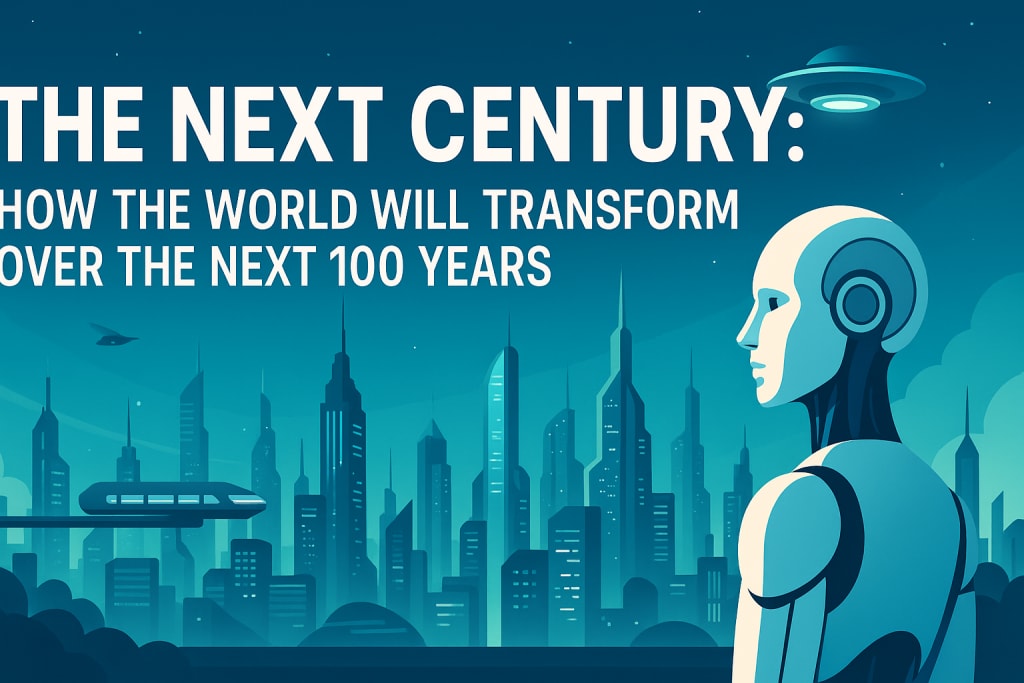
As we stand at the threshold of rapid technological advancement and global change, it’s both thrilling and daunting to imagine what the world might look like a century from now. The past 100 years have seen unimaginable transformations—from the invention of the internet to space travel, genetic engineering, and artificial intelligence. If we consider that pace and assume exponential growth in knowledge, capabilities, and innovation, the next 100 years may reshape civilization in ways we can hardly comprehend today.
Here’s a speculative yet thoughtful exploration of how humanity and the planet might evolve by the year 2125.
---
1. Technological Advancement: Beyond the Digital Age
By 2125, humanity will likely be far beyond the Digital Age, possibly well into what futurists call the “Post-Human Era” or “Technological Singularity.” Artificial Intelligence (AI) will become an integral part of daily life—ubiquitous, adaptive, and vastly more intelligent than today's systems. Machines may not only match but exceed human intelligence in most areas.
Human-AI Integration: Neural implants could become commonplace, allowing humans to directly connect their brains to the internet and other digital systems. This "brain-computer interface" might allow people to learn new skills in minutes, communicate telepathically, or experience virtual realities that feel as real as the physical world.
Quantum Computing: Traditional binary computers will likely be replaced or complemented by powerful quantum computers capable of solving complex problems in seconds that would take today’s supercomputers millennia.
Automation and Robotics: Most manual labor and even creative work might be done by highly intelligent robots. From factories and farms to hospitals and schools, machines could handle tasks with perfect efficiency.
---
2. Healthcare and Human Lifespan
Medicine is likely to be revolutionized. Not only will diseases like cancer, diabetes, and Alzheimer's be curable or preventable, but aging itself might be treatable.
Genetic Engineering and CRISPR: Advances in gene editing will allow scientists to correct genetic defects at birth or even before. Designer babies with enhanced intelligence, immunity, or physical abilities might become a reality.
Regenerative Medicine: Organ failure could become a thing of the past as 3D printing of organs and tissue regeneration using stem cells become routine.
Life Extension: Some experts predict that with these advancements, the average human lifespan could increase to 120–150 years or more. Radical life extension technologies could even make biological immortality possible, though controversial.
---
3. Space Exploration and Colonization
As Earth faces the strain of overpopulation and climate change, humanity’s attention will increasingly turn toward the stars.
Permanent Moon and Mars Colonies: We may see fully functioning cities on the Moon and Mars, supported by advanced life support, hydroponics, and energy systems. These colonies might house thousands or even millions of people.
Interstellar Travel: While traveling to other stars is still a daunting challenge today, future propulsion technologies like antimatter engines, warp drives, or solar sails might make interstellar travel a reality within the next century.
Asteroid Mining: Space could become the new economic frontier, with robotic missions extracting valuable minerals and rare elements from asteroids to support both Earth-based and off-world economies.
---
4. Climate and Environmental Change
The next 100 years will be critical in determining how humanity addresses climate change and environmental degradation.
Climate Engineering: If global warming reaches catastrophic levels, nations may resort to geoengineering techniques such as stratospheric aerosol injection or ocean fertilization to control the Earth’s temperature.
Sustainable Living: Cities of the future might be fully sustainable, powered by renewable energy sources such as solar, wind, fusion, and potentially even antimatter. Vertical farming, green architecture, and zero-emission transportation could be standard.
Extinction and Revival: While many species may unfortunately go extinct due to habitat loss and environmental changes, some may be revived through de-extinction technologies, bringing animals like the woolly mammoth or dodo back to life.
---
5. Society, Politics, and Culture
Social structures will evolve dramatically in the next century as globalization, digitization, and migration reshape societies.
Universal Basic Income (UBI): As AI and automation reduce the need for human labor, governments may adopt UBI to ensure citizens have a standard living income.
Decentralized Governance: With blockchain and digital ID technologies, political systems might become more transparent and decentralized, with citizens voting directly on policies via secure digital platforms.
Cultural Fusion: Globalization will lead to the blending of cultures, languages, and traditions. Languages like English, Spanish, Mandarin, and even newly created digital languages might evolve or merge.
Virtual Societies: The concept of nationality might blur as people spend more time in global, shared virtual realities. Entire communities could exist in the metaverse, where people live, work, and socialize without geographical limitations.
---
6. Education and Learning
Education will transform from static classroom-based learning to continuous, personalized, and immersive experiences.
AI Tutors: Each student might have a personalized AI tutor that adapts to their learning style and pace, ensuring mastery of subjects without stress or boredom.
Virtual Reality (VR) Classrooms: Learning might take place in fully immersive virtual environments—imagine studying ancient Rome by walking its streets or learning biology inside a simulated human body.
Global Access: Thanks to internet satellites and cheap smart devices, even the remotest areas of the world might have access to world-class education.
---
7. Philosophy and Ethics of Progress
With such transformative change, philosophical and ethical questions will become more urgent.
What does it mean to be human? As we integrate with machines and modify our biology, we’ll need to redefine identity, rights, and consciousness.
AI Rights: If AI becomes self-aware or emotionally intelligent, debates about their rights and status in society will arise.
Equity and Access: Ensuring that technological benefits are distributed fairly will be one of the greatest ethical challenges of the next century.
---
Conclusion
The next 100 years hold immense promise—and peril. We may conquer disease, transcend our planetary boundaries, and unlock mysteries of the universe. Or we may face new conflicts, resource crises, and existential risks from unchecked technology.
What’s clear is that humanity stands at a crossroads. The decisions we make today—in science, ethics, and governance—will shape not just the future of civilization, but of life itself.
Will we rise to meet the challenge? The answer lies in our vision, our choices, and our collective will.
About the Creator
Keep reading
More stories from ankesh kushwah and writers in Futurism and other communities.
“From Nothing to Everything: The Mysterious Birth of the Universe”
The Birth of the Universe: A Journey from Nothing to Everything The question of how the universe came into existence has captivated the minds of philosophers, scientists, and theologians for centuries. From the ancient myths of creation to the modern discoveries of cosmology, the origins of the cosmos remain one of humanity’s deepest inquiries. In this article, we will explore the fascinating story of the universe's birth through both scientific and philosophical lenses, from the Big Bang theory to quantum fluctuations, and even touch upon the mystery of what might have existed before everything began.
By ankesh kushwah10 months ago in History
Stanislav Kondrashov Oligarch Series: Intercontinental Electricity Networks and the Future of Energy Connectivity
Across the world, electricity systems are entering a new phase. For decades, national grids developed largely within their own borders, expanding step by step to meet growing demand. Today, a different vision is emerging: vast intercontinental electricity networks capable of linking regions thousands of kilometres apart.
By Stanislav Kondrashov6 days ago in Futurism
Voice AI Agents Market Reaching USD 47.5 Billion By 2034
Voice AI Agents Market Overview The global Voice AI Agents Market is experiencing rapid development as organizations increasingly adopt automated voice interfaces for customer interaction, internal operations, and digital services. The market is projected to reach USD 47.5 Billion by 2034, increasing from USD 2.4 Billion in 2024, reflecting a strong CAGR of 34.8% between 2025 and 2034. Growth is supported by the expansion of voice-enabled digital platforms, increasing integration of conversational AI technologies, and rising demand for automated customer engagement solutions. Voice AI agents are now widely implemented in sectors such as telecommunications, banking, healthcare, retail, and e-commerce.
By Roberto Crum6 days ago in Futurism
Early March 2026: 4 Goals Accomplished
It's early March and I've now accomplished my 4th writing goal for the year of 2026. Before diving into the behind-the-scenes of it... why not tell you up front what that accomplishment was? I was published in a 2nd publication for this year. Published in Helix Literary Magazine out of Central Connecticut State University. You can read it for free right now!
By Stephen Kramer Avitabile6 days ago in Writers


Comments
There are no comments for this story
Be the first to respond and start the conversation.