
The Mystery of Fast Radio Bursts (FRBs): What We Know Now
Space

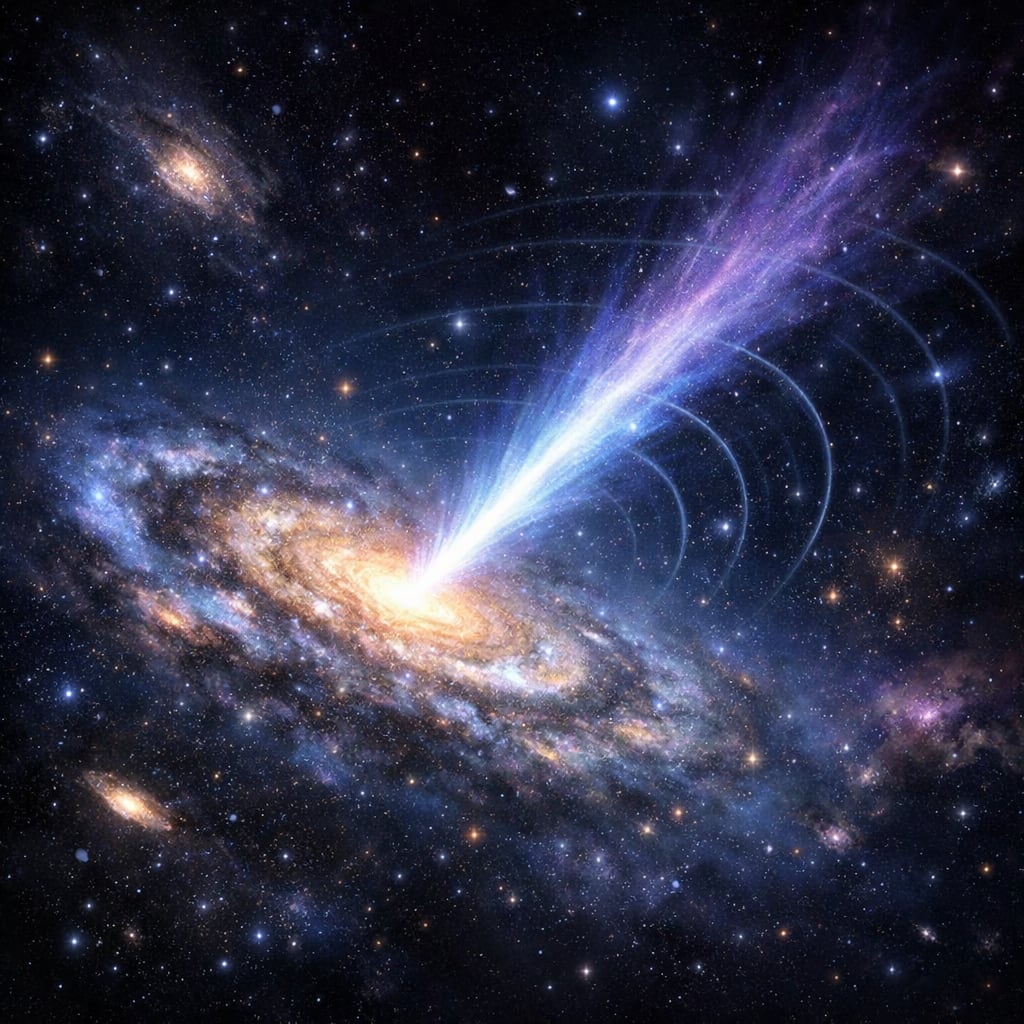
Since the first discovery of Fast Radio Bursts (FRBs) in 2007, these brief, intense flashes of radio waves have become one of the most captivating mysteries in modern astrophysics. With their incredible brightness, extremely short duration, and unknown origins, FRBs have fascinated both professional astronomers and the general public. Despite significant progress in observations and theory, many questions about their nature remain unanswered.
What Are FRBs?
FRBs are ultra-short bursts of radio energy, lasting only a few milliseconds—a tiny fraction of a second. Yet, in that brief instant, an FRB can release as much energy as the Sun emits over several days. They arrive from various directions in the sky, typically from extragalactic sources, located millions or even billions of light-years away. The extreme distance and power of these signals make them both puzzling and incredibly valuable for studying the cosmos.
Recent Breakthroughs in Observations
1. The Brightest FRB Yet
In August 2025, astronomers detected the brightest FRB ever recorded, informally dubbed RBFLOAT (Radio Brightest Flash Of All Time). Originating from the spiral galaxy NGC 4141, roughly 130 million light-years from Earth, this FRB stunned researchers with its intensity. Advanced instruments like Canada’s CHIME radio telescope, paired with ground-based outrigger antennas, not only detected the burst but also precisely pinpointed its location within the galaxy.
Interestingly, RBFLOAT is a single, non-repeating burst. After six years of follow-up observations, no repetitions were observed. This distinction between one-off and repeating FRBs provides important clues about the different classes of sources and the mechanisms behind them.
2. Direct Evidence Linking FRBs to Neutron Stars
One of the most exciting discoveries in recent years involves FRB 20221022A. Using a technique known as scintillation analysis, which examines subtle changes in a signal’s brightness much like the twinkling of stars, astronomers traced the burst to the magnetosphere of a neutron star. These extremely dense, rapidly spinning stellar remnants have extraordinarily strong magnetic fields, supporting the theory that at least some FRBs are powered by magnetars—a type of neutron star with the most intense magnetic fields in the universe.
The Big Questions: What Causes FRBs?
Despite these discoveries, the ultimate origin of FRBs remains uncertain. Scientists currently explore several leading hypotheses:
- Magnetars: These highly magnetized neutron stars can release tremendous bursts of energy through magnetic reconnection or starquakes. Some FRBs observed in our own galaxy have already been linked to such sources.
- Binary Systems: Observations from China’s FAST telescope suggest that interactions between magnetars and companion stars—such as the release of coronal mass ejections—might trigger some FRBs.
- Mergers of Compact Objects: Collisions between neutron stars, white dwarfs, or combinations of compact objects could produce extremely brief but powerful radio flashes.
Repeating vs. Non-Repeating FRBs
Only a small fraction of detected FRBs show repeating behavior. Some even display periodic activity. This suggests that different types of sources or mechanisms may be responsible for different FRBs. Distinguishing between these classes remains one of the key challenges in current research.
FRBs as Tools for Cosmic Exploration
Beyond understanding the bursts themselves, FRBs have become valuable tools for probing the universe. As radio waves travel through the intergalactic medium, they experience dispersion—a delay in arrival times across different frequencies. By analyzing these delays, astronomers can measure the density of matter between galaxies and even map out the distribution of previously “missing” baryonic matter in the universe. In this way, FRBs serve as cosmic flashlights, illuminating structures that would otherwise be invisible.
Technological Advances Driving Discovery
Modern FRB research owes much to wide-field radio monitoring and rapid data analysis. Observatories like CHIME, together with networks of outrigger antennas, have greatly expanded FRB catalogs while improving localization.
Machine learning is also playing a transformative role. Algorithms can now identify FRB events in raw radio data without traditional manual processing, accelerating discoveries and uncovering subtle bursts that might have gone unnoticed in the past.
The Road Ahead
FRBs remain one of the most active areas of astrophysics in the 21st century. Recent achievements include:
- Pinpointing individual FRBs within specific regions of galaxies.
- Obtaining direct evidence linking some FRBs to extreme magnetic environments around neutron stars.
- Expanding understanding of the surrounding environment and potential mechanisms of FRB generation.
- Using FRBs as cosmological tools to study the large-scale structure of the universe.
Yet, the central question—what exactly produces these powerful, millisecond-long radio flashes—remains unresolved. Ongoing observations with next-generation telescopes, combined with advanced data analysis techniques, promise to significantly deepen our understanding of these cosmic enigmas in the coming years.
In the end, FRBs are not just fleeting bursts of energy—they are windows into some of the most extreme, fascinating, and unexplored corners of the universe. Each new discovery brings us closer to unraveling one of the most exciting mysteries in modern astronomy.
About the Creator
Keep reading
More stories from Holianyk Ihor and writers in Futurism and other communities.
New Plans for Resource Extraction Beyond Earth
For most of human history, the idea of mining resources beyond Earth belonged firmly to the realm of science fiction. Asteroids rich in precious metals, lunar factories producing rocket fuel, and self-sufficient colonies extracting materials from alien soil were staples of futuristic novels rather than serious policy discussions. Today, however, this vision is rapidly transforming into a concrete strategy supported by governments, private companies, and long-term economic planning. Humanity is approaching the dawn of an off-world resource economy—one that could fundamentally reshape our relationship with space and with Earth itself.
By Holianyk Ihor7 days ago in Futurism
About Binding Prometheus
I want to start actively advocating on behalf of my own work, and the most valuable part of my canon is, without a doubt, Binding Prometheus, the play I have been working on since 2019 and only finished in 2023 as part of my MA. The play itself is an amalgamation of a million different inspirations. On one end, it evokes the Ancient Greek myth-play, deriving its own title from the earliest extant work of Western drama we have, Aeschylus’s Prometheus Bound. On the other end, it borrows significantly from the sci-fi bulwarks from over the years, namely Mary Shelley’s Frankenstein and Karel Capek’s Rossum’s Universal Robots. The play could be an episode of Black Mirror, I fear. I don’t know. I’ve only ever seen one episode of Black Mirror.
By Steven Christopher McKnight19 days ago in Futurism
Saudi Arabia Cloud Computing Market & Forecast 2025–2033
Introduction Saudi Arabia’s digital transformation is entering a decisive phase, with cloud computing at the core of the Kingdom’s technology roadmap. As enterprises, government agencies, and startups accelerate their shift toward digital platforms, cloud infrastructure is rapidly becoming the backbone of innovation, efficiency, and scalability across industries.
By jaiklin Fanandish5 days ago in Futurism



Comments
There are no comments for this story
Be the first to respond and start the conversation.