
The Mysterious “Dark Beads” Above Saturn’s Pole: JWST Unveils a Cosmic Puzzle
Space

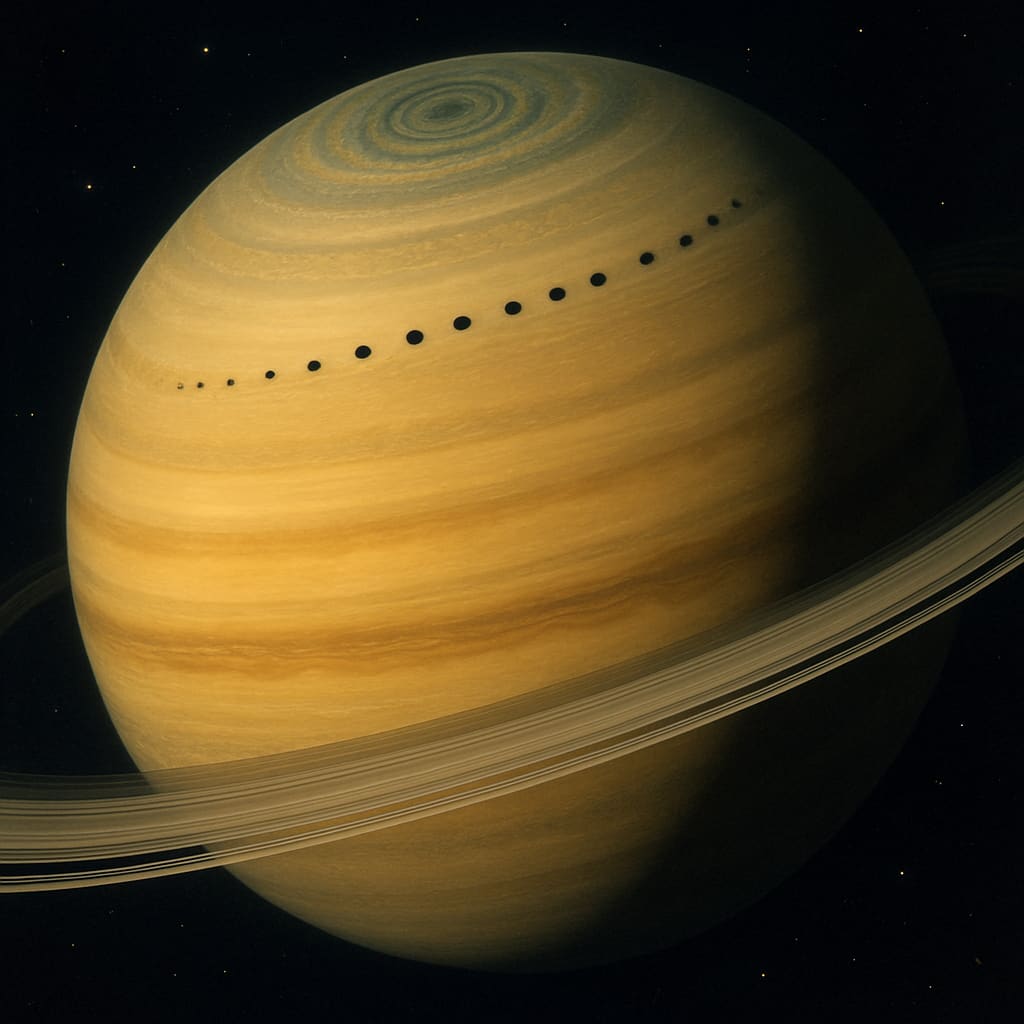
Saturn has always been one of the most enigmatic worlds in our solar system. Known for its dazzling rings, its golden-hued atmosphere, and its bizarre six-sided polar storm, the gas giant is a favorite subject of astronomers. Yet just when we think we’ve learned most of its secrets, Saturn surprises us again. Recently, NASA’s James Webb Space Telescope (JWST) captured something utterly unexpected in the planet’s northern atmosphere: a string of strange, dark structures scientists are calling “mysterious dark beads.”
These peculiar spots, appearing like pearls threaded along an invisible string, are unlike anything seen before on Saturn—or anywhere else in the solar system. And for now, they defy explanation.
A Discovery Nobody Anticipated
When astronomers directed JWST’s powerful infrared instruments toward Saturn, their goal was fairly straightforward: refine measurements of the planet’s atmospheric composition and thermal structure. But instead of just confirming existing theories, the telescope delivered an unanticipated mystery.
On the processed infrared images, astronomers noticed chains of dark spots aligned near Saturn’s pole. Each one was small compared to the vastness of the planet, but together they formed repeating patterns that looked almost deliberate. Imagine holding a string of beads against the backdrop of Saturn’s swirling clouds—that’s what researchers saw.
What makes this discovery even stranger is that none of Saturn’s previous observers noticed anything similar. Neither the legendary Cassini spacecraft, which orbited Saturn for more than a decade, nor the Hubble Space Telescope, which has monitored the planet for decades, recorded such features. The fact that JWST sees them suggests they might only appear in a narrow range of infrared wavelengths—or perhaps they’re a newly emerging atmospheric phenomenon.
What Could They Be?
Right now, scientists are cautious about jumping to conclusions. Theories are forming, but none fully explain the odd “dark beads.”
Atmospheric Waves. One possibility is that these beads are the visible traces of unusual wave patterns in Saturn’s upper atmosphere. Similar to how ripples form on Earth’s oceans or clouds, giant gas planets can experience undulating waves that organize atmospheric material into repeating clusters.
Chemical Oddities. Saturn’s atmosphere is primarily hydrogen and helium, but it also contains methane and other trace gases. Under the right conditions, interactions between these molecules could create localized “dark patches” when viewed in infrared light.
Magnetic Influence. Saturn has a powerful magnetic field that shapes auroras and influences charged particles near its poles. The beads may be linked to invisible magnetic processes, perhaps like scars left by the planet’s dynamic magnetosphere.
Something Entirely New. There’s also the thrilling possibility that this is a phenomenon no one has ever seen before—a brand-new atmospheric process unique to Saturn, or perhaps common on gas giants but hidden from view until JWST came online.
Why It Matters
At first glance, a row of dark spots on a distant planet might not sound revolutionary. But in planetary science, small anomalies often lead to big breakthroughs. When Cassini first revealed Saturn’s hexagonal polar storm, many dismissed it as a curiosity. Today, that hexagon is a textbook example of large-scale fluid dynamics. Similarly, Jupiter’s famous Great Red Spot was once considered just “a big storm.” Now we know it’s a massive, centuries-old system that helps scientists model weather patterns across the solar system.
The “dark beads” could serve the same role: opening new pathways for understanding not just Saturn but all gas giants, including exoplanets. Many of the worlds orbiting distant stars are Saturn-like in size and composition. If these strange features turn out to be a universal process, JWST may have given us a new diagnostic tool for studying alien skies.
Looking Ahead
The story doesn’t end with this first observation. JWST will continue to monitor Saturn over time, capturing the planet during different seasons and solar cycles. The beads may vanish, multiply, or shift positions. Tracking these changes will help astronomers determine whether they’re connected to solar radiation, Saturn’s magnetic field, or deep atmospheric currents.
Future missions could also weigh in. Although we no longer have an orbiter around Saturn since Cassini’s dramatic plunge in 2017, proposed spacecraft might one day revisit the system. With modern instruments, they could fly closer to the poles and confirm whether these beads are surface-level structures, high-altitude anomalies, or something else entirely.
The Allure of the Unknown
In the end, it’s the mystery that captures the imagination. Astronomers are trained to explain, to measure, and to model. Yet the universe constantly resists being fully understood. The “dark beads” of Saturn remind us that even in our own solar system, where spacecraft have already mapped moons and sniffed atmospheres, we are still stumbling upon phenomena no one predicted.
As one researcher put it during an early press briefing: “Sometimes the most exciting discoveries are the ones we don’t have a name for yet.”
So while the dark beads remain unexplained, they’ve already done something important—they’ve reawakened our sense of wonder about Saturn. And perhaps that’s the most valuable discovery of all.
About the Creator
Keep reading
More stories from Holianyk Ihor and writers in Futurism and other communities.
The Most Distant Quasar: A Glimpse Into the Dawn of the Universe
Astronomers have recently made a discovery that pushes the limits of our cosmic vision: the most distant quasar ever found. This ancient beacon of light formed just 500 million years after the Big Bang—when the Universe itself was still in its infancy. Peering at this quasar is like looking back across time to witness the first chapters of cosmic history.
By Holianyk Ihor4 months ago in Futurism
About Binding Prometheus
I want to start actively advocating on behalf of my own work, and the most valuable part of my canon is, without a doubt, Binding Prometheus, the play I have been working on since 2019 and only finished in 2023 as part of my MA. The play itself is an amalgamation of a million different inspirations. On one end, it evokes the Ancient Greek myth-play, deriving its own title from the earliest extant work of Western drama we have, Aeschylus’s Prometheus Bound. On the other end, it borrows significantly from the sci-fi bulwarks from over the years, namely Mary Shelley’s Frankenstein and Karel Capek’s Rossum’s Universal Robots. The play could be an episode of Black Mirror, I fear. I don’t know. I’ve only ever seen one episode of Black Mirror.
By Steven Christopher McKnight17 days ago in Futurism
Activated Carbon Fiber Market: Advanced Filtration & Growth Outlook
According to IMARC Group's latest research publication, The global activated carbon fiber market size reached USD 463.6 Million in 2024. Looking forward, IMARC Group expects the market to reach USD 779.0 Million by 2033, exhibiting a growth rate (CAGR) of 5.64% during 2025-2033.
By James Whitman4 days ago in Futurism
Rachel Reviews: The Spiral Archive by Pieter Hendrik
It's difficult for me to know where to start with a review of this book as it was, for me, an entirely unique experience and one that I'll probably never have again. I don't want that to be interpreted as unenjoyable but it has left me scratching my head a little and ruminating on its content, its themes and its characters.
By Rachel Deemingabout 7 hours ago in BookClub


Comments
There are no comments for this story
Be the first to respond and start the conversation.