
The Moon: A New Frontier — How China and Russia Are Building the Base of the Future
Space

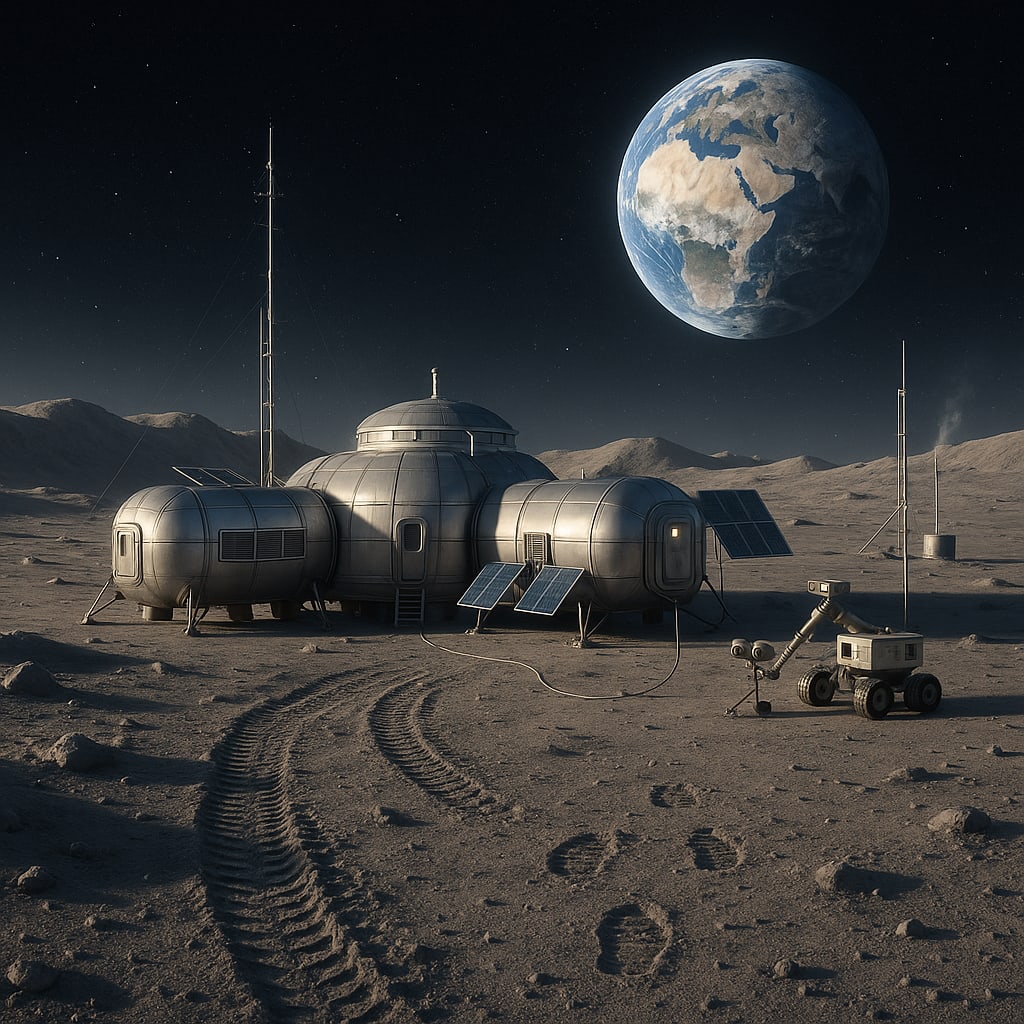
Imagine looking up at the Moon one night and knowing that somewhere, amid its silver craters and endless shadows, a joint Chinese–Russian lunar base is quietly operating. It sounds like science fiction — something out of a 1960s space novel — but this time, it’s real. The project is already underway and could soon reshape not only our understanding of space but also the balance of power on Earth.
A New Era Begins
In the spring of 2021, the China National Space Administration (CNSA) and Roscosmos, Russia’s space agency, signed an agreement to create the International Lunar Research Station (ILRS) — a permanent complex on or around the Moon that will host both automated systems and, eventually, humans.
The idea is simple but monumental: combine resources, experience, and technology to build a fully functional scientific base on the lunar surface. The ILRS will serve as a hub for research missions, resource exploration, and — in the long run — the foundation of a sustainable lunar infrastructure.
The target location is the Moon’s south pole, where deep, shadowed craters contain vast deposits of water ice. And ice means much more than hydration. It’s hydrogen and oxygen — in other words, fuel. Without it, there’s no long-term human presence and no deep-space travel to Mars or beyond.
The Technological Challenge
Constructing a base on the Moon is among the most complex engineering tasks ever attempted. The Moon is not a friendly place: there’s no air, no magnetic protection from radiation, and temperatures swing by more than 200 degrees Celsius between day and night.
Plans for the ILRS include living modules, power stations, laboratories, and transportation systems. At first, it will be fully automated — maintained by robots and remotely controlled rovers. Only once the systems are proven reliable will humans set foot there to stay.
The cornerstone of the project is its nuclear power system. China has confirmed that it’s developing a compact lunar reactor capable of supplying energy for decades. It’s expected to be operational around 2035.
Energy is the biggest bottleneck for all lunar missions. Solar panels are useful only part-time, since a lunar night lasts about 14 Earth days. A nuclear power source offers independence — the ability to keep systems running continuously, regardless of sunlight or temperature.
Science That Could Change the Earth
The ILRS is not just a technological milestone; it’s a future scientific hub. Researchers will study lunar geology, seismic activity, radiation levels, and the effects of low gravity on living organisms. They’ll analyze local resources and test methods to extract and refine them.
One of the most promising technologies is 3D printing using lunar regolith — the dusty soil covering the Moon’s surface. If modules and structures can be printed on-site using local materials, the cost of transporting supplies from Earth could drop dramatically.
The Moon also offers a pristine environment for astronomical observation. With no atmosphere, there’s no interference. A radio telescope on the far side of the Moon could listen to the Universe in frequencies impossible to detect from Earth, giving scientists an entirely new window into the cosmos.
Politics in Orbit
Make no mistake: the lunar base is not only about science — it’s also about geopolitics. Space is once again becoming a stage for global rivalry, and cooperation between China and Russia is a strategic move.
While the United States and its allies push forward with NASA’s Artemis Program and sign the Artemis Accords — a set of international rules for lunar exploration — China and Russia are building an alternative system. Their station is officially open to other nations, but under the principles of “equality and mutual benefit.”
For Moscow, this partnership helps maintain its status as a major space power by leveraging China’s rapid technological growth. For Beijing, it’s an opportunity to demonstrate that it’s not just catching up — it’s ready to lead.
What’s emerging is a new cosmic order: not a single unified world project, but multiple centers of power, each with its own philosophy, technology, and alliances.
A Glimpse of the Future
If everything goes according to plan, the first components of the base could appear in the 2030s — a power module, antennas, research platforms, and eventually living quarters.
Picture this: silver domes gleaming against the stark gray plains, their curved surfaces reflecting the distant sunlight. Autonomous rovers glide silently between modules, sending streams of data back to Earth. And above it all, in the black sky, hangs our blue planet — the cradle of life, shining over the desolate serenity below.
Inside the modules, scientists study lunar samples under bright LED lights or tend to small green plants growing in sealed hydroponic pods. Every system is optimized — water recycled, waste reused, energy balanced between solar and nuclear. The base becomes a microcosm of sustainable living, a preview of what humanity’s future might look like both off-world and at home.
Obstacles and Optimism
The challenges remain daunting. Life-support systems still need refinement, transporting cargo costs billions, and international tensions could delay progress. Yet China and Russia have a key advantage: experience.
China has successfully landed rovers on both the near and far sides of the Moon, while Russia — and before it, the Soviet Union — pioneered lunar missions decades ago. Together, they bring a mix of heritage and innovation that could prove surprisingly powerful.
If successful, ILRS would not only change space exploration but also provide technologies and lessons applicable to Earth — in energy, recycling, robotics, and remote autonomy.
The Moon as Humanity’s Mirror
The joint Chinese–Russian lunar base is more than a scientific outpost. It’s a test of humanity itself. Can we truly cooperate beyond Earth? Or will we carry our old rivalries into the stars?
For centuries, the Moon has symbolized dreams — cold, distant, unreachable. Now it’s becoming a symbol of reality, a place where imagination meets determination.
If everything goes as planned, in just a decade or two humanity may look up and say:
- “We don’t just look at the Moon anymore —
- we live there.”
About the Creator
Keep reading
More stories from Holianyk Ihor and writers in Futurism and other communities.
Homes Beneath the Red Dust: How Subsurface Living Could Keep Mars Settlers Safe and Warm
When humans finally set foot on Mars, they won’t be building glass domes under the crimson sky — at least not right away. The first Martian homes will likely be hidden beneath the planet’s surface, buried in the dusty regolith, where the hostile environment gives way to safety, stability, and warmth.
By Holianyk Ihor3 months ago in Futurism
About Binding Prometheus
I want to start actively advocating on behalf of my own work, and the most valuable part of my canon is, without a doubt, Binding Prometheus, the play I have been working on since 2019 and only finished in 2023 as part of my MA. The play itself is an amalgamation of a million different inspirations. On one end, it evokes the Ancient Greek myth-play, deriving its own title from the earliest extant work of Western drama we have, Aeschylus’s Prometheus Bound. On the other end, it borrows significantly from the sci-fi bulwarks from over the years, namely Mary Shelley’s Frankenstein and Karel Capek’s Rossum’s Universal Robots. The play could be an episode of Black Mirror, I fear. I don’t know. I’ve only ever seen one episode of Black Mirror.
By Steven Christopher McKnight18 days ago in Futurism
Glass Straw Market Size and Forecast 2025–2033
Introduction The global push toward sustainability is reshaping everyday consumer choices, from grocery bags to beverage packaging. Among the most visible symbols of this transformation is the humble drinking straw. Once dominated by single-use plastic, the category is rapidly evolving as governments, businesses, and consumers prioritize environmental responsibility. In this context, glass straws have emerged as a premium, reusable alternative that combines sustainability with style.
By Aaina Oberoi6 days ago in Futurism



Comments
There are no comments for this story
Be the first to respond and start the conversation.