
The Journey of Light: How a Photon Travels from the Heart of the Sun to Your Window
Space

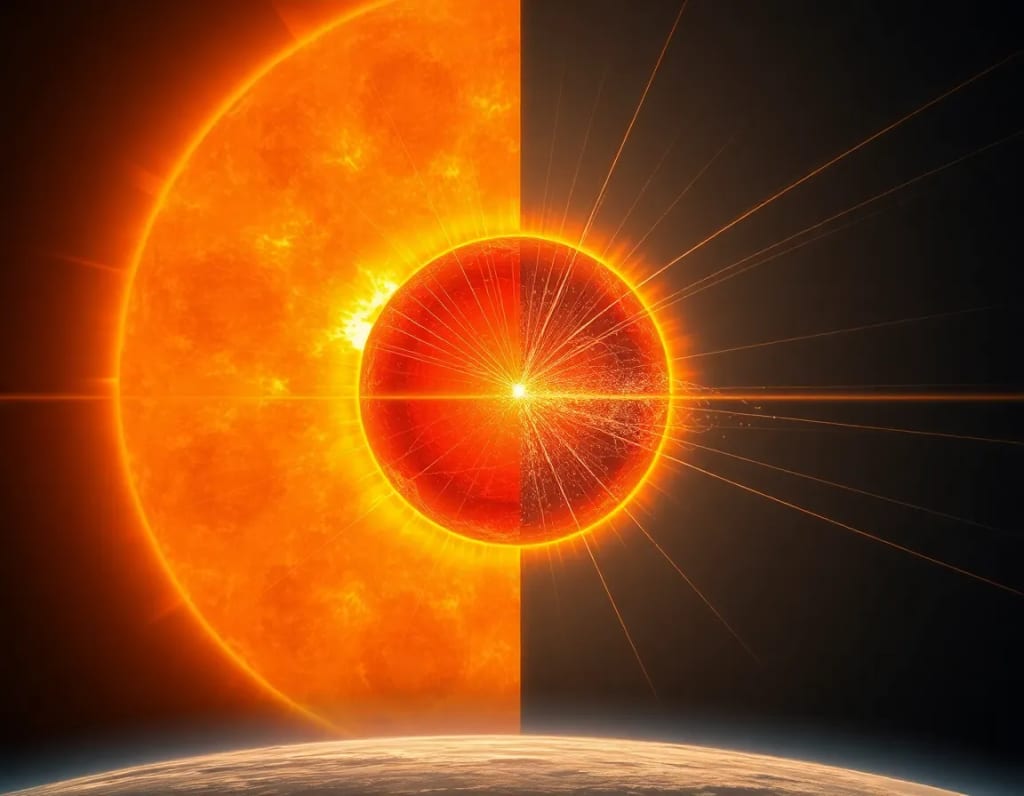
Every morning, when sunlight streams through your window, it feels instant and effortless. The room brightens, shadows retreat, and a new day begins. But behind that familiar beam of light lies one of the most extraordinary journeys in the universe a journey that takes tens of thousands, sometimes even millions of years to complete.
Let’s follow the path of a single photon a tiny particle of light from its birth deep inside the Sun to the moment it gently touches your face. What seems like a fleeting blink is, in reality, a cosmic odyssey filled with extreme conditions, random wanderings, and a final triumphant sprint across the vastness of space.
Born in Fire: The Photon Awakens
The story begins at the very core of the Sun a blisteringly hot and unimaginably dense environment where temperatures soar above 15 million degrees Celsius. Here, hydrogen atoms are packed so tightly that they fuse into helium, releasing colossal amounts of energy in the process. Among the byproducts of this nuclear fusion is our hero: a newborn photon.
But don’t picture the golden sunlight you're used to just yet. At this stage, the photon is a gamma ray an extremely high-energy form of light, invisible and potentially deadly. It now faces its first challenge: escaping the suffocating interior of the Sun.
The Radiative Zone: A Slow-Motion Maze
Surrounding the Sun’s core is the radiative zone a vast layer of superheated plasma. For our photon, this is not a free ride. In fact, it’s a maddeningly slow and chaotic crawl.
The photon can’t travel straight out. Instead, it constantly collides with electrons and atoms, being absorbed and re-emitted in random directions. Each step it takes is less than a millimeter long. It’s like trying to exit a crowd of billions where everyone keeps bumping into you and spinning you around.
This process, called radiative diffusion, is painfully inefficient. It takes the photon anywhere from 10,000 to 1 million years just to make it through this zone. Yes, you read that right the sunlight warming your skin today may have started its journey back when mammoths still roamed the Earth.
The Convective Zone: Riding the Currents
After eons of being jostled in the radiative zone, the photon finally reaches the convective zone, the outer layer of the Sun's interior. Things are different here. The plasma is less dense, and instead of bouncing around like a pinball, energy is now transported by massive, boiling currents of hot gas.
These convection currents work like giant elevators, lifting pockets of hot plasma and the energy within them toward the surface. The photon is swept along for the ride, rapidly accelerating toward its escape.
Breaking Free: Into the Cosmos
At last, the photon reaches the photosphere, the Sun’s visible “surface.” From here, it finally escapes into space, free from the dense, turbulent interior.
No more detours. No more collisions. Now it can travel in a straight line at the universal speed limit: 299,792 kilometers per second. Its destination? Earth.
This final leg of the journey is surprisingly fast just 8 minutes and 20 seconds. After traveling 150 million kilometers, the photon arrives… and lands on your windowsill.
Earthfall: The Final Steps
As the photon enters Earth's atmosphere, it meets new challenges. Molecules of air scatter it especially the blue wavelengths which is why our skies appear blue during the day. At sunset, the photon’s path is longer, scattering away blue light and leaving only warm reds and oranges.
If the sky is clear, your photon may pass through the glass and land on your skin, reflect off a book, or dance on your wall. Its journey is over. What began as a burst of energy in the fiery heart of a star has become a warm, visible touch in your everyday life.
The Light’s Legacy
The next time you pull back the curtains and sunlight pours in, pause and imagine the story it brings with it. That light is ancient. It’s not just illumination it’s history. It has endured nuclear fusion, the chaos of stellar interiors, the silence of space, and the complexity of Earth's atmosphere.
A photon is not just a particle. It’s a traveler, a survivor, a messenger from the stars. Each beam of sunlight carries the memory of the Sun’s core, the story of energy transformed and released, and the proof that the universe connects to us in the most subtle, radiant ways.
In every sunbeam lies a cosmic tale — and now, you know how to read it.
About the Creator
Keep reading
More stories from Holianyk Ihor and writers in Futurism and other communities.
Why Your Shadow on the Moon Will Be the Strangest One of Your Life
Imagine standing on the Moon’s dusty, gray surface, suited up in your bulky spacesuit, surrounded by absolute silence. Above you, a pitch-black sky stretches out endlessly. The Sun blazes down, not through a blue sky, but in raw, direct brilliance. You take a step and suddenly notice your shadow. But it’s… bizarre. Unlike anything you’ve ever seen on Earth.
By Holianyk Ihor6 months ago in Futurism
About Binding Prometheus
I want to start actively advocating on behalf of my own work, and the most valuable part of my canon is, without a doubt, Binding Prometheus, the play I have been working on since 2019 and only finished in 2023 as part of my MA. The play itself is an amalgamation of a million different inspirations. On one end, it evokes the Ancient Greek myth-play, deriving its own title from the earliest extant work of Western drama we have, Aeschylus’s Prometheus Bound. On the other end, it borrows significantly from the sci-fi bulwarks from over the years, namely Mary Shelley’s Frankenstein and Karel Capek’s Rossum’s Universal Robots. The play could be an episode of Black Mirror, I fear. I don’t know. I’ve only ever seen one episode of Black Mirror.
By Steven Christopher McKnight19 days ago in Futurism
Flexible Packaging Market Size and Forecast 2024–2033
Introduction The global packaging industry is undergoing a fundamental transformation as businesses, regulators, and consumers demand lighter, more sustainable, and more functional solutions. At the heart of this transformation lies flexible packaging—a category that has moved far beyond its early reputation for basic plastic wraps and bags. Today, flexible packaging is synonymous with innovation, sustainability, branding potential, and operational efficiency across industries.
By Aaina Oberoi6 days ago in Futurism



Comments
There are no comments for this story
Be the first to respond and start the conversation.