
The Inscription of the South China Sea
What a Sunken Tablet Could Reveal About the Future of Maritime Power
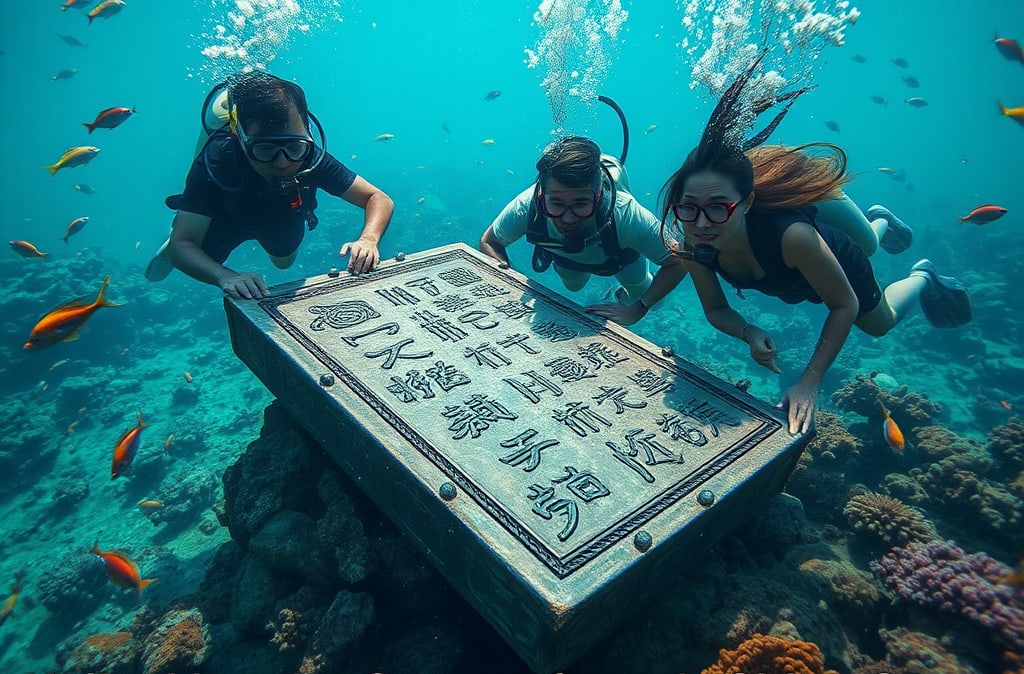
The Inscription of the South China Sea: What a Sunken Tablet Could Reveal About the Future of Maritime Power
Introduction:
The South China Sea: a vast, strategic waterway teeming with marine life, bustling shipping lanes, and simmering geopolitical tensions. For centuries, nations have coveted its resources and strategic importance, leading to a complex web of territorial disputes that continue to fuel conflict today. But what if the key to understanding the future of this volatile region lay not in the current political machinations, but in a relic of the past – a mysterious inscribed tablet discovered deep beneath the waves?
This is the question that drives Dr. Lin Mei, a brilliant but somewhat eccentric maritime archaeologist, whose life has been dedicated to unlocking the secrets hidden within the submerged history of the South China Sea.
The Discovery:
During a research expedition near the contested Spratly Islands, Dr. Lin's team stumbled upon an anomaly. Using advanced sonar technology, they identified a large, flat object resting on the seabed at an unprecedented depth. What they initially believed to be a natural geological formation turned out to be anything but. After months of meticulous planning and a daring deep-sea dive, they recovered a large, rectangular tablet composed of an unknown metallic alloy.
The tablet's surface was covered in intricate carvings, a script unlike anything Dr. Lin had ever seen. It was neither Chinese, Vietnamese, Malaysian, nor Filipino – the languages of the nations bordering the South China Sea. The script was older, far older, dating back potentially thousands of years.
The Enigma of the Script:
Dr. Lin's discovery sent ripples of excitement through the archaeological community. The inscription on the tablet, which she dubbed "The Inscription of the South China Sea," presented a tantalizing puzzle. What language was it written in? What civilization had created it? And, most importantly, what message did it convey?
The race to decipher the script was on. Linguists, historians, and cryptographers from around the globe joined the effort, pouring over digital scans of the tablet in search of clues. Theories abounded. Some speculated that it was the work of a lost seafaring civilization, a precursor to the maritime empires that would later dominate the region. Others suggested a more outlandish origin, pointing to the possibility of an extraterrestrial influence.
The Hidden Message:
After months of painstaking work, Dr. Lin's team finally achieved a breakthrough. They discovered that the script was a complex form of ideographic writing, where symbols represented not just words but entire concepts. The inscription, when translated, revealed a stunning narrative.
It told the story of a powerful, advanced civilization that had once thrived in the South China Sea millennia ago. These people possessed advanced technology and a deep understanding of the natural world. However, they were ultimately undone by their own ambition and their relentless pursuit of resources. The inscription served as a warning, a cautionary tale about the dangers of unchecked exploitation and the potential for self-destruction.
The Geopolitical Implications:
The discovery of the inscription had profound implications for the geopolitical landscape of the South China Sea. If the tablet's account was accurate, it suggested that the region had a long and complex history that predated the current territorial claims of any nation. It challenged the established narratives and raised uncomfortable questions about the legitimacy of existing power structures.
Dr. Lin knew that her discovery could potentially defuse the tensions in the region, encouraging cooperation and shared stewardship of the sea. But she also knew that it could be exploited by those seeking to further their own agendas, igniting new conflicts and fueling existing disputes.
The Dilemma:
Dr. Lin now faces a crucial decision: How to share her discovery with the world? Should she publish her findings immediately, risking potential exploitation and misinterpretation? Or should she work with international organizations to ensure that the inscription is understood and used responsibly?
The Inscription of the South China Sea is more than just an archaeological artifact; it's a mirror reflecting humanity's past, present, and potential future. The story that is shared will shape that future.
Conclusion:
As Dr. Lin prepares to unveil her findings to the world, she is acutely aware of the weight of her responsibility. The Inscription of the South China Sea holds the potential to either unite or divide, to inspire cooperation or incite conflict. The fate of this volatile region, and perhaps even the world, may depend on how its message is understood. What comes next could change the course of history.
About the Creator
About Binding Prometheus
I want to start actively advocating on behalf of my own work, and the most valuable part of my canon is, without a doubt, Binding Prometheus, the play I have been working on since 2019 and only finished in 2023 as part of my MA. The play itself is an amalgamation of a million different inspirations. On one end, it evokes the Ancient Greek myth-play, deriving its own title from the earliest extant work of Western drama we have, Aeschylus’s Prometheus Bound. On the other end, it borrows significantly from the sci-fi bulwarks from over the years, namely Mary Shelley’s Frankenstein and Karel Capek’s Rossum’s Universal Robots. The play could be an episode of Black Mirror, I fear. I don’t know. I’ve only ever seen one episode of Black Mirror.
By Steven Christopher McKnight19 days ago in Futurism
How to Succeed at the Benson Directory®
Congratulations and welcome to the Benson Directory® employee #22391! As our newest call handler, you will have the privilege of speaking with dozens of unique and interesting people on a daily basis as well as the opportunity to earn bonuses for high performance. Contained within this handbook you will find a set of ease to follow instructions designed to help you settle in to your new role and begin paving the way to success.
By S. A. Crawford3 days ago in Fiction




Comments
There are no comments for this story
Be the first to respond and start the conversation.