
The Inevitable Satellite War
Shadows in the Sky: Predicting the Inevitable Satellite War
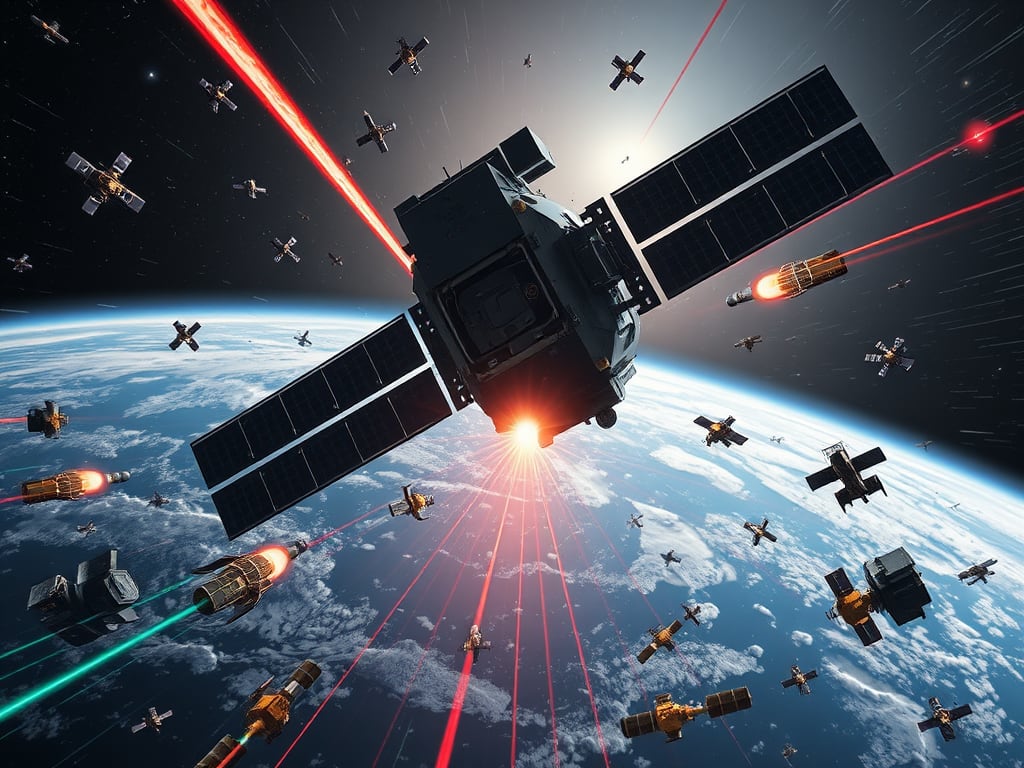
Shadows in the Sky: Predicting the Inevitable Satellite War
Introduction:
For decades, space has been regarded as the ultimate high ground, a domain for scientific exploration and peaceful communication. However, with increasing reliance on satellites for everything from GPS navigation and global communications to military intelligence and financial transactions, space is rapidly becoming a contested arena. The potential for a "satellite war" – a conflict in which nations target and disable each other's satellites – is no longer a far-fetched science fiction scenario, but a growing concern among military strategists and policymakers. This article explores the reasons why a satellite war is becoming increasingly likely, the potential forms it could take, and the devastating consequences it could have for life on Earth.
Our Dependence on the Heavens:
The modern world is utterly dependent on satellites. Consider just a few of the critical services they provide:
Communication: Satellites facilitate global telephone calls, internet access, and television broadcasts.
Navigation: GPS satellites provide precise location data for everything from civilian navigation to military operations.
Surveillance and Intelligence: Satellites provide critical intelligence on military activities, troop movements, and weapons development.
Weather Forecasting: Satellites monitor weather patterns and provide data for accurate weather forecasts.
Financial Transactions: Satellites enable secure financial transactions and power automated teller machines (ATMs).
Disaster Relief: Satellites play a crucial role in disaster relief efforts, providing communication links and mapping affected areas.
Disrupting or disabling these services would have devastating consequences for economies, militaries, and civilian populations around the world.
Why a Satellite War is Increasingly Likely:
Several factors are contributing to the growing risk of a satellite war:
Increased Reliance on Satellites: As our dependence on satellites grows, the incentives to disrupt or deny access to them also increase.
Proliferation of Anti-Satellite (ASAT) Weapons: Several countries are developing and testing anti-satellite weapons, including missiles, lasers, and electronic jamming systems. These weapons could be used to disable or destroy satellites in orbit.
Blurring Lines Between Civilian and Military Satellites: Many satellites provide services to both civilian and military users, making them potential targets in a conflict.
Lack of Clear International Norms and Rules: There are currently no binding international agreements that prohibit the development or use of ASAT weapons. This lack of clear rules creates a permissive environment for irresponsible behavior in space.
Escalation Dynamics: A conflict in space could quickly escalate out of control, leading to a wider war on Earth.
Potential Forms of a Satellite War:
A satellite war could take several forms, ranging from limited attacks to a full-scale conflict:
Electronic Jamming: Disrupting satellite communications through electronic jamming.
Cyberattacks: Hacking into satellite systems to disrupt their operation or take control.
Kinetic ASAT Weapons: Using missiles or other projectiles to destroy satellites in orbit. This is the most destructive type of ASAT weapon, as it creates space debris that can threaten other satellites.
Directed-Energy Weapons: Using lasers or high-powered microwave weapons to disable or damage satellites.
Co-orbital ASAT Weapons: Deploying "killer satellites" that can maneuver close to target satellites and disable or destroy them.
Consequences of a Satellite War: A World Disconnected:
The consequences of a satellite war would be catastrophic:
Disrupted Communications: Loss of satellite communications would cripple global telecommunications networks, disrupting internet access, telephone service, and television broadcasts.
Navigation Failures: Loss of GPS navigation would affect everything from air travel and shipping to emergency services and precision agriculture.
Military Blindness: Loss of satellite intelligence would cripple military operations, making it difficult to track enemy movements and assess threats.
Economic Collapse: Disruption to financial transactions and supply chains would lead to widespread economic disruption and potentially a global recession.
Space Debris Crisis: The destruction of satellites would create a vast amount of space debris, making it difficult and dangerous to operate satellites in orbit for decades to come. This is known as the Kessler Syndrome.
Humanitarian Crisis: The loss of essential services, such as communication, navigation, and weather forecasting, would lead to widespread suffering and potentially a humanitarian crisis.
Preventing a Satellite War: A Path to Peaceful Coexistence in Space:
Preventing a satellite war requires a concerted effort by all nations to:
Establish Clear International Norms and Rules: Develop binding international agreements that prohibit the development or use of ASAT weapons.
Promote Transparency and Confidence-Building Measures: Share information about satellite activities and military capabilities in space to reduce the risk of misunderstandings and miscalculations.
Invest in Defensive Measures: Develop technologies to protect satellites from attack, such as improved cybersecurity and maneuverability.
Promote Space Situational Awareness: Improve our ability to track and monitor objects in space to detect potential threats.
Encourage Diplomatic Dialogue: Engage in diplomatic dialogue to address the underlying tensions that are driving the arms race in space.
Conclusion:
The potential for a satellite war is a serious and growing threat to global security and prosperity. While the risks are significant, it is not too late to prevent such a conflict. By working together to establish clear rules, promote transparency, invest in defensive measures, and engage in diplomatic dialogue, we can ensure that space remains a domain for peaceful exploration and collaboration, not a battleground for global conflict. The future of our interconnected world depends on it.
About the Creator
Why I'm Scared of AI — And I Work in Tech
Let me say something that doesn't get said enough in tech circles: I am genuinely scared of where AI is heading. I don't mean this in a dramatic, Hollywood-robot-apocalypse sense. This is not a dramatic, Hollywood-robot-apocalypse kind of fear, but rather a quiet, 3 am, staring-at-the-ceiling kind of fear.
By Bethel Nwabuikeabout 22 hours ago in Futurism
The Piggy Project
I’ve had so many names in this life I lose track of which ones were ever really mine and which ones I wore because someone needed me to. Some were handed to me before I had words to refuse them, before I knew what they meant, before I knew I could say no. Most weren’t meant to hurt. That doesn’t mean they didn’t leave marks. Marks that told me who I belong to, who I am by way of who claims me, recognizes me in the good and bad, who walks beside me.
By Fatal Serendipity6 days ago in Confessions




Comments
There are no comments for this story
Be the first to respond and start the conversation.