
The Impact of Artificial Intelligence on Modern Healthcare: Revolutionizing the Future.
Harnessing the Power of AI to Transform Healthcare Delivery and Patient Outcomes.
Introduction:
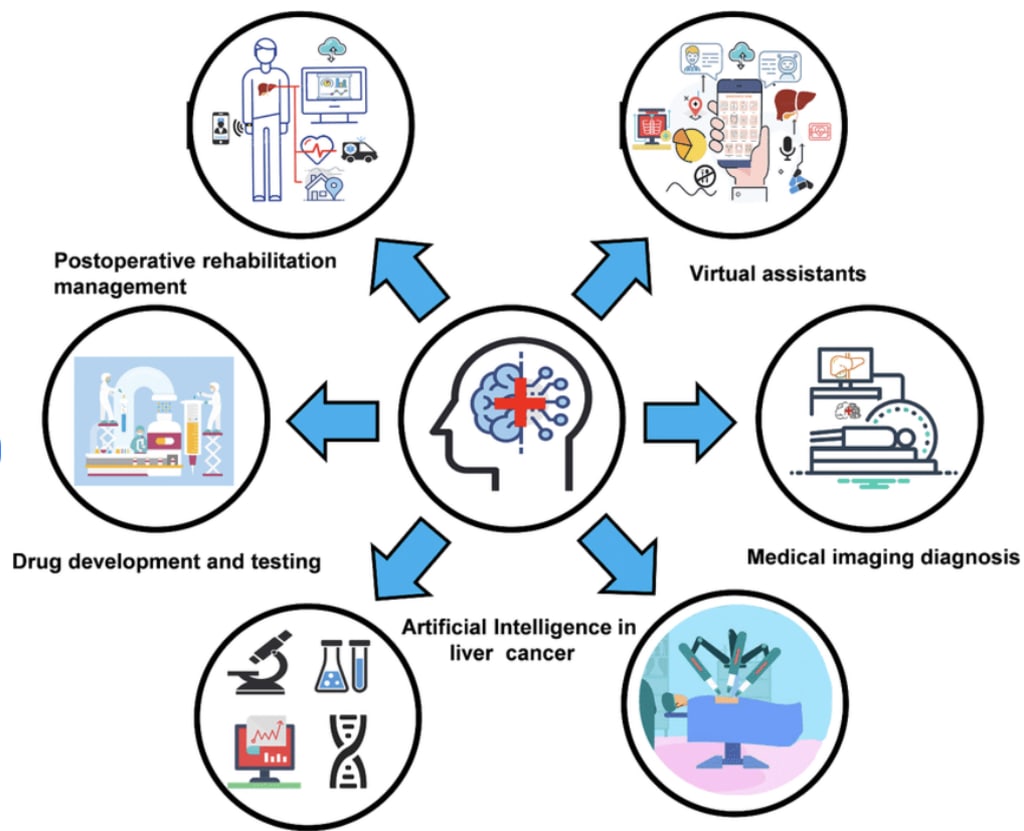
In recent years, the field of healthcare has witnessed a remarkable transformation, largely due to the integration of Artificial Intelligence (AI) technologies. From diagnosis and treatment to patient monitoring and personalized care, AI has revolutionized the way healthcare services are delivered. With its ability to process vast amounts of data, identify patterns, and make accurate predictions, AI has emerged as a powerful tool in the hands of healthcare professionals. In this article, we explore the profound impact of AI on modern healthcare, examining its applications, benefits, and potential challenges.
AI-Assisted Diagnosis and Treatment:
One of the most significant contributions of AI in healthcare lies in its ability to assist in accurate and timely diagnosis. Machine Learning algorithms can analyze patient data, including medical records, test results, and imaging scans, to detect patterns and anomalies that might be missed by human physicians. By harnessing this capability, AI-powered diagnostic systems can provide faster and more precise diagnoses, leading to early intervention and improved patient outcomes.
Predictive Analytics and Early Detection:
AI algorithms excel at predicting future events based on historical data. In healthcare, this ability is leveraged for early detection of diseases and potential complications. By analyzing a patient's medical history, lifestyle factors, and genetic predispositions, AI systems can identify individuals at a higher risk of developing specific conditions. This allows healthcare providers to intervene proactively, providing personalized interventions and preventive measures to mitigate the risks.
Personalized Medicine and Treatment Planning:
AI's data processing capabilities enable the development of personalized treatment plans for patients. By analyzing large datasets, including genetic information and clinical trial results, AI algorithms can identify the most effective treatment options for individuals. This enables healthcare professionals to tailor therapies based on a patient's unique characteristics, optimizing outcomes and minimizing adverse effects. Moreover, AI-driven systems can continually learn and adapt from real-time patient data, refining treatment strategies for improved efficacy.
Remote Patient Monitoring:
AI-powered technologies have paved the way for remote patient monitoring, transforming the delivery of healthcare services. Wearable devices and sensors can continuously collect patient data, including vital signs, activity levels, and sleep patterns. AI algorithms can then analyze this data in real-time, flagging any deviations or warning signs. Healthcare providers can remotely monitor patients and intervene promptly when necessary, reducing hospital readmissions and enabling more efficient resource allocation.
Surgical Assistance and Robotics:
The integration of AI and robotics has revolutionized the field of surgery. Robotic surgical systems equipped with AI algorithms provide surgeons with enhanced precision, control, and visualization during complex procedures. AI can assist in image-guided surgeries, allowing for more accurate tumor resections and reducing the risk of complications. Additionally, AI-powered robots can perform repetitive tasks with high precision, freeing up healthcare professionals to focus on more complex aspects of patient care.
Challenges and Considerations:
While the potential of AI in healthcare is vast, several challenges and considerations need to be addressed. Ensuring data privacy and security is paramount, as AI systems rely on large amounts of sensitive patient information. Moreover, the ethical implications of using AI in healthcare, such as decision-making biases and accountability, must be carefully navigated. Collaborative efforts between healthcare professionals, policymakers, and technology experts are essential to develop robust frameworks that govern the responsible and ethical use of AI in healthcare.
Conclusion:
Artificial Intelligence has ushered in a new era of possibilities in healthcare, offering immense potential to improve patient care, enhance clinical decision-making, and streamline healthcare operations. From AI-assisted diagnosis and treatment to personalized medicine and remote patient monitoring, AI has transformed the way healthcare services are delivered. However, it is crucial to approach the integration of AI in healthcare with caution, addressing ethical concerns and ensuring patient privacy. By harnessing the power of AI responsibly, the future of healthcare holds tremendous promise, ultimately leading to better health outcomes for individuals worldwide.
About the Creator
Keep reading
More stories from writers in Futurism and other communities.
About Binding Prometheus
I want to start actively advocating on behalf of my own work, and the most valuable part of my canon is, without a doubt, Binding Prometheus, the play I have been working on since 2019 and only finished in 2023 as part of my MA. The play itself is an amalgamation of a million different inspirations. On one end, it evokes the Ancient Greek myth-play, deriving its own title from the earliest extant work of Western drama we have, Aeschylus’s Prometheus Bound. On the other end, it borrows significantly from the sci-fi bulwarks from over the years, namely Mary Shelley’s Frankenstein and Karel Capek’s Rossum’s Universal Robots. The play could be an episode of Black Mirror, I fear. I don’t know. I’ve only ever seen one episode of Black Mirror.
By Steven Christopher McKnight24 days ago in Futurism
Saudi Arabia Hair Transplant Market Analysis: Key Players and Market Forecast
According to IMARC Group's latest research publication, Saudi Arabia hair transplant market size reached USD 71.56 Million in 2024. The market is projected to reach USD 432.56 Million by 2033, exhibiting a growth rate of 22.13% during 2025-2033.
By Abhay Rajput4 days ago in Futurism
🅼🅸🅳🅽🅸🅶🅷🆃 🆂🅽🅰🅲🅺🆂
"It's 10 in Tuscon! We all know what that means... It's Time for Midnight Snacks with your man, Gerald Gee! Ready to spend the night together? Me too! I'm full of snacks and can't wait to regurgitate them all back into your hungry ears. Crack a brew! Pop some corn! Anything to get ready for one hell of a show where the talk maybe cheap but the words cut deep...
By Lamar Wiggins2 days ago in Fiction
Thoughts on Vocal and the way the world is
"Death cannot stop true love, only delay it." – Wesley in The Princess Bride. I decided to come back to Vocal on a very cold and dark night at the end of December. I had been, and still am, convalescing from a horrible staph infection that had gone misdiagnosed for months. This, paired with the increasing challenges of being healthy, making the best choices for my co-parented child, being a wife, and being a director at a new job, was a lot to manage.
By Jazzy 6 days ago in Confessions



Comments
There are no comments for this story
Be the first to respond and start the conversation.