
The Horizon of Tomorrow: A Vision for Earth in 2050
A World Reimagined: Where Innovation, Nature, and Humanity Thrive Together

The Horizon of Tomorrow: A World in 2050
Year: 2050; Twenty-five years after the struggles that humanity had faced in dealing with climate change, political instability, and social unrest, the world had been transformed in ways considered impossible in previous years. It was only then that the human race finally managed to break through one of the doors to survival while exploring innovation, new contacts, and what was thought to be possible and merely taken for granted as mere potentialities in former times. Hope spread like a wave over the world through technological breakthroughs and an acknowledgment of the fact that survival was no longer going to be enough; humanity needed to thrive.
Among these great thinkers was Maya, an environmental architect and one of the visionaries in a global initiative known as the Rebirth Project, under which lost ecosystems of the Earth were being restored and sustainable cities were being engineered. Maya grew up in a world where oceans had risen, parts of the Earth ravaged with natural disasters, and climate refugees became a harsh reality. But in 2050, the cities she had a hand in designing were not in any way unlike any other city that had ever existed on Earth at any time before. They were living cities where nature and technology went along together in total harmony. Here, the line drawn between urban development and nature began to dissolve, and those cities had become their own ecosystems—growing, dynamic, and suitable for living.
Maya's interest in the field of urban design came from personal history. Born in an old city of a drowned coastal town rising at the end of the 2020s, she had lost what inspired her to rebuild everything lost all through life. This young woman believed that cities could heal from the ground up—places where human interaction with nature tried to recapture the lost balance. Her dream was to have cities she would build that would not hurt nature but help rejuvenate the planet.
By the end of the century, going into 2050, such a technological revolution had made her dream a reality. Biotechnology had advanced to the point where problems were galvanized and addressed. Solutions for renewable energy and AI came in nature—clean water, food, and shelter for all. No more steel and concrete, but biogenetically engineered buildings to photosynthesize, suck carbon, and emit oxygen. Those structures themselves became large air purifiers, filtering from the atmosphere all pollutants, thereby making the breathable clean air.
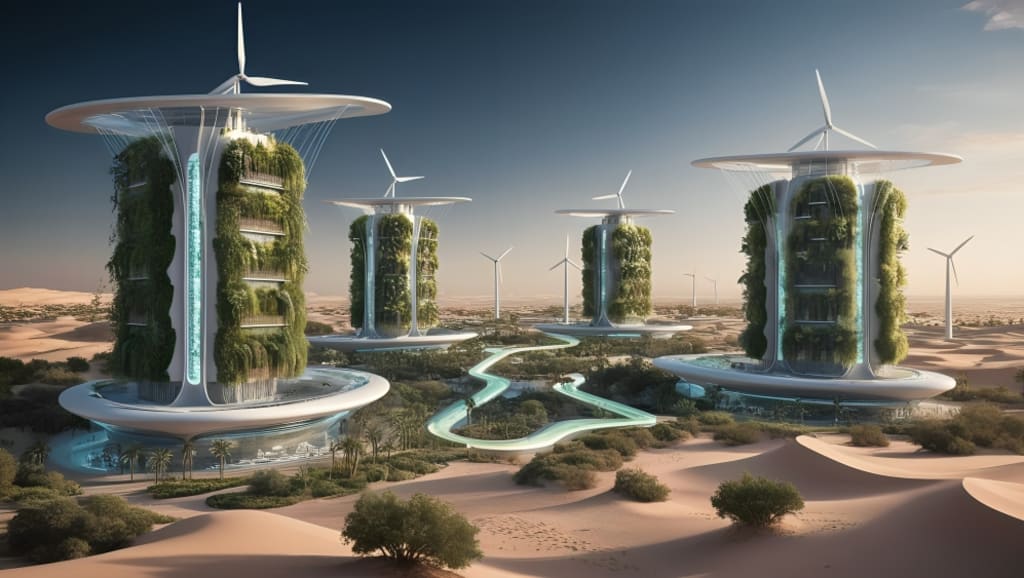
Vertical gardens on either side of every building helped hold temperature, cut down energy consumption, and be a source of food and shelter for the community.
Energy became no longer scarce. Cities themselves were now efficient entities; a breakthrough in new sources of solar panels, wind turbines, and geothermal power would mean that the demand for resources, water, or energy utilization would only be optimized through those means by super-advanced AI systems in real-time, so nothing should go to waste. Waste was turned into a source of value through advanced recycling technology and biodegradable materials of all sorts. Number of lands haven't seen a landfill once again because in a circular economy, everything has a purpose.
Maya had undertaken the biggest project up to date: the Global Oasis Initiative. The nub of its plan was to transform the dry deserts of the Middle East into friendly, prosperous habitable zones. The plan was through high-tech desalination using solar energy to draw fresh water from oceans. It shall be used to irrigate the farmlands, supply the populace with drinking water, and the whole setting. What Maya had envisioned and presented before the desert cities was more than what involved this infrastructure; it was also the path towards a sustainable, self-sustaining society supporting human life without spoiling the earth.
Maya, entering one of the construction sights of one of these new desert cities, could not but gaze in awe at how much is being done. Buildings sprouting with green walls contrasted the bare desert landscape. The buildings were shades, hence acting as natural coolers. In return, the desert had just begun cooling down because of people's human-manufactured artificial air conditioning systems. Every building was designed to consume less energy and had arrays of solar panels put across rooftops, producing surplus power that couldn't be consumed by the city, so it fed back into the grid.
May walks down some of the facility when she encounters one of her mentors, Professor Tariq, one of the highest scientists who had spent decades developing crops that would not only work during a drought but succeeded in their implementation. Here is Tariq standing with just a small area of land where newly planted trees are just erupting out of the desert soil. "Maya, I just got the most incredible news,he says, his face lighting up. "We sowed the first climate-change-responsive trees ever in the Sahara. And, lo and behold, they thrive as though hell froze over, actually, in places we thought impossible."
Maya's chest swelled with pride. Here was a landmark: the trees had been designed to be drought-hardy and extremely heat-resistant, making them ideally suited to sow new forests in the driest and most inhospitable lands on earth. But the impact would be many times more than the real trees. The genetically modified plants could sequester carbon at a rate many times greater than that achieved through ordinary trees. And that, too, would put a lid on the damage perpetrated by centuries of industrialization and deforestation.
"This is exactly the kind of innovation we need," Maya said, her voice full of awe. "This is how one heals the planet—by cooperating with nature rather than against it."
There sat Maya and Professor Tariq together as the first desert oasis began to take shape. Already, the once-alive-less area was beginning to bloom. It was alive—the fruit of what humanity could do if it brought itself together to work out a problem, not for its benefit but for the benefit of Earth itself. It was not a matter of rebuilding cities or rediscovering nature, but somehow a simple, only starting to live a new life—technology and nature living harmoniously side by side, with both in perfect balance.
Such a discussion brings out that they cannot but think of how far the world has traveled since it was at its worst time in the 2020s when, through climate change, the very existence of human civilization was threatened, and there seemed to be no way out for political divisions. Maybe the devastation had already threatened to bury human civilization due to natural disasters. Something had changed, though, by 2050. When the world was at war—total war—a decade or two before, the very concept of global cooperation wasn't the fanciful dream it had once been but a fact. They realized they weren't going to survive the next disaster; survival meant learning to live with Earth in a way that would leave behind a planet capable of supporting life for those behind them.
This thinking style was reflected in every level of life in the cities of 2050: one could no longer look at earth as something to consume and use but as a thing to protect and care for. Urban development is no longer compelled to take away all the costs but on sustainable development that respects the environment and nurtures well-being in the community. Public spaces are green and available to all, open to anyone and everyone. The old neighborhood days based on the level of wealth or social class are gone; cities were constructed so that each citizen can have full access to resources, education, and opportunity.
It was a shift in consciousness at the global level. Nations and borders were a thing of the past as people thought as one whole and called upon the human race to be part of a world community. All those united through technology could no longer turn their backs on each other's problems. Climate change, poverty, and inequality began being treated as inevitable interlocking problems with solutions sought that would find the problems within more holistic terms.
There was much hope while Maya stood amidst all this. This was a world that learned from its mistakes. This was a world wherein humanity had survived but truly thrived because they had grabbed onto the unlooked-for. Tomorrow wasn't something to be feared in 2050; it was something to be created. A future of innovation: its technology stretching out toward new senses; a future in which one finds pain in the most unlikely places, and humanity finally realizes that progress is not found in dominating or exploiting the planet but in cooperating with it, maintaining it, and in respect for it.
She had lived for this moment all her life and stands there, looking at a desert that was slowly taking on the visage of a lush oasis, realizing that this was far from over; it was the first time that she thought mankind was to become the armed tools that it needed in order to work its way around an even better world, one capable of living in and, actually, thriving in. It was a world that made impossibility not a dream but a fact. Tomorrow's horizon held no easy planet to live on. It was home and had to be loved, protected, and cared for. And now, finally, humanity was ready to do its part.
About the Creator
Keep reading
More stories from Imtiyaz Ali and writers in Futurism and other communities.
The Heart of the Holidays: Finding Magic in Joy, Memories, and Winter’s Quiet Moments
Take Joy, Connection, and Calm in Winter's Glow from Holiday Time Holiday time is that season of joy and nostalgia and reflection in the final throes of the year. For most, it is a time of the year when all the steps of the neighborhood light up, families sit across tables full of food, and laughter abounds in rooms full of all styles of festive cheer. But under all that partying, it all tries to be a chance to reconnect and reflect, savoring small pockets of peace. Okay, well, let's dive into the heart of the season and how to do it all in big and little ways.
By Imtiyaz Aliabout a year ago in Poets
About Binding Prometheus
I want to start actively advocating on behalf of my own work, and the most valuable part of my canon is, without a doubt, Binding Prometheus, the play I have been working on since 2019 and only finished in 2023 as part of my MA. The play itself is an amalgamation of a million different inspirations. On one end, it evokes the Ancient Greek myth-play, deriving its own title from the earliest extant work of Western drama we have, Aeschylus’s Prometheus Bound. On the other end, it borrows significantly from the sci-fi bulwarks from over the years, namely Mary Shelley’s Frankenstein and Karel Capek’s Rossum’s Universal Robots. The play could be an episode of Black Mirror, I fear. I don’t know. I’ve only ever seen one episode of Black Mirror.
By Steven Christopher McKnight17 days ago in Futurism
Saudi Arabia Packaging Market: FMCG Demand, Lightweight Solutions, Innovation Drive & Vision 2030
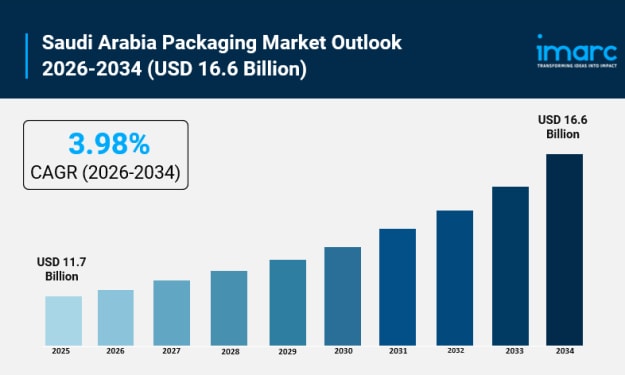
According to IMARC Group's latest research publication, Saudi Arabia packaging market size reached USD 11.7 Billion in 2025. The market is projected to reach USD 16.6 Billion by 2034, exhibiting a growth rate of 3.98% during 2026-2034.
By Jeffrey Wilson6 days ago in Futurism



Comments
There are no comments for this story
Be the first to respond and start the conversation.