
The Hammer That Shouldn't Exist: Mysteries from a Forgotten Past
Geological analysis suggested that the rock itself was part of the Cretaceous strata, estimated to be over 100 million years old. The hammer's head was made of iron, far too pure to have been forged by any known ancient method.

Mysteries from a Forgotten Past
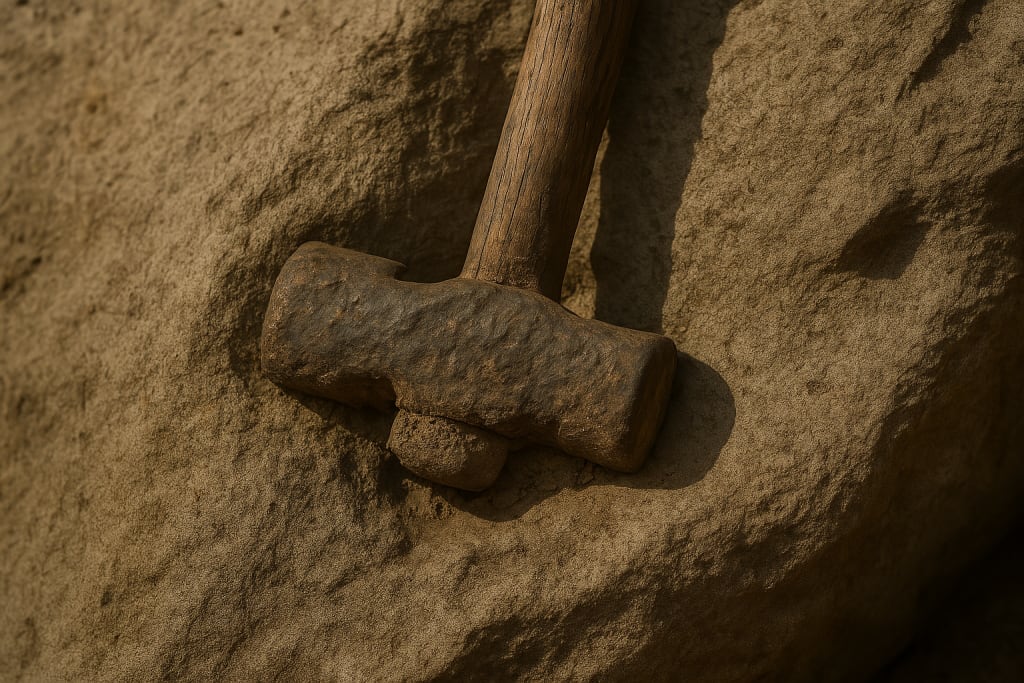
In the serene hills of East Texas during the early 1930s, a couple strolling along a creek stumbled upon a discovery that would spark one of the most awe-inspiring mysteries of our time. Encased in a solid lump of stone, partially concealed, was the head of an ancient hammer. At first glance, it seemed to be a forgotten miner's tool, frozen in time. However, as the stone was meticulously chipped away, the truth revealed itself. The rock surrounding the hammer appeared impossibly ancient, not just hundreds of years old, but possibly hundreds of millions of years old.
The hammer came to be known as the London Hammer, named after the nearby town of London, Texas. Geological analysis suggested that the rock itself was part of the Cretaceous strata, estimated to be over 100 million years old. The hammer's head was made of iron, far too pure to have been forged by any known ancient method. The wooden handle, now petrified and turning to coal, added to the mystery. How could a human-made object be older than humanity itself?
Over the years, scientists have debated whether the rock surrounding the hammer could have formed around it later through mineralization. Even this explanation raises questions, as the purity of the iron and the tight seal of the stone suggest something far more peculiar. The hammer seems to gaze back at us through time, challenging us to question what we know about our history.
The London Hammer is not an isolated case. Across the globe, scattered among the pages of dusty books and in the back rooms of obscure museums, are other equally enigmatic relics, objects, and stories that resist fitting into the neat narrative of human progress.
The Baghdad Battery: Forgotten Technology
In the National Museum of Iraq, a collection of small clay jars is housed, discovered near Baghdad in the 1930s. These simple vessels each contain a copper cylinder and an iron rod, sealed with bitumen. For decades, they gathered dust, assumed to be ceremonial or decorative. However, when German archaeologist Wilhelm König examined them closely, he made a startling suggestion: they might be ancient batteries.
Replicas of the so-called Baghdad Battery, when filled with vinegar or grape juice and connected with wires, produced a weak electrical current. While not enough to light a bulb, it was sufficient for electroplating metals or delivering a mild shock. The jars are dated to around 250 BC, over two thousand years before the invention of the modern battery.
Who constructed these devices, and for what purpose? Some scholars dismiss them as coincidences or claim they were for storing sacred scrolls. Others speculate that priests used these strange jars to awe worshipers with electric shocks or gold plating, or perhaps even to power some lost technology we can no longer comprehend. Like the hammer in Texas, the Baghdad Battery seems to peer out from the shadows of history as if to say: You've forgotten something.
The Mechanical Men of Ancient India
If the hammer and the battery hint at lost knowledge, the ancient Sanskrit texts of India speak of it directly. In the Samarangana Sutradhara, a treatise on architecture and technology written nearly a thousand years ago, we find astonishing descriptions of mechanical beings.
The text describes how skilled artisans could build humanoid automatons from wood and metal, capable of moving, guarding doors, performing tasks, and even engaging in combat. It speaks of chariots that could fly without horses and machines that could think and obey commands. Even earlier Vedic texts reference vimanas, flying ships, and divine weapons with incredible power.
Most modern readers dismiss these passages as mere allegories or poetic imagination. However, as more and more seemingly impossible artifacts come to light, such as hammers that predate humanity and batteries created before the discovery of electricity, these ancient verses begin to sound less like fantasy and more like historical memory. These accounts are echoes of a time when machines walked alongside humans, a time when people possessed knowledge and tools that are now lost to us.
Echoes of a Forgotten Age
Individually, each of these anomalies can be dismissed or explained away as flukes, misinterpretations, or oddities of nature. Yet, together they form a chorus, a quiet but persistent murmur suggesting that the story of humanity is far older and more mysterious than we realize.
The hammer buried in stone poses the question: Who forged it when no one was there to do so? The Baghdad Battery raises the question of who required power when no one should have known how to create it. The mechanical men of India prompt us to ask: Who built them when no human hands should have possessed the necessary skill?
What other relics lie hidden, waiting for us to uncover them? What other stories are buried in the rock and dust of the earth, whispering their secrets to those who dare to listen? Perhaps our history is not a straight line from ignorance to enlightenment, but rather a great circle in which knowledge is lost and then rediscovered, much like the turning of a wheel. We have risen before, only to fall, only to rise again.
The hammer still sits encased in its ancient stone, silent and patient. The battery remains in its jar, waiting to spark once more. And the verses of India continue to speak of iron men and flying ships. Together, they beckon us to dig deeper, to look beyond what we are told, and to remember that the past is not lost, it merely awaits our awakening.
About the Creator
The Secret History Of The World
I have spent the last twenty years studying and learning about ancient history, religion, and mythology. I have a huge interest in this field and the paranormal. I do run a YouTube channel
Keep reading
More stories from The Secret History Of The World and writers in Futurism and other communities.
Do Spirits Have Guardians? Climbing the Infinite Ladder of Consciousness
The Spiritual Realm An age-old belief, whispered across cultures and in ancient texts, is that an invisible presence watches over every human or animal. Some call it a guardian angel, others a spirit guide, and some refer to ancestral protectors or divine watchers. These presences are said to guide our footsteps, shield us from unseen harm, and gently whisper truths into our dreams when the world becomes heavy. This belief is deeply embedded in the human spirit. Even in moments of silence or despair, we often feel that someone, or something, is there, just beyond the veil.
By The Secret History Of The WorldExclusive • 7 months ago
About Binding Prometheus
I want to start actively advocating on behalf of my own work, and the most valuable part of my canon is, without a doubt, Binding Prometheus, the play I have been working on since 2019 and only finished in 2023 as part of my MA. The play itself is an amalgamation of a million different inspirations. On one end, it evokes the Ancient Greek myth-play, deriving its own title from the earliest extant work of Western drama we have, Aeschylus’s Prometheus Bound. On the other end, it borrows significantly from the sci-fi bulwarks from over the years, namely Mary Shelley’s Frankenstein and Karel Capek’s Rossum’s Universal Robots. The play could be an episode of Black Mirror, I fear. I don’t know. I’ve only ever seen one episode of Black Mirror.
By Steven Christopher McKnight16 days ago in Futurism
Wild Card Weekend Recap: What Happens Now?
I think I figured out why I love Wild Card Weekend so much. It's because it's the first playoff anything of the calendar year. The NFL season starts in the fall, and once upon a time, the champion was crowned either on or slightly before New Year's. The evolution of the NFL schedule has resulted in the playoffs starting just into the New Year, and currently, the final week of the season falls on the first weekend of the New Year, with Wild Card Weekend coming a week after that. So yes, chronologically, the NFL's Wild Card Weekend serves as the first playoff anything of the calendar year.
By Clyde E. Dawkins4 days ago in Unbalanced



Comments
There are no comments for this story
Be the first to respond and start the conversation.