
The Future of Robotics.
From Companion Robots to AI Assistant.

Introduction.
In recent years, the field of robotics has made significant strides, bringing us closer to a future where robots play a crucial role in our daily lives. From companion robots that provide emotional support to AI assistants that enhance our productivity, robotics is transforming the way we interact with technology. This article explores the exciting advancements in robotics, highlighting real-life examples and envisioning the possibilities of a robotic future. As robotics technology continues to evolve, it is essential to understand its potential applications, benefits, and the impact it will have on various industries and our society as a whole.
Companion Robots: A New Kind of Relationship.
Companion robots are designed to provide emotional support, companionship, and assistance to individuals. They are especially beneficial for the elderly, those with disabilities, or individuals who require extra care. For instance, Paro, a therapeutic robot designed to resemble a baby seal, has shown remarkable results in calming and engaging individuals with dementia. Another example is Pepper, a humanoid robot that can recognize and respond to human emotions, serving as a companion in homes, hospitals, and public spaces. These companion robots are not only useful in providing companionship but also in improving the overall well-being and quality of life for individuals in need.
Real-Life Example: Sophia the Robot.
Sophia the Robot, developed by Hanson Robotics, has gained international attention as one of the most advanced humanoid robots. With a human-like appearance and the ability to express emotions, Sophia has participated in numerous interviews, conferences, and even obtained citizenship in a country. Sophia represents the potential of robotics to bridge the gap between humans and machines, leading to intriguing discussions about the future of artificial intelligence and robotics in our society. Sophia's realistic facial expressions, conversational abilities, and interactions have sparked both curiosity and excitement, showcasing the progress made in creating lifelike and intelligent robots.
AI Assistants: Enhancing Productivity.
AI assistants, such as Siri, Alexa, and Google Assistant, have become integral parts of our daily lives, helping us manage tasks, answer questions, and control smart devices. These voice-activated assistants utilize artificial intelligence to understand and respond to human commands and queries. They have transformed the way we interact with technology, simplifying tasks and increasing efficiency. Whether it's setting reminders, playing music, or providing weather updates, AI assistants have become virtual companions that streamline our daily routines. As AI technology continues to advance, we can expect AI assistants to become even more intelligent and capable of understanding complex instructions, ultimately becoming indispensable tools for productivity and convenience.
Real-Life Example: Boston Dynamics' Spot Robot.
Boston Dynamics' Spot robot is an impressive example of robotic technology that showcases the potential for automation and efficiency in various industries. Spot is a quadruped robot designed to navigate challenging terrains and perform tasks that would otherwise be hazardous or time-consuming for humans. It has been employed in industries such as construction, inspection, and public safety, demonstrating its ability to carry out complex missions autonomously. Spot's agility, stability, and versatility highlight the potential for robotics to revolutionize industries, making them safer, more efficient, and cost-effective.
The Future of Robotics and Collaboration.
The future of robotics holds immense potential for collaboration between humans and machines. As robots become more intelligent and capable, they can work alongside humans in a wide range of industries, augmenting human abilities and increasing productivity. For instance, in the healthcare sector, robotic surgeons are assisting doctors in performing precise and minimally invasive procedures. In manufacturing, collaborative robots, or cobots, are working alongside human workers, handling repetitive or physically demanding tasks. The synergy between humans and robots creates opportunities for increased efficiency, improved safety, and new avenues for innovation.
Conclusion.
The future of robotics is both exciting and promising, with companion robots and AI assistants revolutionizing our daily lives. From providing emotional support to enhancing productivity, robotics is transforming industries and redefining human-machine interactions. As we continue to advance in robotics technology, it is crucial to consider the ethical implications and ensure that these technologies are developed and deployed responsibly. By embracing the possibilities of robotics, we can shape a future where humans and machines collaborate harmoniously, leading to a more efficient, productive, and innovative society.
About the Creator
Ogunwusi Adedapo Kolawole
In a world filled with endless possibilities, it is the brave souls who dare to dream and pursue their passions that leave an indelible mark on the tapestry of life. Meet: Ogunwusi Adedapo, a visionary, a dreamer, and an agent of change.
Keep reading
More stories from Ogunwusi Adedapo Kolawole and writers in Futurism and other communities.
Exploring the World of Biohacking:
Introduction. In the pursuit of pushing the limits of human potential, biohacking has emerged as a fascinating field. Biohacking involves leveraging science, technology, and lifestyle modifications to optimize human performance and well-being. From enhancing cognitive function to improving physical capabilities, biohackers are exploring innovative approaches to achieve peak performance. This article delves into the world of biohacking, exploring its principles, techniques, and real-life examples that highlight the potential to unlock the full potential of the human body and mind.
By Ogunwusi Adedapo Kolawole3 years ago in Futurism
GCC Fruit Juice Market Analysis: Key Drivers, Market Dynamics & Future Prospects
According to IMARC Group's latest research publication, GCC fruit juice market size reached USD 3.7 Billion in 2024. The market is projected to reach USD 5.6 Billion by 2033, exhibiting a growth rate (CAGR) of 4.8% during 2025-2033.
By Abhay Rajput7 days ago in Futurism
Alternative Fuels Market Insights: USD 688.2 Billion by 2034
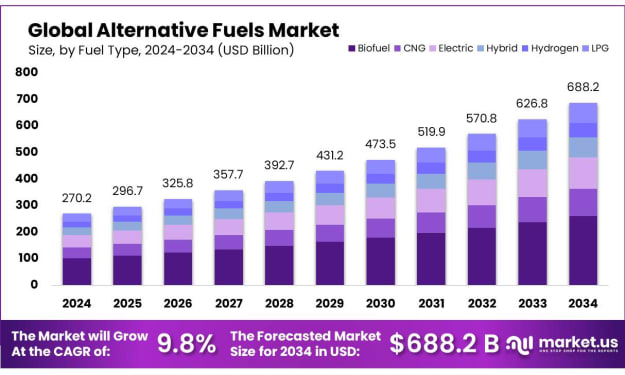
Overview The Global Alternative Fuels Market is on a strong growth trajectory, projected to expand from USD 270.2 billion in 2024 to USD 688.2 billion by 2034, representing a compound annual growth rate of 9.8% over the forecast period. North America currently leads the market, accounting for a 43.2% share of global revenue in 2024.
By Hayden Kulasabout 7 hours ago in Futurism



Comments
There are no comments for this story
Be the first to respond and start the conversation.