
THE FUTURE OF RECHARGEABLE BATTERIES
Take over from lithium batteries
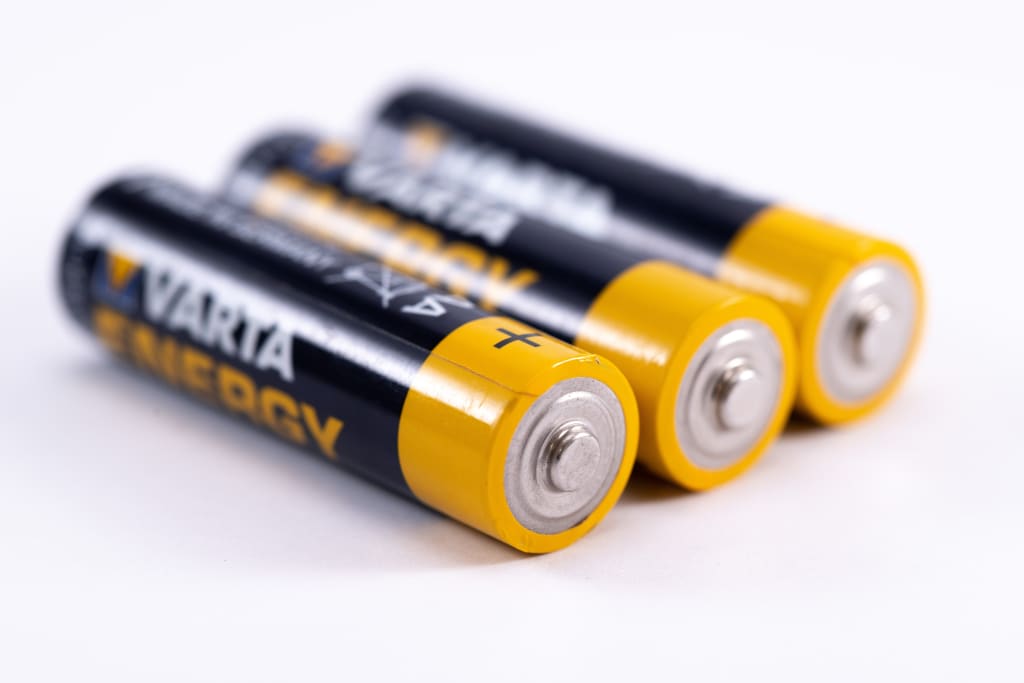
Companies and research labs are trying to create a battery that is more powerful, safer, charges faster, and lasts longer than the lithium ion battery. One company is even 3D printing batteries to change our perception of what a battery can look like. To understand how a battery works, we need a positive end (cathode), a negative end (anode), and an electrolyte to connect them. The electrolyte can be something like a potato.
The chemical reaction occurs between the potato and each end, where the anode releases electrons that flow through the wire back to the cathode, converting the chemical reaction into electricity. Unfortunately, the attempt did not yield any results. However, incorporating more potatoes should activate the light. These connections are challenging, but now let's proceed to illuminate the lights. This process forms the foundation of a chemical battery. The lithium-ion battery is a notable example of this, but there is still room for improvement.
Entrepreneurs are focusing on two critical design elements: the electrolyte and the anode. Most batteries available today, including lithium-ion batteries, use a liquid electrolyte containing lithium ions that facilitate the movement of charge. While liquid electrolytes are efficient conductors, they pose a significant fire risk, particularly when damaged or exposed to high temperatures. Incidents of this nature have received substantial media attention. Solid-state batteries, using stable and non-flammable solid materials, are a potential solution.
Startups are experimenting with electrolytes made from ceramics, glasses, and polymers, while others are looking for more powerful materials to use for the anode. Lithium metal has a higher capacity than other anodes like silicon or graphite, but it's hard to work with and tends to form dendrites that can short the battery. Using a solid material, however, could improve this issue. Sakuu, a California-based company, is designing solid-state batteries with lithium metal anodes and plans to 3D print them.
The company hopes that this manufacturing process will enable them to produce higher energy densities than other competitors using roll-to-roll manufacturing. Sakuu has printed solid-state batteries in their lab, but they have not yet fully printed a battery using their prototype. The company is doing tests and trying to figure out how to make the best battery using this manufacturing process.
How rechargeable batteries work
This is how it works: with the circuit turned off, both electrons and material A atoms are stuck in their high-energy, high-stress state, out of reach. On the other side of the electron barrier are material B atoms, which offer an easy, cushy, low-energy level position. When the circuit is turned on, electrons are given a path to happiness and begin flowing for the circuit to material B since they can't go any other way. Back at material A, the atoms are losing electrons because that's where the electrons are coming from, and they begin turning into positively charged ions. Ions always want to be neutral, so these guys need to find a negative charge, which they find in material B where all the electrons are going. Unfortunately, the electrons are way happier where they are now, so the ions have no choice but to mingle with the atoms of material B. This creates a mishmash with B atoms mingled with A ions as the battery discharges. Electrons and ions are making their way from A to B. When you can't fit any more material A ions into material B, the battery is fully discharged. To recharge the battery, you just do things in reverse. Instead of a circuit, you're putting energy that forces the electrons back into material A ions. Then, ions leave material B and rejoin their lost electrons, and the battery is ready to discharge again.
About the Creator
Keep reading
More stories from Grace Kashe and writers in Futurism and other communities.
Diamonds Diamonds Diamonds
Diamonds are not just for girls, they are also appreciated by male and female chemists, engineers, biologists, and construction workers. Diamonds have become a popular choice for wedding bands due to a successful marketing campaign by De Beers in the 1930s. Diamonds are made up of a lattice structure of simple carbon, which is a common element found on earth. The carbon atoms in diamonds are covalently bonded, making them incredibly strong and durable.
By Grace Kashe3 years ago in Futurism
About Binding Prometheus
I want to start actively advocating on behalf of my own work, and the most valuable part of my canon is, without a doubt, Binding Prometheus, the play I have been working on since 2019 and only finished in 2023 as part of my MA. The play itself is an amalgamation of a million different inspirations. On one end, it evokes the Ancient Greek myth-play, deriving its own title from the earliest extant work of Western drama we have, Aeschylus’s Prometheus Bound. On the other end, it borrows significantly from the sci-fi bulwarks from over the years, namely Mary Shelley’s Frankenstein and Karel Capek’s Rossum’s Universal Robots. The play could be an episode of Black Mirror, I fear. I don’t know. I’ve only ever seen one episode of Black Mirror.
By Steven Christopher McKnight23 days ago in Futurism
Hydrogen Generation Market: Blue, Green & Gray Hydrogen Pathways & Global Supply Dynamics
According to IMARC Group's latest research publication, global hydrogen generation market size reached USD 181.4 Billion in 2025. Looking forward, IMARC Group expects the market to reach USD 279.8 Billion by 2034, exhibiting a growth rate (CAGR) of 4.93% during 2026-2034.
By sujeet. imarcgroup5 days ago in Futurism



Comments (1)
"Wondering why robots can't click the 'I'm Not a Robot' box on websites? One reason could be related to the limitations of current technology, including the need for human-like interactions. Interestingly, this is somewhat similar to how lithium batteries are used in advanced technologies to enhance functionality. Explore the connection between tech advancements and how they impact user experiences online!" https://epro.pk/product/26650-lithium-battery-cell-3-7v-18-5wh-5000mah-hallroad/