
The Future of Medicine: How AI Is Revolutionizing Healthcare
From hospital halls to home apps, artificial intelligence is quietly saving lives—and it’s just getting started.


The Wake-Up Call
I never thought artificial intelligence would touch my life so personally—until it did.
It started on a normal Tuesday. My mom, a retired schoolteacher, called me with that tightness in her voice I knew too well. “I don’t feel right,” she said. “It’s probably nothing. Maybe low sugar.”
She didn’t want to go to the hospital. Didn't want to make a fuss. But I’d just downloaded a health app powered by AI, and out of sheer insistence (read: panic), I told her to try it. She answered a few questions, allowed it to sync with her wearable, and within seconds, it flashed an urgent message: Seek immediate medical attention.
We went to the ER. They found a blood clot in her lung—a pulmonary embolism, potentially fatal if left untreated. The doctors said we caught it just in time.
That AI app didn’t save her. The doctors did. But the app got us through the door.
And that changed everything I believed about medicine.

The Human + Machine Partnership
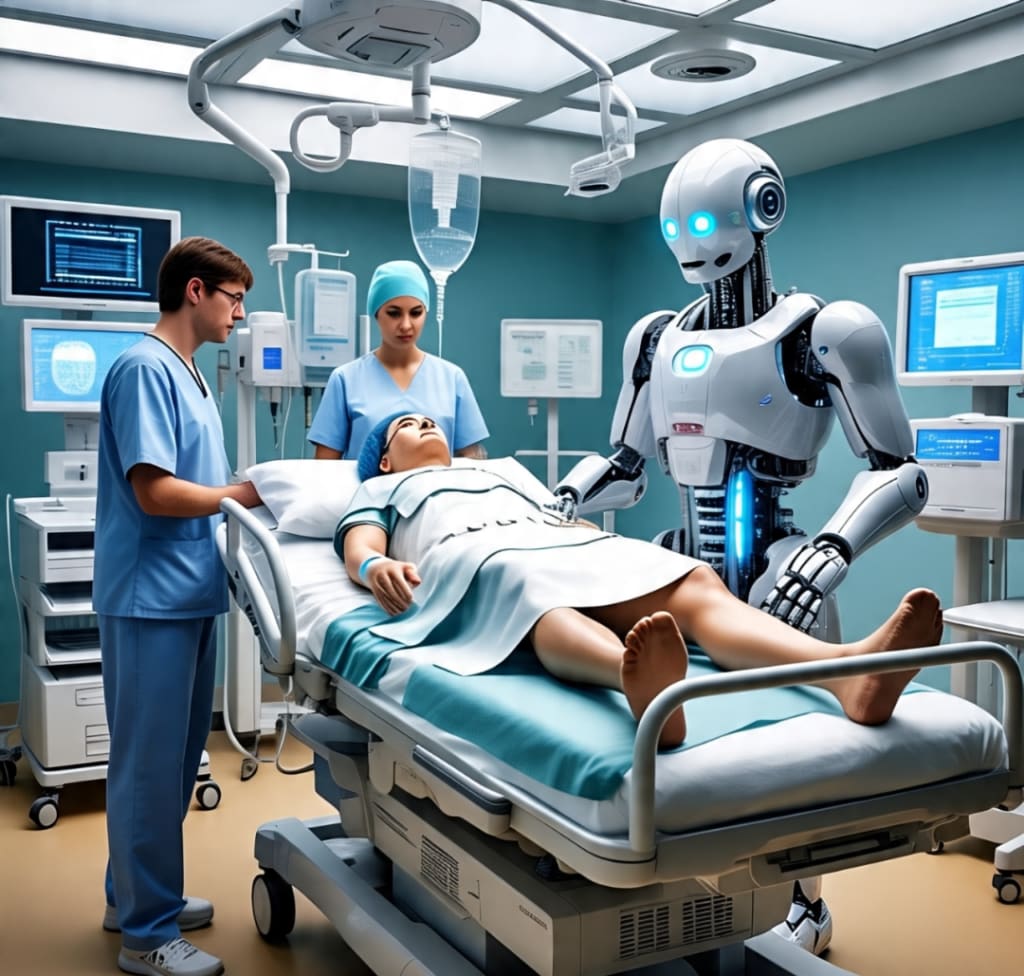
Let’s be clear: Artificial Intelligence isn’t replacing doctors. It’s amplifying them.
Think of AI as the ultimate assistant—never tired, always alert, able to sift through thousands of medical records, case studies, and test results in seconds. That kind of power isn’t about removing the human touch; it’s about giving doctors more time to do what humans do best: connect, care, and make judgment calls.
Imagine your doctor walking into the room with all your medical history, recent lab results, wearable data, and even your family genetics organized and analyzed. Now imagine them also having real-time insights based on what’s worked for millions of other patients like you. That’s not fantasy. That’s already happening in some hospitals around the world.
Take Mayo Clinic, for example. They’ve implemented AI tools to detect heart arrhythmias using just an EKG—a test that looks basic on the surface but holds hidden signals AI can now uncover. These are patterns so subtle, even trained cardiologists might miss them.
From Hospitals to Your Hand: AI in Daily Health
You don’t need to be in an ICU to benefit from AI. You might already be using it without realizing it.
Wearables, like smartwatches and fitness trackers, monitor your heart rate, sleep, and even blood oxygen levels. The AI inside them watches for abnormalities and learns your baseline.
Mental health apps like Woebot and Wysa use AI to provide cognitive behavioral therapy (CBT)-based chats. They’re not a replacement for therapists, but they can be the bridge someone needs before reaching a professional.
Medication reminders, nutrition tracking, and symptom checkers are using AI to personalize advice, flag dangerous drug interactions, or recommend lifestyle changes based on real trends.
And then there’s the growing world of telemedicine, where AI helps route patients to the right specialists, interpret basic test results, and even translate medical jargon into plain English.
Real Stories, Real Impact
A friend of mine, Josh, is a diabetic. He’s had a hard time managing his insulin levels for years. But he recently started using an AI-powered glucose monitor that predicts when his blood sugar might spike or crash based on everything from his activity to his meal patterns. It actually learns from him.
He told me, “It’s like having a diabetic genius living in my pocket, watching my back 24/7.”
Another story: my cousin Lisa had a rare skin condition that three different doctors misdiagnosed. It wasn’t until she uploaded a photo to an AI dermatology app that she got a match—confirmed by a dermatologist afterward. It wasn’t magic. The AI had scanned millions of images, compared them with her photo, and found a statistical match faster than a human could.
Challenges and Ethical Questions
Of course, it’s not all smooth sailing. With great power comes great responsibility—and AI is no exception.
Bias in algorithms is a real issue. If the data the AI learns from is mostly based on one group of people (say, white men), it might not perform as well for others (like Black women). That’s a problem.
Privacy is another concern. Our health data is incredibly personal. Who owns it? Who has access to it? How do we know it’s secure?
And then there’s the question of accountability. If an AI system makes a wrong prediction, who’s responsible? The developers? The doctors? The patients?
These are not just tech questions—they’re deeply human ones. And the answers will shape the future of medicine for generations.
But here's the thing: none of these challenges are reasons to stop. They’re reasons to proceed wisely. To push for transparency. To demand diversity in medical datasets. To advocate for strong privacy laws. AI isn’t good or bad—it’s a tool. It becomes what we make of it.
The Lesson: Empowerment, Not Replacement
When people talk about AI in healthcare, I often hear fear: “Will robots replace doctors?” But that’s the wrong question.
The better question is: How can AI help us become healthier, earlier?
Because here’s what AI really offers us: early detection, personalized care, and proactive health. It helps us catch diseases before they become dangerous. It helps overwhelmed doctors focus on patients, not paperwork. It helps families—like mine—act quickly when seconds matter.
It doesn’t replace human intelligence. It extends it. And when combined, human and artificial intelligence make a powerful team.

The Moral: The Future Is Closer Than We Think—And We All Have a Role
We live in a time where a phone app can detect a heart problem. Where a smartwatch can alert you to a silent stroke. Where AI can predict your risk for diabetes or depression based on patterns you can’t even see.
But technology alone isn’t enough.
We—patients, caregivers, developers, policymakers, doctors—have to embrace it thoughtfully. We have to use it not just to treat illness, but to build wellness. To make healthcare more equitable. More efficient. And more human.
Because in the end, the future of medicine isn’t just about machines.
It’s about people helping people—smarter, faster, and with more compassion than ever before.
If this article inspired you, remember this: The next time your smartwatch buzzes, or an app suggests a check-up, don’t ignore it.
It might just be the smartest move you’ll ever make.
About the Creator
Salman khan
Hello This is Salman Khan * " Writer of Words That Matter"
Bringing stories to life—one emotion, one idea, one truth at a time. Whether it's fiction, personal journeys.
Keep reading
More stories from Salman khan and writers in Futurism and other communities.
China Unleashes Mosquito-Shaped Drone Swarm: The Future of Surveillance?
The Quiet Whirring of Tomorrow It began with a sound so soft, most people wouldn’t notice it. Just a whisper in the air, like the wings of a mosquito. But these weren’t insects. They were machines. Tiny, nearly invisible to the naked eye. And unlike real mosquitoes, these didn’t bite—they watched.
By Salman khan7 months ago in Futurism
About Binding Prometheus
I want to start actively advocating on behalf of my own work, and the most valuable part of my canon is, without a doubt, Binding Prometheus, the play I have been working on since 2019 and only finished in 2023 as part of my MA. The play itself is an amalgamation of a million different inspirations. On one end, it evokes the Ancient Greek myth-play, deriving its own title from the earliest extant work of Western drama we have, Aeschylus’s Prometheus Bound. On the other end, it borrows significantly from the sci-fi bulwarks from over the years, namely Mary Shelley’s Frankenstein and Karel Capek’s Rossum’s Universal Robots. The play could be an episode of Black Mirror, I fear. I don’t know. I’ve only ever seen one episode of Black Mirror.
By Steven Christopher McKnight18 days ago in Futurism
Gaming Peripherals Market Size and Forecast 2025–2033
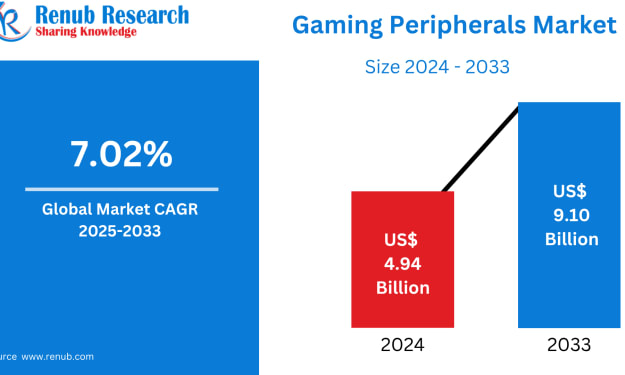
Gaming Peripherals Market: An Industry in Rapid Transformation The global gaming peripherals market is entering a decisive growth phase as gaming continues to evolve from a leisure activity into a mainstream form of digital entertainment and professional competition. According to Renub Research, the Gaming Peripherals Market is expected to grow from US$ 4.94 billion in 2024 to US$ 9.10 billion by 2033, registering a compound annual growth rate (CAGR) of 7.02% from 2025 to 2033. This expansion reflects not only the surging popularity of gaming worldwide but also the rising demand for high-performance devices such as gaming mice, mechanical keyboards, headsets, controllers, and other immersive accessories.
By Aaina Oberoi6 days ago in Futurism



Comments
There are no comments for this story
Be the first to respond and start the conversation.