
THE FUTURE OF JUPITER
Gateway to the Outer Solar System


For centuries, Jupiter has fascinated humanity. Its massive storms, swirling bands, and immense size have inspired both awe and mystery. It’s not just the largest planet in our solar system—it’s also one of the most influential. But what lies ahead for this gas giant? As space exploration accelerates, Jupiter is emerging as more than just an object of study; it’s becoming a gateway to the outer solar system, a possible hub for deep space missions, and a key to understanding planetary systems both near and far.
The Role Jupiter Plays Now
To understand Jupiter’s future, we have to look at its present role. At over 11 times the diameter of Earth and 318 times its mass, Jupiter dominates the solar system’s gravitational landscape outside of the Sun. Its presence helps protect inner planets—including Earth—by redirecting or capturing comets and asteroids. That “cosmic bouncer” effect is critical to the relatively stable environment we’ve enjoyed on our planet for millions of years.
Beyond its protective role, Jupiter acts as a kind of natural laboratory. With over 90 known moons—including ocean worlds like Europa and volcanic hotspots like Io—Jupiter offers a diverse set of environments to explore. Scientists believe some of these moons may harbor conditions suitable for life, particularly beneath Europa’s icy crust.
The Next Big Missions
NASA’s Europa Clipper, scheduled for launch in 2024 and arrival in the early 2030s, is one of the most anticipated missions focused on Jupiter. This spacecraft will orbit Jupiter and make dozens of close flybys of Europa to investigate the moon’s potential habitability. It will carry instruments to scan beneath the ice, measure surface composition, and analyze the magnetic environment.
Not far behind is the European Space Agency’s JUICE (JUpiter ICy moons Explorer) mission, which launched in 2023. JUICE will explore not just Europa, but also Ganymede and Callisto—two other icy moons with the potential for subsurface oceans. These missions may not land, but they will pave the way for more ambitious endeavors, including future landers or even submersibles designed to explore beneath Europa’s ice.
As these probes delve deeper into Jupiter's domain, the gas giant's moons might become stepping stones for deeper space exploration. Think of them as outposts or waypoints—testing grounds for technologies and life support systems that could eventually support human missions farther afield.
Human Missions and the Long View
Jupiter is far too hostile for human colonization. Its atmosphere is a toxic soup of hydrogen, helium, and traces of ammonia and methane, with crushing pressures and intense radiation. However, some of its moons might one day serve as temporary research stations or refueling hubs.
Ganymede, the largest moon in the solar system (even bigger than Mercury), has a magnetic field and evidence of a salty ocean beneath its surface. These characteristics make it a tantalizing candidate for further study and, perhaps one day, human visitation.
To support such missions, we’ll need new propulsion technologies—nuclear thermal engines, ion drives, or even fusion propulsion systems. These would cut travel times dramatically and allow heavier payloads. While this technology is still in the experimental phase, serious research is underway, and Jupiter missions are often cited as prime use cases.
Jupiter as a Gateway
Jupiter's strategic location in the solar system makes it a prime candidate for becoming a staging ground for deeper missions—to Saturn, Uranus, Neptune, and eventually interstellar space. Using Jupiter’s massive gravity, spacecraft can perform slingshot maneuvers to save fuel and time. In fact, most deep-space missions that go beyond Mars use Jupiter for exactly this reason.
In the far future, some scientists imagine building permanent orbiting stations around Jupiter or its moons. These platforms could serve as assembly points for interstellar probes or as bases to manufacture fuel from local resources, reducing the need to launch everything from Earth.
The Broader Implications
Studying Jupiter also informs our understanding of exoplanets. Many gas giants discovered in other star systems are "hot Jupiters," massive planets that orbit close to their stars. By understanding our own Jupiter—its structure, atmosphere, and magnetic field—we gain insight into how these distant worlds might behave and how solar systems form and evolve.
Final Thoughts
Jupiter’s future is inextricably linked to our own. It will never be a second home, but it may become a second frontier—an outpost of science, discovery, and perhaps even a crucial step in humanity’s journey into the cosmos. As we move deeper into the space age, Jupiter will stand as a colossal signpost, reminding us how far we've come—and how far we still have to go.
About the Creator
Keep reading
More stories from SHADOW-WRITES and writers in Futurism and other communities.
FUTURE OF MARS
A New Home in Space? Have you ever gazed at the night sky and wondered if humanity could one day live on another planet? For centuries, space has fascinated scientists and dreamers alike. Today, with rapid advancements in space technology, the idea of living on Mars is no longer just science fiction—it is a serious possibility. But how would that work? What challenges must we overcome? Let's explore the exciting future of space travel and what it would take to turn Mars into a second home for humanity.
By SHADOW-WRITES11 months ago in Futurism
Healthy Snacks Industry Outlook: Plant-Based Snacks & Market Expansion
According to IMARC Group's latest research publication, global healthy snacks market size reached USD 95.8 Billion in 2025. Looking forward, IMARC Group expects the market to reach USD 148.4 Billion by 2034, exhibiting a growth rate (CAGR) of 4.98% during 2026-2034.
By sujeet. imarcgroup3 days ago in Futurism
Adhesion Promoter Market Trends: Sustainable Coatings, High-Performance Materials & Industry Forecast to 2034
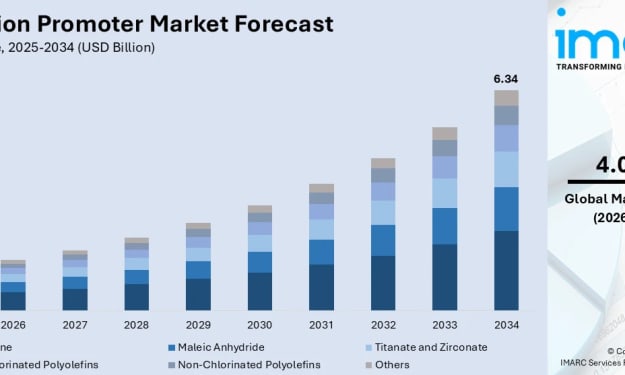
Optimizing bond strength and surface durability is becoming a central focus for industrial manufacturers as they transition toward advanced composites and high-performance coatings. According to IMARC Group’s latest data, the global adhesion promoter market size was valued at USD 4.44 Billion in 2025. Looking forward, IMARC Group estimates the market to reach USD 6.34 Billion by 2034, exhibiting a CAGR of 4.03% from 2026-2034. Asia Pacific currently dominates the market, holding a significant market share of over 45.3% in 2025.
By Andrew Sullivana day ago in Futurism



Comments
There are no comments for this story
Be the first to respond and start the conversation.