
The First “Cosmic Lightning” in Saturn’s Atmosphere
Space

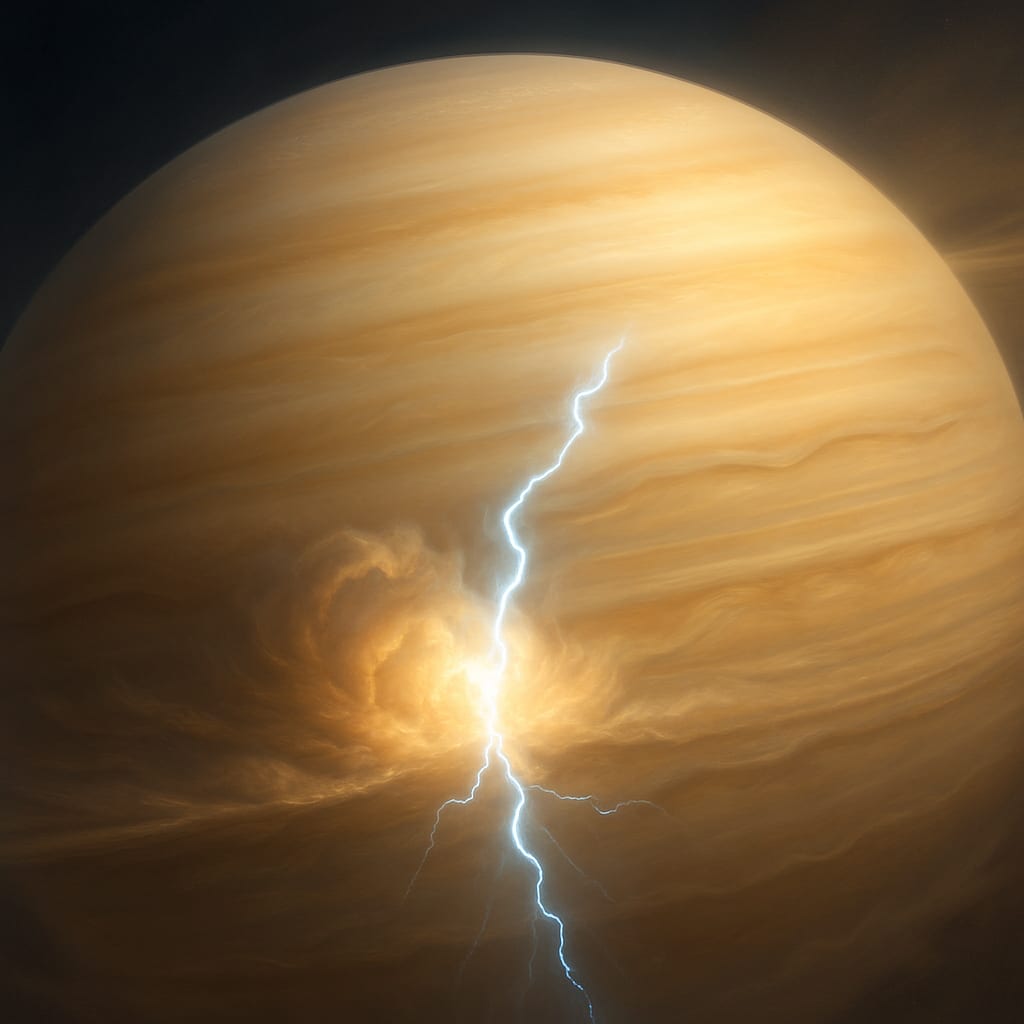
When we think of lightning, we usually picture dramatic flashes streaking across Earth’s stormy skies—illuminating thunderclouds and shaking the air with booming thunder. But lightning is not confined to our home planet. Recently, scientists confirmed that powerful electrical storms also erupt in the swirling skies of Saturn. This extraordinary discovery has been described as the first detection of “cosmic lightning,” an otherworldly display of electrical energy under conditions far more extreme than anything we know on Earth.
Cassini’s Mysterious Signals
For years, NASA’s Cassini spacecraft, which studied Saturn and its moons from 2004 to 2017, collected unusual data. Its instruments occasionally picked up bursts of radio waves and curious flashes of light coming from Saturn’s thick atmosphere. At the time, scientists were puzzled. Were these signals just interference caused by Saturn’s intense magnetic field, or did they point to something more?
The answer came only recently. By revisiting Cassini’s enormous archive with new analytical tools, researchers confirmed that these were not random disturbances. They were the unmistakable fingerprints of lightning—immense electrical discharges flashing through Saturn’s golden clouds.
Lightning, but on a Giant Scale
On Earth, lightning occurs when water droplets and ice particles inside storm clouds collide and build up opposite electrical charges. When the tension becomes too great, a bolt of lightning discharges, neutralizing the imbalance.
Saturn’s lightning, however, plays out on a far grander stage. The gas giant’s atmosphere is made up of water vapor mixed with ammonia, methane, and other volatile compounds. These elements churn together in massive storm systems, some of which are large enough to engulf our entire planet. Within these colossal vortices, electrical discharges can extend thousands of kilometers and last much longer than a typical Earth flash.
To put it into perspective: a single Saturnian lightning bolt may carry many times more energy than an entire terrestrial storm. Imagine a lightning strike so vast and powerful that it lights up layers of atmosphere visible from space—lasting several seconds instead of a fraction of one. That’s the scale scientists are dealing with.
New Tools for Old Data
For a long time, the challenge was separating the faint signals of lightning from the background “noise” produced by Saturn’s strong magnetic field. Cassini’s sensors picked up bursts that looked promising, but the data were messy, leaving room for doubt.
The breakthrough came with advanced algorithms and machine learning. By training models on the patterns of Earth’s lightning storms and applying them to Cassini’s data, scientists were able to filter out interference and detect the genuine signatures of electrical discharges. What once looked like static turned out to be the echoes of alien thunderstorms raging deep within Saturn’s atmosphere.
This success highlights the power of modern computational techniques. Old space mission archives, once thought to be fully analyzed, are now being mined for hidden discoveries. Cassini may have ended its mission years ago, but with new algorithms, its legacy continues to grow.
Why Cosmic Lightning Matters
Lightning is more than just a spectacular natural phenomenon; it is a window into the inner workings of a planet’s atmosphere. On Earth, the study of lightning has helped meteorologists understand storm dynamics, cloud formation, and energy circulation. On Saturn, the stakes are even higher.
Electrical discharges in Saturn’s clouds provide clues about how gases mix and circulate deep below the surface. They reveal the presence of water vapor, offering insight into the chemical composition of the giant planet. More broadly, lightning can help scientists piece together the history of planetary formation—how giant planets like Saturn developed their layered atmospheres and turbulent climates.
There’s also a fascinating link to astrobiology. Some researchers suggest that lightning may play a role in creating complex organic molecules. On Earth, this idea traces back to the famous Miller-Urey experiment of the 1950s, which showed that sparks passing through a gas mixture could generate amino acids. If lightning is common on other planets, it raises intriguing questions about how chemistry unfolds elsewhere in the universe.
Looking Ahead
Although Cassini has long since completed its dramatic plunge into Saturn’s atmosphere, its findings continue to shape planetary science. Future missions may return to Saturn equipped with instruments specifically designed to capture lightning in action—perhaps even cameras capable of directly recording a “cosmic thunderstorm” as it unfolds.
Until then, this discovery reminds us that familiar phenomena from Earth often reappear in the cosmos, but on an entirely different scale. What we see as a fleeting flash of lightning on our planet becomes, on Saturn, a supercharged beacon that reveals the raw power and complexity of gas giant weather.
The phrase “cosmic lightning” captures the wonder of this moment perfectly. It is not only about discovering electrical storms far from Earth—it is about realizing that the universe echoes with familiar rhythms, transformed into something vastly larger, wilder, and more mysterious.
About the Creator
Keep reading
More stories from Holianyk Ihor and writers in Futurism and other communities.
New Evidence for a “Fifth Force” Emerging from Cosmology
Science thrives on surprises. For centuries, physicists believed they had mapped out the fundamental forces that govern reality: gravity, electromagnetism, and the strong and weak nuclear interactions. Together, these four forces seemed to provide the backbone of the universe. Yet cracks in this framework have been showing for decades. Now, new observations from the Euclid space telescope suggest that there might be more to the story—clues pointing toward a mysterious “fifth force” acting on cosmic scales.
By Holianyk Ihor4 months ago in Futurism
About Binding Prometheus
I want to start actively advocating on behalf of my own work, and the most valuable part of my canon is, without a doubt, Binding Prometheus, the play I have been working on since 2019 and only finished in 2023 as part of my MA. The play itself is an amalgamation of a million different inspirations. On one end, it evokes the Ancient Greek myth-play, deriving its own title from the earliest extant work of Western drama we have, Aeschylus’s Prometheus Bound. On the other end, it borrows significantly from the sci-fi bulwarks from over the years, namely Mary Shelley’s Frankenstein and Karel Capek’s Rossum’s Universal Robots. The play could be an episode of Black Mirror, I fear. I don’t know. I’ve only ever seen one episode of Black Mirror.
By Steven Christopher McKnight15 days ago in Futurism
White Box Server Market: Hyperscale Adoption, Cost-Efficient Infrastructure & Open Architecture Trends
According to IMARC Group's latest research publication, global white box server market size reached USD 17.0 Billion in 2024. Looking forward, IMARC Group expects the market to reach USD 67.7 Billion by 2033, exhibiting a growth rate (CAGR) of 15.43% during 2025-2033.
By sujeet. imarcgroupabout 22 hours ago in Futurism




Comments
There are no comments for this story
Be the first to respond and start the conversation.