
The Fermi Paradox: Where Is Everybody in a Universe Teeming with Possibility?
Exploring the Cosmic Silence and the Search for Extraterrestrial Intelligence
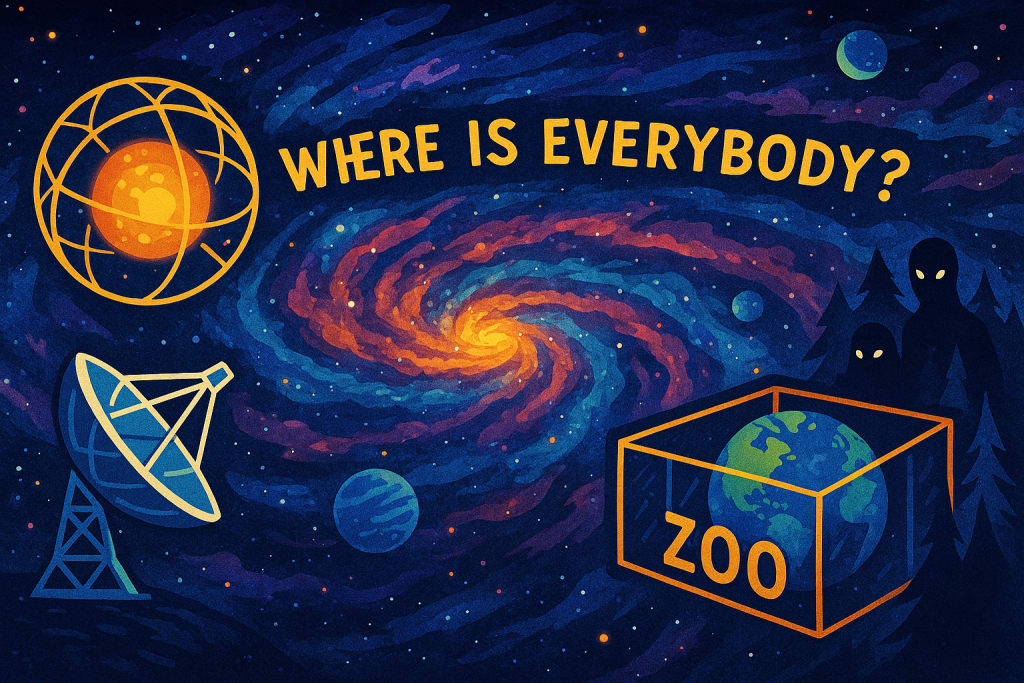
Introduction: A Starry Night and a Haunting Question
Imagine standing under a clear night sky, gazing at the Milky Way’s shimmering band. The universe stretches out in all directions, containing an estimated 100 billion billion Earth-like planets. Yet, amid this staggering cosmic abundance, humanity has found no trace of other intelligent life. This unsettling contradiction—between the high probability of alien civilizations and their apparent absence—is Fermi’s Paradox, a mystery that has haunted scientists and philosophers for decades.
In this article, we’ll unravel the paradox’s origins, explore its scientific and philosophical implications, and delve into the most compelling theories attempting to explain why we seem so alone in the cosmos.
Chapter 1: The Birth of a Paradox
Enrico Fermi’s Lunchtime Epiphany
The paradox traces its roots to a casual conversation in 1950 at Los Alamos National Laboratory. Physicist Enrico Fermi, alongside colleagues Edward Teller and Herbert York, debated the feasibility of interstellar travel and UFO reports. Fermi’s sudden interjection—“Where is everybody?”—captured the essence of the dilemma: if advanced civilizations exist, why haven’t they colonized the galaxy or made contact?.
Fermi’s question wasn’t merely rhetorical. He crunched the numbers:
- The Milky Way is ~13.6 billion years old, with ~100 billion stars.
- Even at sub-light speeds, a civilization could colonize the galaxy in ~10 million years—a blink in cosmic time.
- Yet, Earth shows no signs of visitation or communication.
This disconnect between expectation and reality forms the heart of the paradox.
Chapter 2: The Science Behind the Silence
The Drake Equation: Quantifying Cosmic Loneliness
In 1961, astronomer Frank Drake formulated an equation to estimate the number of detectable civilizations in the Milky Way:
N=R∗⋅fp⋅ne⋅fl⋅fi⋅fc⋅L
- R∗: Rate of star formation.
- fp: Fraction of stars with planets.
- ne: Habitable planets per star.
- fl: Fraction where life emerges.
- fi: Fraction developing intelligence.
- fc: Fraction with communication technology.
- L: Lifespan of civilizations.
While modern astronomy has filled in some variables (e.g., fp⋅ne≈0.1fp⋅ne≈0.1), others—like fifi and LL—remain speculative. Optimistic estimates suggest thousands of civilizations; pessimistic ones argue we might be alone.
The Kardashev Scale: Measuring Civilizational Might
Russian astrophysicist Nikolai Kardashev proposed classifying civilizations by energy use:
- Type I: Harnesses planetary energy (humanity is ~Type 0.7).
- Type II: Controls a star’s energy (e.g., via Dyson spheres).
- Type III: Galactic-scale energy mastery.
A Type III civilization should be unmistakable, yet we see no megastructures or energy signatures. This absence deepens the paradox.
Chapter 3: The Great Silence—Possible Explanations
Group 1: They Exist, But We Can’t Detect Them
- The Zoo Hypothesis: Advanced civilizations observe us like animals in a reserve, avoiding interference to preserve our natural development.
- Communication Barriers: Aliens might use technologies beyond our comprehension—neutrino beams, quantum entanglement, or compressed signals we mistake for noise.
- The Dark Forest Theory: Civilizations stay silent to avoid attracting hostile attention, akin to hiding in a “dark forest”.
Group 2: They Don’t Survive Long Enough
- The Great Filter: A catastrophic barrier prevents life from reaching interstellar stages. This could be behind us (e.g., abiogenesis is rare) or ahead (e.g., self-destruction via climate collapse or AI).
If the filter is ahead, humanity’s survival is uncertain.
- Technological Collapse: Civilizations may succumb to runaway climate change, nanobot disasters (“gray goo”), or resource depletion.
Group 3: We’re Alone
- Rare Earth Hypothesis: Earth’s conditions—a large moon, plate tectonics, a stable orbit—might be uniquely suited for complex life.
- Underwater Civilizations: Alien life might thrive in subsurface oceans (e.g., Europa, Enceladus) but lack the means to communicate or explore space.
Chapter 4: Implications for Humanity
The Great Filter: A Sword of Damocles
If the Great Filter lies ahead, our species faces existential risks. Climate change, nuclear war, or unaligned AI could end our technological trajectory. Conversely, if the filter is behind us, we might be among the first intelligent life forms—a humbling yet empowering prospect.
SETI and the Search for Answers
Projects like the Breakthrough Listen Initiative and the James Webb Space Telescope aim to detect biosignatures or technosignatures. However, as astrophysicist Heidi Jo Newberg notes, “We’ve barely dipped a glass into the cosmic ocean”.
Chapter 5: The Future of the Paradox
New Frontiers in Astrobiology
- Exoplanet Atmospheric Analysis: Detecting oxygen or methane could hint at life.
- Interstellar Probes: Projects like Breakthrough Starshot aim to send nanocraft to Alpha Centauri.
- Metamaterials and Quantum Communication: Novel technologies might unlock new ways to listen—or be heard.
Philosophical Reflections
The paradox forces us to confront our place in the cosmos. Are we a fluke, a precursor, or a doomed experiment? As science fiction author Liu Cixin writes, “The universe is a dark forest. Every civilization is an armed hunter staring through the trees like ghosts”.
Conclusion: The Cosmic Riddle Persists
Fermi’s Paradox remains one of science’s greatest enigmas. Whether the answer lies in humanity’s uniqueness, cosmic caution, or impending doom, the search for extraterrestrial intelligence is also a search for ourselves. Until we find definitive evidence, the question echoes through the void: Where is everybody?
For More Stories, Follow My Blog
About the Creator
About Binding Prometheus
I want to start actively advocating on behalf of my own work, and the most valuable part of my canon is, without a doubt, Binding Prometheus, the play I have been working on since 2019 and only finished in 2023 as part of my MA. The play itself is an amalgamation of a million different inspirations. On one end, it evokes the Ancient Greek myth-play, deriving its own title from the earliest extant work of Western drama we have, Aeschylus’s Prometheus Bound. On the other end, it borrows significantly from the sci-fi bulwarks from over the years, namely Mary Shelley’s Frankenstein and Karel Capek’s Rossum’s Universal Robots. The play could be an episode of Black Mirror, I fear. I don’t know. I’ve only ever seen one episode of Black Mirror.
By Steven Christopher McKnight18 days ago in Futurism
Is Digital Transformation a New Operating System of Pharma?
Key Takeaways: Digital transformation is becoming the core driver of efficiency and innovation in the pharmaceutical industry. Advanced technologies like AI, ML, big data, and IoT are streamlining research, manufacturing, and supply chains. Patients, executives, and quality teams alike benefit from safer, smarter, and more connected pharma ecosystems. Digital evolution is swiftly impacting the pharmaceutical industry, and we are already embracing its ability to recast the entire healthcare landscape. Today, we will share some insights that witness how imperative this shift has become in patient-centric outcomes.
By Davin Convay4 days ago in Futurism
Ludacris and Nelly draw backlash over bookings at MAGA-coded music festival
Ludacris and Nelly headlining a mostly right-wing event is good for them. It’s also great for the genre of hip hop. The two rap veterans have showcased their talents on other stages. Why can’t they perform for mostly MAGA folks and grab that bag?
By Skyler Saunders4 days ago in Beat




Comments
There are no comments for this story
Be the first to respond and start the conversation.