

The desecration of a grave was a crime when my grandfather was young. I recall being a small child sitting in his lap while he told me about “wakes” and “funerals” about how it was common practice then to bury people and to respect the dead. Even though it’s morbid, death has fascinated me since I was a child. My favorite story was the story of his mother’s burial. She was laid in a white, silk lined oak casket. She was adorned with her pearls and her favorite blue chiffon dress with white glass buttons down the front, her arms folded neatly across her chest, surrounded by the orchids she so fondly grew in her flower garden. My grandfather was only 8 when she passed, my great grandmother was only 34. I’ve seen pictures of how beautiful she was, she had the same light brown shoulder length hair and iridescent green-blue eyes that I have. The same athletic build and slightly above average height, We even share the same name, Evelyn Allston. I've always felt a deep connection with my great grandmother, I tend to wonder if she would despise or respect me for my job. Especially as the years rage on and I creep nearer to the age she was when she passed on. Now at twenty eight I cannot fathom only having only six years left of my life, but the harsh reality of the world we live in, that may be pushing it.
I think of her as I pull my heavy, well worn brown leather work boots over a pair of thick black wool socks, my pinky toe peeking out on my right foot. These socks and boots have carried me through many a work day. I lace up my boots groaning from knee pain as I go to stand at my window overlooking the Charles River, the wood floor panels squeaking under the weight of my boots. From my fourth floor old fashioned brick apartment in Boston I can see that the red smog has already made it’s home in the air today. Some days we can get away with a light pink or even a scarlet red, but today it’s a deep burgundy like blood. I pulled on a pair of thick corduroy overalls and a heavy jacket along with my respirator before I left the apartment.
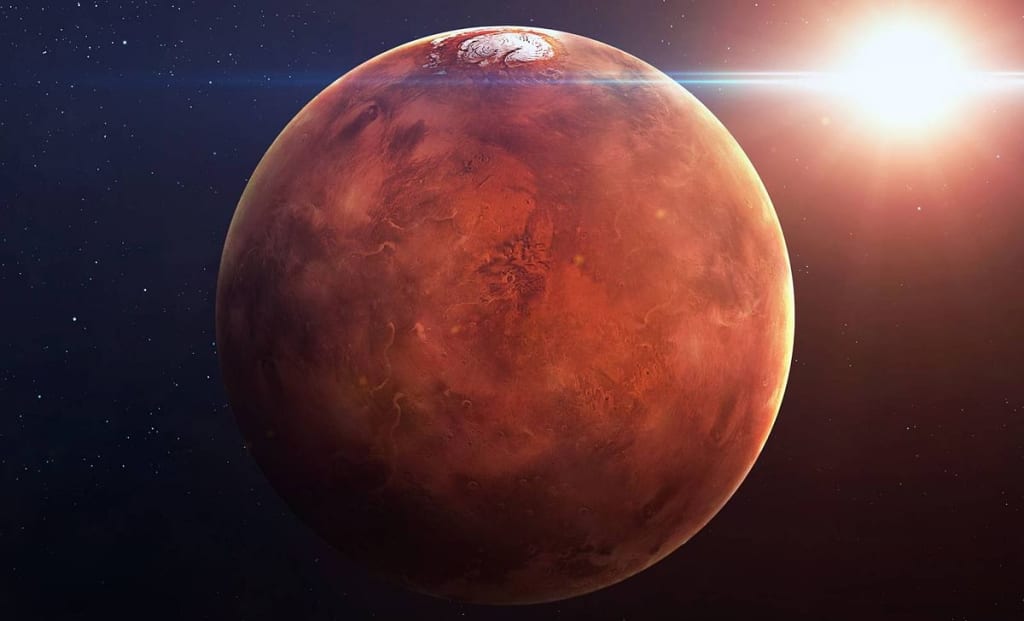
When my great grandmother was a young adult there was a great illness that swept across the world killing millions of people. Wearing cloth over your face became somewhat of a normalcy. When they found a cure for the illness wearing a face covering became sort of a taboo, but that didn’t last too long. The people of the world were not prepared for the havoc they were about to unleash on themselves when they sent an astronaut to Mars. The government sent a shuttle up to Mars to see if the planet was habitable with new technology to “clean the air”. Upon entry into the planet's atmosphere the shuttle exploded sending debris flying through the air. Because Mars has one-third the gravity of Earth the government thought things would be fine, but they weren’t. Somehow one of the fluids that the shuttle contained sent off a chemical reaction with the high carbon dioxide levels on the planet that sent off an unforeseeable chain of events, and that chain of events lead to the explosion of Mars.
If you asked any old timers, including my grandfather, they’ll tell you that you could hear the explosion from Earth. They also say that the change was almost immediate. Within days red clouds started appearing, within months people were dropping like flies. People started staying inside as much as they could. The cloth facial coverings returned and then over the years were replaced with respirators as the smog grew heavier. And that was only some of the damage done. Once the respirators were plentiful, and everyone had a few, people started emerging more from their homes, but we had all spent so long in isolation that no one had been sick in years. No one was prepared for the common cold to be deadly. Almost a whole generation of people, my parents generation, had stayed inside for so long even average diseases had mutated beyond recognition.
That’s when doctor Evan Gregory took the stage, he told the world that by extracting the bone marrow of those who passed before the Mars explosion could create a preventive vaccination for these mutated diseases. At first the medical community along with the rest of the world laughed at him, but he was absolutely right. So began the exhuming of graves. It started off with just a few, an adult biological male’s bones will vaccinate about three people, a biological woman’s body about two, and a child’s body will vaccinate one.Since Mars we only burn our dead, so it’s not hard to decipher what era a body is from, but the more bodies we exhume and harvest the fewer graveyards of usable bodies there are.
I have been a grave exhumer for ten years now. It’s a difficult and time consuming job. Especially with all the personal protective equipment we need to withstand being outside for hours on end, an exhumer tends to get incredibly overheated. While my job does feel kind of rewarding and I know every bone I place in my wheelbarrow is going to help another person extend their life; sometimes I wonder if my great grandmother would approve. Then I wonder, has she already been exhumed? If she hasn't, is she going to be exhumed? I think of her beautiful chiffon dress and her pearls and feel a great sadness wash over me. Is it right to disturb their peace? Are all of these people long forgotten or do they have families who are upset their bones are being taken?
I start my short walk to the subway station, the sidewalks are fairly scarce today due to the intensity of the red smog looming over the city. I hustle down the subway stairs and onto the subway heading to Jamaica Plain where the day's digging is taking place. The ride only lasts about fifteen minutes, then I’m hustling up the stairs and walking towards my job site, the monotony of the day rearing its head. Forest Hills Cemetery looms ahead of me, and a familiar chill runs down my spine. Even after ten years I still occasionally get creeped out touching human remains all day. Our forman, James, stands at the entrance of the cemetery, wheelbarrows containing shovels, picks, gloves, bags, a rope ladder, and a map with a highlighted section next to him. He nods at me and scans my ID badge. I grab my wheelbarrow and head towards my section.
After about three months of exhuming bodies, grave robbers started becoming more and more bold, walking on job sites pretending to be on the crew. As an exhumer we’re under strict instruction to not take any clothes or jewelry. We place any personal items into a donation bag if it’s salvageable or a trash bag if it isn’t. This is why the scannable ID badges were implemented and the rules on not taking things from graves. Even though we throw all our dead into massive incinerators now, there are still some boundaries we don’t cross. Money is hard to come by these days, but we make good money, so the need to steal and lose our jobs isn’t particularly appealing to most anyone.
I start digging into my first grave of the day, the ground is rough and hard even though it’s late April, it is New England and still pretty cold in the morning. But the ground is not quite frozen, so eventually I break through the top layer and dirt starts flying as I move my shovel in the quick precise motions I’ve mastered over the last decade, sweat already starting to form on my upper lip and eyebrows. After what seems like only a few short minutes of digging I hear the familiar thunk of a shovel hitting hard wood. I remove the remaining dirt and carefully drop down into the hole with my rope ladder, secured with stakes in the ground. Carefully opening the casket I realize it’s the grave of an old woman, long grey hair on the bottom of the casket. Her clothes are tattered and I can tell she wasn’t above middle class, but the heart shaped locket on her neck is stunning. Gold or at least gold-plated, and heavy in my hand as I gently unclasp it from her remains, After a little bit of struggling I got the locket opened, in it a picture of what I assume is a younger version of herself on one side and a handsome young man in a Navy uniform on the other side. I held it for a long time, surely nothing so personal should be donated, I thought, slipping it into the pocket of my overalls.
Yes, most people would fear losing their jobs and wouldn’t risk it for something so trivial, but realistically, I will never find my grandmother or her pearls, so I try and make do. I especially love finding things so personal, like the locket. Just to get a glimpse into the lives of other people even for a moment. To remember that they are people not just a vaccine, not objects, but real people who had feelings and loved ones; even if it was a long time ago and they are long forgotten, I will not forget them. Part of me is envious that they have a purpose even in death, I will not be so lucky, my final physical moments in this world will be up in flames.
About the Creator
Tyra Mitchell
Twenty-three year old amateur writer from a small town in Massachusetts.
Keep reading
More stories from Tyra Mitchell and writers in Futurism and other communities.
Mama
I awoke to the feeling of polyester under me and utter darkness. The familiar symptoms of a panic attack set in as I realized that not only was I curled up in a small and dark unknown place, but that I was trapped. My heart began to race, my palms started sweating, and I could hear my breath becoming shallow over a familiar roaring noise that I had not yet identified. I began to focus on the noises in an attempt to ground myself, but the panic was slow to relinquish its grasp on me.
By Tyra Mitchell 3 years ago in Fiction
About Binding Prometheus
I want to start actively advocating on behalf of my own work, and the most valuable part of my canon is, without a doubt, Binding Prometheus, the play I have been working on since 2019 and only finished in 2023 as part of my MA. The play itself is an amalgamation of a million different inspirations. On one end, it evokes the Ancient Greek myth-play, deriving its own title from the earliest extant work of Western drama we have, Aeschylus’s Prometheus Bound. On the other end, it borrows significantly from the sci-fi bulwarks from over the years, namely Mary Shelley’s Frankenstein and Karel Capek’s Rossum’s Universal Robots. The play could be an episode of Black Mirror, I fear. I don’t know. I’ve only ever seen one episode of Black Mirror.
By Steven Christopher McKnight17 days ago in Futurism
Massage Equipment Market: Ergonomic Innovation, Wellness Demand & Market Momentum
According to IMARC Group's latest research publication, The global massage equipment market size reached USD 8.1 Billion in 2024. Looking forward, IMARC Group expects the market to reach USD 16.3 Billion by 2033, exhibiting a growth rate (CAGR) of 8.08% during 2025-2033.
By James Whitman6 days ago in Futurism


Comments
There are no comments for this story
Be the first to respond and start the conversation.