
The Evolution of Natural Language Processing in 2025
By Jay Phoenix
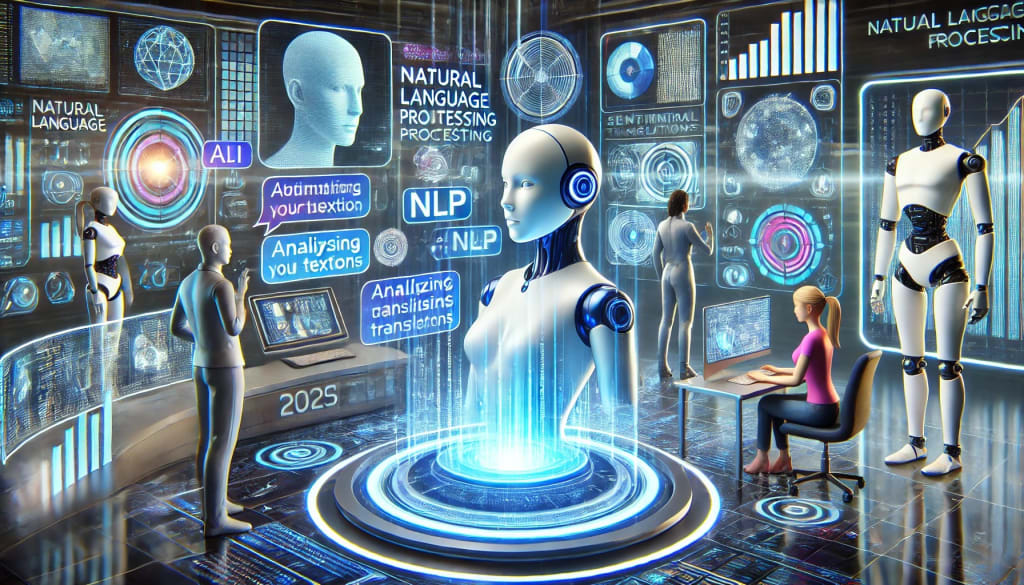
Natural Language Processing has come a long way in recent years. From simple chatbots to highly advanced conversational AI, the ability of machines to understand and generate human language is now more sophisticated than ever. In 2025, NLP is no longer just a tool for automation; it is transforming industries, enhancing communication, and even reshaping how humans interact with technology. The evolution of NLP is one of the most exciting advancements in artificial intelligence, and its impact is only growing stronger.
AI-Powered Virtual Assistants Are Smarter Than Ever
Virtual assistants like Siri, Alexa, and Google Assistant have been around for years, but in 2025, they have evolved far beyond basic voice commands. AI-powered assistants now engage in meaningful conversations, understand complex requests, and provide context-aware responses. These systems use advanced deep learning models to remember past interactions, anticipate user needs, and provide highly personalized assistance.
Companies are integrating these assistants into customer service, healthcare, and even legal advisory roles. Instead of waiting on hold for a human representative, customers now interact with AI systems that can resolve their issues instantly. In the healthcare industry, AI-driven assistants help doctors with patient diagnoses, reducing administrative workload and improving efficiency.
Breaking Language Barriers with Real-Time Translation
One of the biggest breakthroughs in NLP is real-time translation. In 2025, language is no longer a barrier to communication. AI-powered translation tools can instantly convert speech and text into multiple languages with near-human accuracy. This technology is making global collaboration easier than ever before.
From business meetings to casual conversations, AI translation is bridging gaps and fostering inclusivity. Travelers can now use smart devices to speak any language on demand, eliminating the need for traditional translators. International businesses are expanding faster because communication is no longer an obstacle.
Sentiment Analysis Is Redefining Customer Experience
Understanding emotions in text has always been a challenge for machines, but in 2025, sentiment analysis has reached new heights. AI models can now detect subtle emotions, sarcasm, and even underlying intentions behind text-based interactions. Businesses are using this technology to analyze customer feedback, predict trends, and personalize marketing strategies.
Companies monitor social media and online reviews in real time to understand public sentiment about their products. AI can now detect dissatisfaction early and help brands make proactive decisions to improve customer experience. This ability to gauge emotions is also being used in mental health applications, where AI-powered systems provide emotional support and guidance to users in distress.
Content Generation and AI Writing Are Mainstream
NLP advancements have made AI-generated content a powerful tool for businesses, journalists, and marketers. AI-powered writing assistants can generate news articles, product descriptions, and even creative stories with incredible coherence and originality. In 2025, AI-generated content is so refined that it is often indistinguishable from human writing.
Businesses leverage AI to draft reports, create marketing campaigns, and optimize SEO-friendly content in seconds. While AI does not replace human creativity, it enhances efficiency by providing suggestions, grammar corrections, and stylistic improvements. The result is faster content production and higher engagement rates.
Personalized Search and AI-Powered Recommendations
Search engines have become more intuitive with NLP-powered advancements. In 2025, users no longer have to type exact keywords to find relevant information. AI-powered search engines understand context, intent, and even user preferences, delivering personalized results that go beyond simple keyword matching.
E-commerce platforms, streaming services, and online education portals use NLP to provide customized recommendations. Whether it’s suggesting the perfect movie, an ideal book, or an online course, AI ensures that recommendations align with individual preferences and browsing habits.
AI Ethics and Bias in NLP
As NLP technology becomes more advanced, ethical concerns regarding bias and misinformation have gained attention. AI systems learn from vast datasets, but if these datasets contain biased information, the results can be problematic. Developers are now prioritizing fairness, inclusivity, and transparency in NLP models to ensure ethical AI usage.
Tech companies are implementing stricter guidelines to eliminate biases in AI-generated content and decision-making processes. Fact-checking mechanisms powered by AI help filter out misinformation, ensuring that users receive accurate and unbiased information.
The Future of NLP and Human-Machine Interaction
As we move further into 2025, NLP will continue to evolve and redefine how humans interact with technology. The next wave of NLP innovations will include AI that understands emotions even better, anticipates user needs before they arise, and creates more human-like interactions. Conversational AI will become indistinguishable from talking to another person, and businesses will leverage these tools to enhance customer experience, productivity, and engagement.
The rapid progress of NLP is making technology feel more human, breaking down communication barriers, and opening doors to a future where AI understands, responds, and interacts seamlessly with people. With continuous advancements in deep learning, reinforcement learning, and AI ethics, the potential for NLP remains limitless. The only question now is how quickly industries and individuals will adapt to this revolution.
About the Creator
Keep reading
More stories from Jay Phoenix and writers in Futurism and other communities.
AI and Robotics: The Next Frontier in Automation
Artificial intelligence and robotics are no longer confined to science fiction. They are transforming the way we work, live, and interact with the world. Automation is no longer just about speeding up repetitive tasks—it’s about revolutionizing industries, enhancing efficiency, and even redefining the concept of human labor. The next wave of AI-powered robotics is poised to reshape entire economies, and the changes are happening faster than most people realize.
By Jay Phoenix12 months ago in Futurism
About Binding Prometheus
I want to start actively advocating on behalf of my own work, and the most valuable part of my canon is, without a doubt, Binding Prometheus, the play I have been working on since 2019 and only finished in 2023 as part of my MA. The play itself is an amalgamation of a million different inspirations. On one end, it evokes the Ancient Greek myth-play, deriving its own title from the earliest extant work of Western drama we have, Aeschylus’s Prometheus Bound. On the other end, it borrows significantly from the sci-fi bulwarks from over the years, namely Mary Shelley’s Frankenstein and Karel Capek’s Rossum’s Universal Robots. The play could be an episode of Black Mirror, I fear. I don’t know. I’ve only ever seen one episode of Black Mirror.
By Steven Christopher McKnight26 days ago in Futurism
Saudi Arabia E-Health Market: E-Health Solutions, Smart Healthcare Platforms, Analytics & System Transformation
According to IMARC Group's latest research publication, Saudi Arabia e-health market size reached USD 1.5 Billion in 2025. The market is projected to reach USD 5.5 Billion by 2034, exhibiting a growth rate (CAGR) of 15.32% during 2026-2034.
By Jeffrey Wilson7 days ago in Futurism



Comments (1)
Hello, just wanna let you know that if we use AI, then we have to choose the AI-Generated tag before publishing 😊