
The Evolution of AI: From Turing Test to Deep Learning
The Turing Test: The Dawn of AI
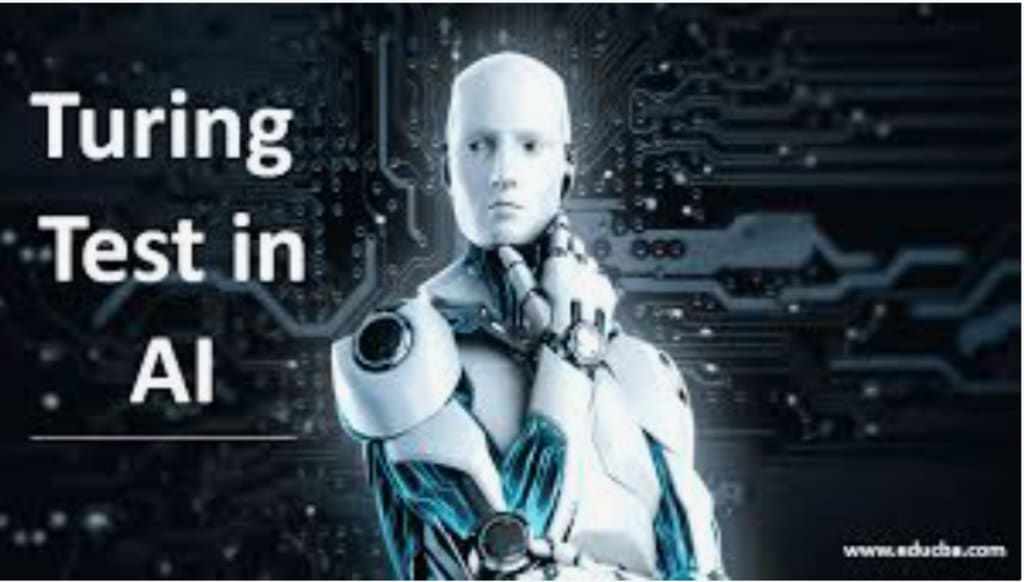
The narrative of Artificial Intelligence (AI) is a thrilling tale of human ingenuity and ambition. Since the inception of the concept, AI has continuously evolved, shaping and being shaped by the societies it inhabits. This article traces the journey of AI, from the foundational Turing Test to the present era of Deep Learning, capturing the extraordinary progression of this field.
The Turing Test: The Dawn of AI
Our story begins with the British mathematician and logician, Alan Turing. In 1950, Turing proposed a simple, yet profound question: "Can machines think?" To answer this, he conceptualized a test, now known as the Turing Test, where a human interacts with a machine and another human through text. If the human can't discern the machine from the other human, the machine passes the test and is considered intelligent.
The Turing Test established a benchmark for AI and sparked the beginning of AI as a formal academic discipline. However, it would take several decades before machines could convincingly pass this test.
The Birth of Machine Learning
In the mid-20th century, AI research focused on symbolic logic and rule-based systems. But these systems were limited, as they could only solve problems defined by explicit rules.
The 1980s saw a shift towards Machine Learning (ML), a subset of AI that enables machines to learn from data. This was a major breakthrough, as ML systems could improve their performance over time without being explicitly programmed. An early success was IBM's Deep Blue, a chess-playing AI that defeated world champion Garry Kasparov in 1997.
The Deep Learning Revolution
While early ML algorithms could learn from data, they struggled with raw sensory data and complex tasks. The solution to this problem emerged from an unexpected place: neuroscience.
In the mid-2000s, researchers started applying neural networks, computational models inspired by the brain's structure, to ML tasks. These deep neural networks, or Deep Learning models, could learn from raw sensory data and solve complex tasks, such as image and speech recognition.
Deep Learning has powered many recent AI successes. For example, Google's DeepMind developed AlphaGo, a Deep Learning system that defeated the world champion in Go, a game considered much more complex than chess. Self-driving cars, voice assistants, and personalized recommendation systems are all powered by Deep Learning.
The State of AI Today
Today, AI is ubiquitous, influencing diverse aspects of society. It's in the smartphones we use, the movies we watch, and the way businesses operate. Its evolution from the Turing Test to Deep Learning illustrates the incredible strides the field has made.
However, despite these advances, we are still far from achieving Artificial General Intelligence (AGI) – machines that can perform any intellectual task that a human can. Modern AI is narrow, excelling at specific tasks but struggling outside its training domain. The quest for AGI remains one of the grand challenges of AI research.
Looking Ahead: The Future of AI
As we look ahead, it's clear that the journey of AI is far from complete. Researchers are exploring new paradigms beyond Deep Learning, such as neuro-symbolic approaches that combine neural networks with symbolic logic. There's also growing interest in AI ethics, addressing issues like bias, fairness, and transparency in AI systems.
In conclusion, the evolution of AI has been a fascinating journey of discovery, from the philosophical queries of the Turing Test to the technological marvels of Deep Learning. As we continue this journey, we can anticipate a future where AI will increasingly shape our world, offering immense opportunities and challenges. The tale of AI is a testament to human curiosity and inventiveness, a tale that continues to unfold.
About the Creator
Geoffrey Muriuki
Geoff is a tech enthusiast with interest in the transformative powers of Artificial Intelligence and blockchain. He strives to demystify the world of AI and blockchain. He believes in the potential of technology to shape a better future.
Keep reading
More stories from Geoffrey Muriuki and writers in Futurism and other communities.
AI and Cybersecurity: A Game Changer?
We live in an era where digital data has become as valuable as gold. With the advent of the internet and our increasing reliance on digital systems, data has been recognized as one of our most precious resources. Yet, as the volume and value of this data continue to rise, the threats to its security have also escalated. Cybersecurity, consequently, has become a focal point of concern for businesses, governments, and individuals worldwide. Amid these challenges, one technology stands out as a potential game-changer: artificial intelligence (AI). In this in-depth exploration, we will uncover how AI is revolutionizing the landscape of cybersecurity.
By Geoffrey Muriuki3 years ago in Futurism
About Binding Prometheus
I want to start actively advocating on behalf of my own work, and the most valuable part of my canon is, without a doubt, Binding Prometheus, the play I have been working on since 2019 and only finished in 2023 as part of my MA. The play itself is an amalgamation of a million different inspirations. On one end, it evokes the Ancient Greek myth-play, deriving its own title from the earliest extant work of Western drama we have, Aeschylus’s Prometheus Bound. On the other end, it borrows significantly from the sci-fi bulwarks from over the years, namely Mary Shelley’s Frankenstein and Karel Capek’s Rossum’s Universal Robots. The play could be an episode of Black Mirror, I fear. I don’t know. I’ve only ever seen one episode of Black Mirror.
By Steven Christopher McKnight18 days ago in Futurism



Comments
There are no comments for this story
Be the first to respond and start the conversation.