
The end of the birth
When endings arrive, sometimes they come disguised as beginnings.
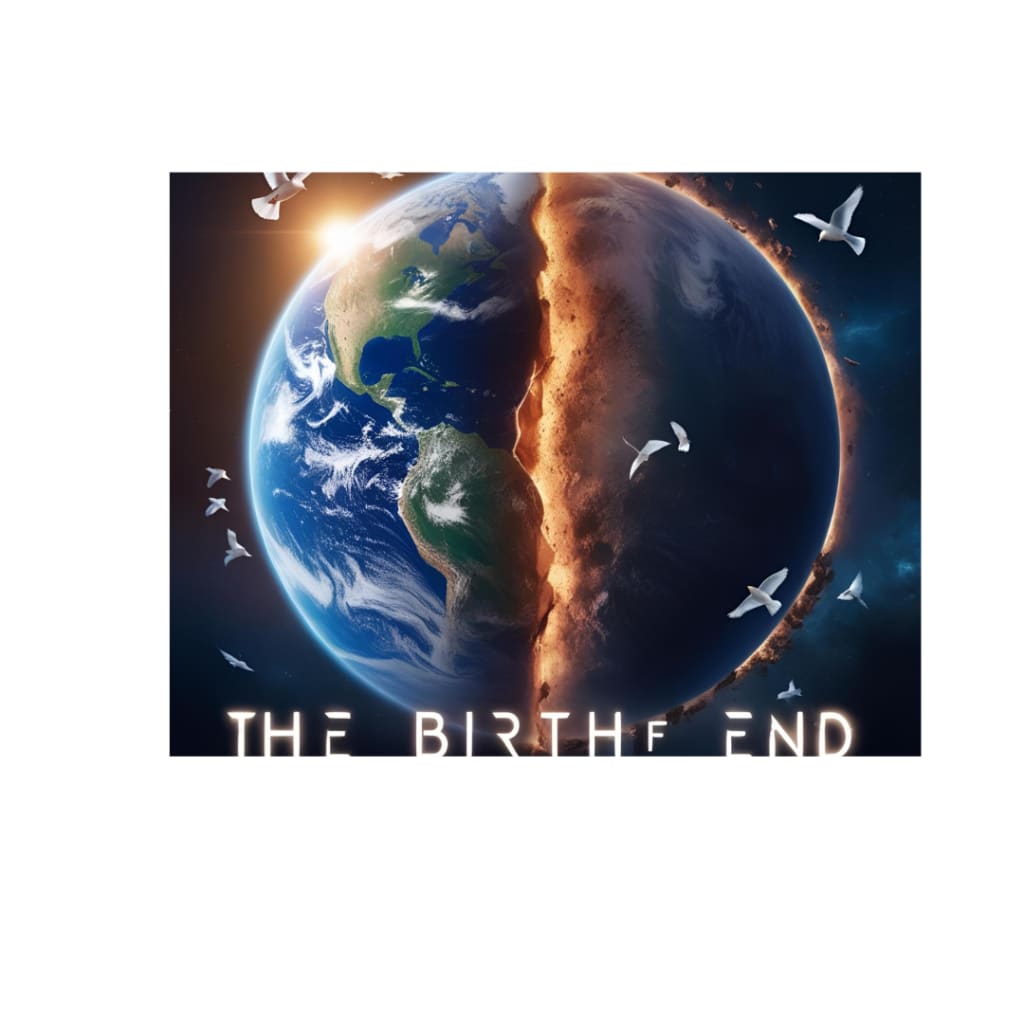
The Birth of the End
When endings arrive, sometimes they come disguised as beginnings.
The world didn’t end with an explosion.
It ended with silence.
It began on a cold morning in December. The news headlines were calm but strange: “Unknown Lights Seen Over Five Continents,” “Sudden Decline in Bird Migration Patterns,” “Ocean Currents Shifting Unnaturally.”
Most ignored it. Some theorized. A few feared. But no one truly believed the world could end—not like this.
Not with a whisper.
Among the billions who watched in confusion was Aarav, a climate scientist who had spent years warning governments, writing reports, and being politely dismissed. He had predicted crises, but not extinction. Not silence.
But the silence came anyway.
It started in the forests—no birds, no rustling leaves. The air grew still. Then came the cities. Buses stopped running. Communications faltered. Satellite signals dropped. Power grids began flickering out like dying stars.
Aarav stood at the balcony of his apartment in New Delhi, watching as the skyline darkened. Not with clouds, but with absence. No horns, no people shouting. Just... emptiness.
His phone buzzed once more. A final emergency alert:
“Stay indoors. Unknown airborne particles detected. Global response underway. Await further updates.”
Then, nothing.
No further updates ever came.
He packed essentials—food, water, a few tools—and drove to the old research center outside the city, a place now deserted. What he found there would change everything.
Inside the sealed laboratory’s last working chamber, the systems had recorded something unbelievable. Not a natural disaster. Not war. But a signal—repeating every few seconds, buried in the cosmic noise of space. It wasn’t random. It was language.
Not human.
He played it over and over. A soft tone, followed by three pulses. A pattern. A countdown?
He didn’t know.
Two weeks passed. The world fell quieter. The skies remained dull, as if life itself was being unplugged slowly, gently, without protest.
Then one morning, the signal changed.
Instead of pulses, it sent a new sequence—a spiral of sound frequencies Aarav had once seen in ocean life communication. It was mimicking Earth. Speaking back.
And it terrified him.
He began documenting everything, keeping records for no one. Humanity was gone. The net was down. The governments had either fallen or fled. But he kept writing, because something in him refused to let go.
Until he met Zoya.
She appeared one evening as he scavenged an abandoned medical store. Dressed in tattered clothes, cautious but alert, holding a makeshift weapon.
“I’m not here to hurt you,” he said.
“Neither am I,” she replied. “I saw your smoke signal yesterday.”
He hadn’t lit it intentionally—but she had seen it. She was the first human being he had spoken to in 19 days.
Zoya had once been a teacher. She had a sharp mind and a grieving heart. Her family hadn’t survived the first wave of “the silence”—a term survivors had started using for whatever had begun draining the Earth.
Together, they set up camp in the lab. Days passed. They shared stories, theories, and fears.
She asked him one night, “Do you think this is the end?”
He paused. “I think it’s the birth of the end. Something new is arriving. It isn’t just taking life. It’s replacing it.”
Zoya looked up at the darkened sky. “So this is the moment between what was and what’s coming.”
Aarav nodded. “The last breath before the new air.”
They worked together to decode the rest of the signal. Through fragmented patterns, they discovered a horrifying truth.
The signal wasn’t alien in origin.
It was human-made.
Decades ago, an experimental deep-space transmission program had sent signals beyond the solar system—inviting intelligent life. A cosmic greeting.
And something had answered.
Something that didn’t understand peace or boundaries.
Something that mimicked and replaced.
It hadn’t invaded Earth.
It had been invited.
Aarav and Zoya realized too late—the silence wasn’t death. It was transition.
By the hundredth day, the stars changed. Familiar constellations dimmed. The moon shimmered unnaturally. The trees stopped shedding leaves.
And one morning, the birds came back.
But they weren’t birds.
They looked right. Moved right. But when one landed too close, Aarav saw its eyes—glassy, still, too perfect.
“What do we do?” Zoya whispered.
Aarav looked at the sky. “We write. We witness. If this is the end, let the future—whatever form it takes—know we remembered.”
They began etching everything on stone, paper, metal—whatever could survive. They buried stories in iron boxes, placed markers far from cities.
Their last message read:
> “This is not the end of the Earth, but the end of us.
We began with fire, we left with silence.
If you are reading this, know we existed.
And once, we dreamed.”
The end had come. But in its quiet wake, something else began.
About the Creator
Keep reading
More stories from Muhammad umar and writers in Futurism and other communities.
The silent Echo
The Silent Echo The town of Ashfield never liked noise. Wrapped in foggy mornings and silence that lingered like perfume, it sat tucked between old hills and older secrets. For Amelia Hart, Ashfield had always been more than just home—it was history stitched into every stone and whispering through every alley.
By Muhammad umar 8 months ago in Education
About Binding Prometheus
I want to start actively advocating on behalf of my own work, and the most valuable part of my canon is, without a doubt, Binding Prometheus, the play I have been working on since 2019 and only finished in 2023 as part of my MA. The play itself is an amalgamation of a million different inspirations. On one end, it evokes the Ancient Greek myth-play, deriving its own title from the earliest extant work of Western drama we have, Aeschylus’s Prometheus Bound. On the other end, it borrows significantly from the sci-fi bulwarks from over the years, namely Mary Shelley’s Frankenstein and Karel Capek’s Rossum’s Universal Robots. The play could be an episode of Black Mirror, I fear. I don’t know. I’ve only ever seen one episode of Black Mirror.
By Steven Christopher McKnight16 days ago in Futurism
Top 10 Fintech Software Development Companies in USA 2026
In today’s rapidly evolving digital finance landscape, fintech companies and traditional financial institutions alike are investing heavily in advanced software solutions that enable secure transactions, seamless customer experiences, and robust compliance with regulatory standards. As we enter 2026, the demand for specialized fintech software development services continues to grow, driven by technologies such as blockchain, artificial intelligence (AI), machine learning (ML), and cloud-native architectures. Choosing the right development partner can make or break a fintech project, whether it’s launching a next-generation digital wallet, a mobile banking platform, a payment processing system, or a comprehensive financial analytics suite. This article profiles the top 10 fintech software development companies that stand out in the United States market for their innovation, technical expertise, industry experience, and ability to deliver scalable, secure solutions that meet the unique needs of finance organizations.
By Steve Waugh3 days ago in Futurism



Comments
There are no comments for this story
Be the first to respond and start the conversation.