
The Economist 2025 is Terrifying: It’s predictions Are Coming True in Order
The Antichrist & The World Ahead 2025-The Economist Magazine


The Economist 2025 is Terrifying: Its Predictions Are Coming True in Order"
The Economist magazine is renowned for its in-depth analysis and annual predictions on global trends. Its special edition, The World Ahead 2025, has generated considerable debate, as some of its projections appear to be materializing. This 3,000-word article takes a detailed look at these predictions, their context, and the accuracy with which they are unfolding.
Since its founding in 1843, The Economist has been an influential source of economic and political analysis. Each year, its The World Ahead edition provides a forward-looking view of events and trends that could shape the world in the coming year. The 2025 edition was no exception, presenting a series of predictions ranging from significant political changes to technological advancements and global challenges.
Political Predictions
1. The Return of Donald Trump to the U.S. Presidency
One of the most notable predictions was Donald Trump's return to the White House in 2025. According to The Economist, this second term could have profound implications for U.S. domestic and foreign policy. A more protectionist stance on trade, stricter immigration policies, and a reevaluation of international alliances were anticipated. Furthermore, with Republican control of both chambers of Congress, Trump could implement his agenda with fewer legislative obstacles.
2. Rising Geopolitical Tensions
The magazine also pointed to an increase in geopolitical tensions, particularly in regions such as Eastern Europe and Asia. The U.S.-China relationship was projected to be particularly strained, with trade and military disputes in the South China Sea. Additionally, a more assertive Russia was expected to exert influence in its sphere, potentially leading to conflicts in areas such as Ukraine and the Baltic states.
Economic Predictions
1. Moderate Economic Growth
In economic terms, The Economist projected moderate global GDP growth. Factors such as inflation, central bank monetary policies, and supply chain disruptions due to geopolitical conflicts could limit expansion. However, certain emerging economies were expected to experience robust growth, driven by industrialization and foreign direct investment.
2. Technological Innovations and Their Impact on the Labor Market
The acceleration of automation and artificial intelligence was highlighted as a key trend. While these technologies can enhance efficiency and productivity, they also pose significant challenges for the labor market. Disruptions in traditional industries were anticipated, potentially leading to the disappearance of certain roles and the creation of new positions requiring specialized skills.
Social and Environmental Predictions
1. Climate Change and Natural Disasters
The Economist warned about the increasing frequency and intensity of natural disasters due to climate change. Events such as hurricanes, wildfires, and floods were predicted to become more common, affecting millions of people and causing significant economic damage. The magazine emphasized the need for stricter environmental policies and a transition to sustainable energy sources.
2. Pandemics and Global Health
The possibility of new pandemics was also a key concern. Globalization and urbanization increase the risk of infectious disease outbreaks. The Economist suggested that healthcare systems must be strengthened and that international cooperation is essential to prevent and mitigate future health crises.
Analysis of Predictions That Have Come True So Far
As we progress through 2025, it is pertinent to evaluate which of these predictions have materialized:
1. Donald Trump’s Return to the Presidency
In January 2025, Donald Trump assumed his second term as U.S. president, just as The Economist predicted. Since then, he has implemented policies reflecting his previous agenda, including stricter immigration restrictions and a protectionist approach to international trade. His administration has also reassessed several international alliances, prioritizing national interests over multilateral commitments.
2. Rising Geopolitical Tensions
Tensions between the U.S. and China have escalated, particularly in trade and military affairs. Disputes in the South China Sea and mutual economic sanctions have exacerbated their rivalry. Additionally, Russia has intensified its influence in Eastern Europe, raising concerns in the international community about potential conflicts in the region.
3. Technological Innovations and the Labor Market
The adoption of artificial intelligence and automation has advanced rapidly. Many industries have integrated these technologies to enhance efficiency, leading to the elimination of certain job roles. However, new employment opportunities have emerged in technology-related fields, highlighting the need for retraining programs and continuous education for the workforce.
Predictions Yet to Be Confirmed
Although several of The Economist's 2025 predictions have come true, some are still in development or have not yet materialized:
1. Natural Disasters and Climate Change
While significant climate events have occurred, there has not been a drastic increase in the frequency or intensity of natural disasters compared to previous years. However, ongoing climate data will determine whether the trend aligns with the magazine’s warnings.
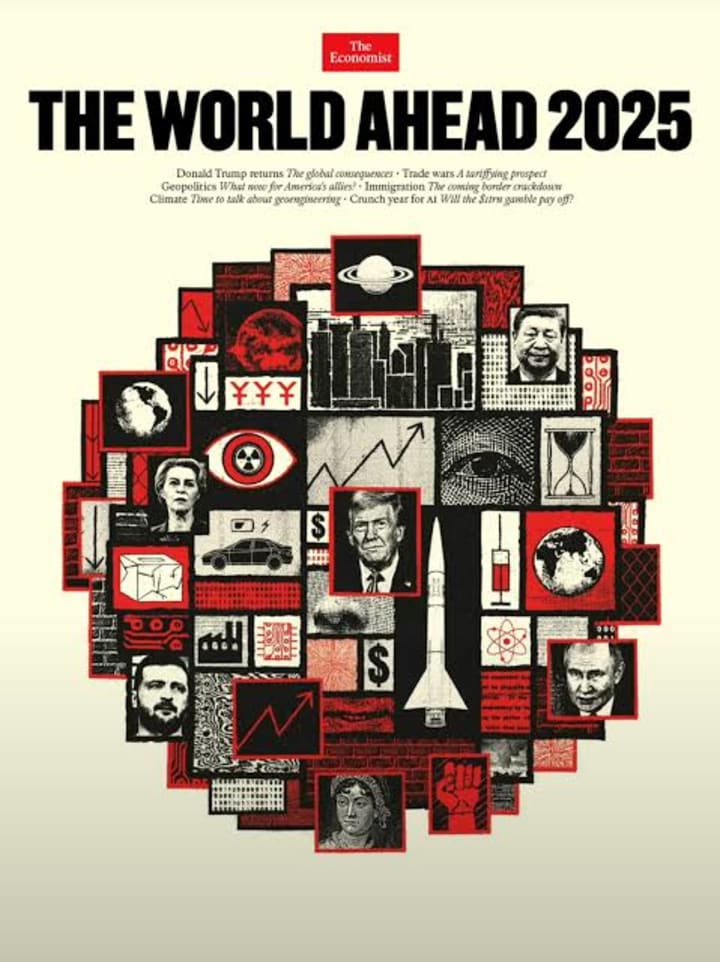
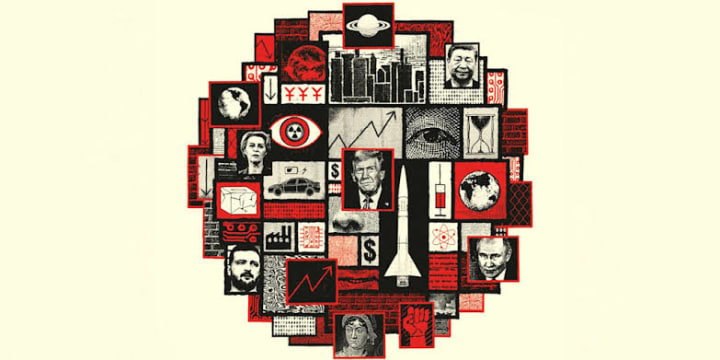
The Economist's "The World Ahead 2025" cover has sparked various interpretations due to its intricate symbolism. Some analyses suggest that the cover contains imagery associated with the concept of the "Antichrist." For instance, geopolitical analyst Hamza Yardımcıoğlu points out that the central design features a human face with Saturn prominently positioned on its forehead. He interprets this arrangement as carrying profound religious and cultural significance, noting that in modern symbolism, Saturn has evolved to represent satanic imagery. The placement of Saturn on the forehead evokes descriptions of the Antichrist in certain religious texts, particularly in Islamic eschatology, where the Antichrist is said to have "kafir" (disbeliever) written on his forehead.
References: The Economist magazine
Google.
About the Creator
JONATAN DAVID VEGA
Hello Welcome! I am Jonatan Vega
Iam self-published mexican author living Sacramento,California
My Instagram: @JonatanVega_writesbooks
My published books in lulu.com
www.lulu.com/spotlight/JonatanVega
Amazon: Jonatan Vega
Keep reading
More stories from JONATAN DAVID VEGA and writers in Futurism and other communities.
A Planet Larger Than Jupiter with the Density of Cotton Candy
Incredible Discovery: A Planet Larger Than Jupiter with the Density of Cotton Candy The discovery of exoplanet WASP-193b has challenged existing theories of planetary formation. This gas giant, approximately 50% larger than Jupiter yet possessing a density 25 times lower, exhibits characteristics akin to the lightness of cotton candy. Located about 1,200 light-years from Earth, WASP-193b's unique properties provide insights into the diversity of planetary systems and the complexities of planet formation. This article explores its discovery, physical and orbital characteristics, theoretical challenges, and future research directions.
By JONATAN DAVID VEGAabout a year ago in Futurism
Your Galaxy Watch 7 Just Got a Major 2026 Refresh: 4 Things You Need to Know
For many of us, the ping of a software update notification often triggers a brief moment of anxiety—a nagging worry that a new patch might slow down a reliable device or tether us to a charger. However, in the high-stakes tech landscape of early 2026, these updates have evolved into the primary way our hardware actually improves over time. As the new Galaxy S26 series makes its debut, Samsung is ensuring the Galaxy Watch 7 receives the same software dignity as its latest flagships, proving this 2024-era wearable remains a vital, high-performing pillar of the ecosystem. The big news this week? The February 2026 security update has officially moved beyond its initial testing grounds in South Korea and has gone global.
By Tech Horizonsa day ago in Futurism
Australia Aerospace and Defense Market: Sovereign Defense Capability Development, Next-Generation Aerospace Systems & Integrated Security Infrastructure
According to IMARC Group, the Australia aerospace and defense market reached a value of USD 13.6 Billion in 2025 and is projected to reach USD 21.4 Billion by 2034, growing at a compound annual growth rate (CAGR) of 5.04% during 2026–2034. The market is expanding as Australia strengthens its national security framework and invests in advanced aerospace technologies and defense capabilities. Rising geopolitical considerations and evolving security challenges are encouraging governments to increase defense budgets and modernize military infrastructure. Programs focused on sovereign defense capability development are encouraging domestic manufacturing of defense equipment, aircraft systems and advanced military technologies. At the same time, collaborations between Australian defense agencies and international contractors are accelerating innovation and enabling technology transfer. Investments in next-generation aerospace systems, cyber defense technologies and satellite communication infrastructure are further supporting the growth of the aerospace and defense sector.
By Kevin Cooper3 days ago in Futurism
The Forsyth House Fire
Since 1851, Forsyth House has stood on the corner of Union Street and Gordon Street in the heart of Glasgow. Its iconic, or was... because on Sunday 8th of March, 2026, a fire broke out in a small, seemingly un-named shop in the building and tore all that history down. As I write, the rubble is still unsettled and the street is still blocked off. Central Station is quiet on the upper level, and around 30 small businesses have quite literally gone up in smoke.
By S. A. Crawford3 days ago in The Swamp



Comments (1)
Wow! Scary predictions, mixed of bagged goods. Great woke work!