
The Earthquake Machine of Nikola Tesla: A Forgotten Power That Shook the World
He believed that if properly tuned, his machine could create resonant vibrations powerful enough to destroy anything, from a skyscraper to the planet's crust.
A Genius Beyond His Time
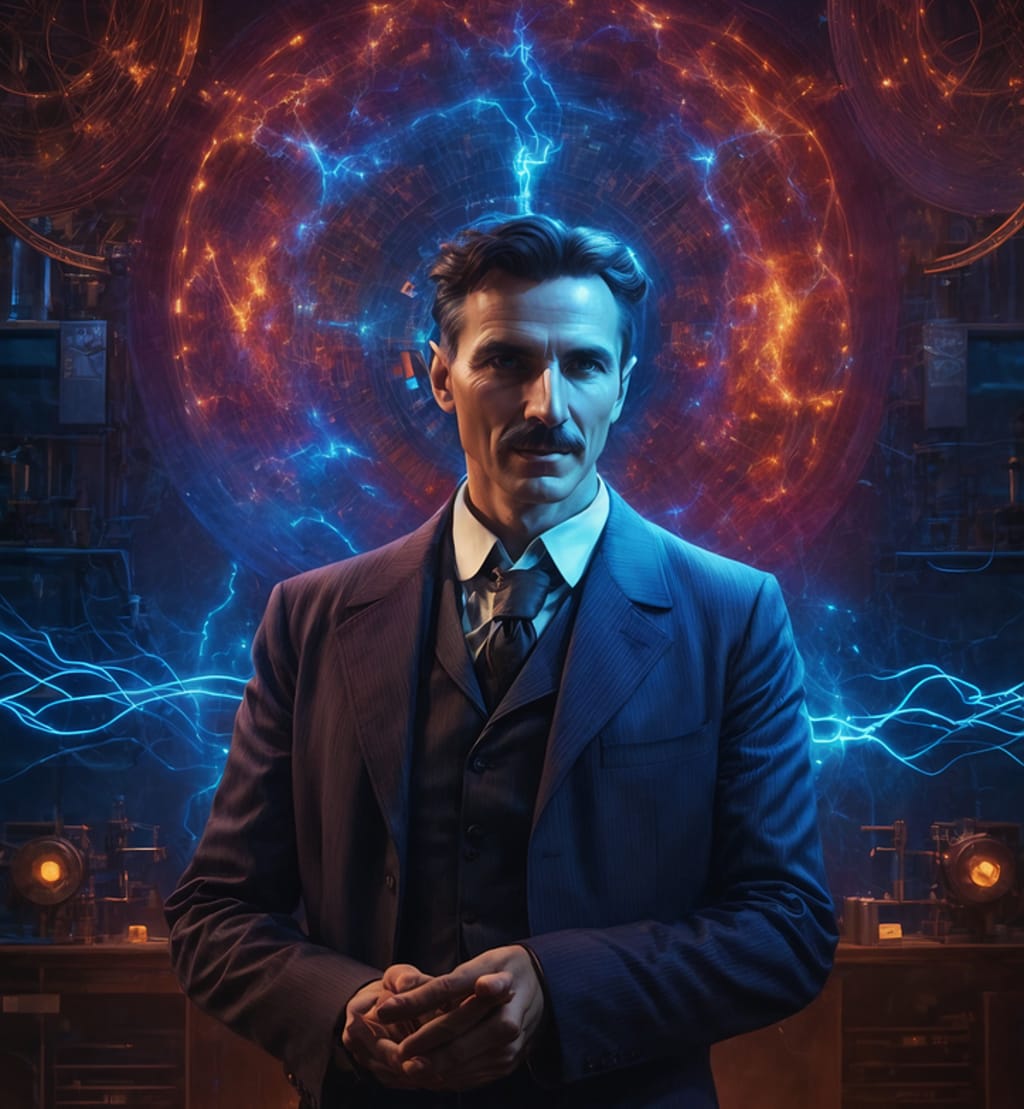
In the flickering light of a Manhattan laboratory, a peculiar man worked alone. Surrounded by coils, tubes, and devices that defied comprehension, he pursued ideas that most people couldn't even dream of. His name was Nikola Tesla.
Known for his brilliance in electricity, Tesla's contributions to modern life are evident everywhere, from wireless technology to the development of alternating current. However, among his many obscure experiments, one stands out as particularly mysterious: a machine that could shake buildings, mimic earthquakes, and potentially even tear apart entire cities if its full potential were ever realized.
They called it the Earthquake Machine. It was real. It was tested. And Tesla himself claimed it could split the Earth in half.
The Birth of the Resonance Experiment
In the late 1890s, Tesla became fascinated with the concept of mechanical resonance. This idea suggests that everything, from a bridge to a building or even the Earth itself, has a natural frequency at which it vibrates. By correctly applying the correct frequency, even the most solid structures can tremble, crack, or collapse.
Tesla believed he could harness this principle to create a machine that produced small, repeating vibrations that would grow stronger over time. Much like a child on a swing, a gentle push at just the right moment could lead to dramatic movement. Driven by this vision, he built a small device—a steam-powered mechanical oscillator, no larger than a toaster. One day, he decided to test it.
The Day Tesla Made a Building Shake
In 1898, inside his laboratory on East Houston Street in New York City, Tesla attached his oscillator to a steel support beam of the building. It began to hum, sending out rhythmic pulses. Initially, it was subtle, barely noticeable.
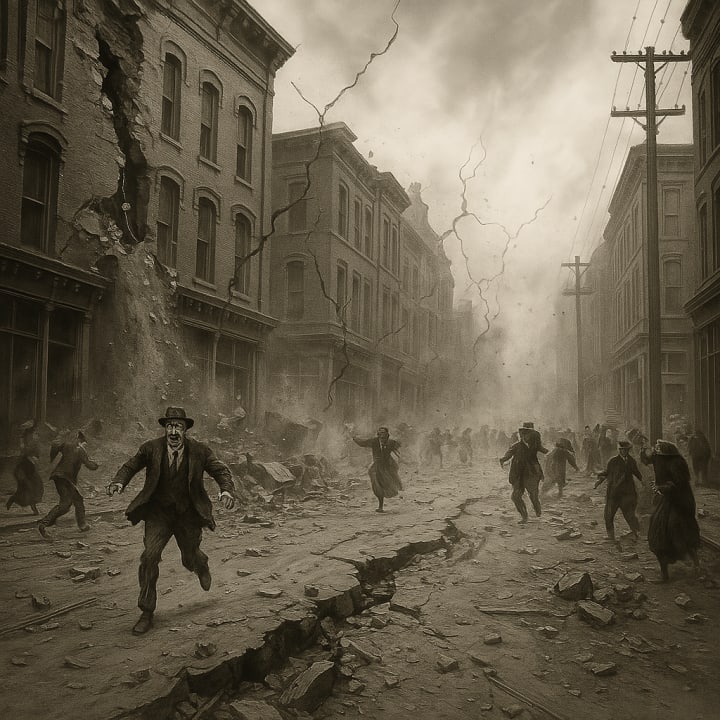
Then, strange events began to unfold. Metal equipment clanged together, the floor started to tremble, and cracks appeared in the walls. Panic spread throughout the neighborhood as windows shattered and people rushed into the streets, convinced that an earthquake had struck.
Realizing that the situation was spiraling out of control, Tesla grabbed a sledgehammer and smashed the device. The vibrations ceased immediately. When the police arrived, Tesla met them at the door. Calmly, he explained, "Gentlemen, I'm sorry. You are just a little late to witness my experiment. I was trying to shake the Earth."
The Science Behind the Machine
Tesla's oscillator operated by applying tiny yet precise mechanical pulses. Unlike explosives or brute force, it did not rely on sudden energy bursts; instead, it depended on timing, specifically, the phenomenon of resonance.
Imagine pushing a swing: if you push at the right moment, the swing goes higher and higher with minimal effort. However, if you try at random intervals, it barely moves. Tesla's oscillator worked similarly, only with solid objects such as walls, beams, bridges, or even the ground itself.
He believed that if properly tuned, his machine could create resonant vibrations powerful enough to destroy anything, from a skyscraper to the planet's crust. Tesla once stated, "If I had enough time and the right place, I could split the Earth like an apple."
Fear and Suppression
News about Tesla's earthquake machine spread, but rather than being celebrated, it was met with fear. A machine capable of causing earthquakes, toppling buildings, or being used as a weapon was something that neither governments nor financiers wanted in the hands of a lone inventor.
Tesla sought funding to develop the device further, but few were willing to invest in something with such destructive potential. Some believe the machine was suppressed, while others think it was stolen or that Tesla dismantled it himself, realizing it could be too dangerous if misused.
Today, no physical version of the machine survives; only Tesla's notes and scattered interviews remain.
Modern Echoes and the Power of Resonance
Years later, scientists confirmed the power of mechanical resonance, the same principle that caused the Tacoma Narrows Bridge in Washington to collapse in 1940. Wind created a resonant vibration that caused the massive steel structure to twist and fall like a ribbon. Tesla understood this concept decades earlier.
Today, some theorists speculate that similar technology may still be explored in secret, possibly within underground laboratories or military black projects. Whether it is used for peaceful purposes, such as earthquake research, or weaponization remains uncertain.
Tesla's original intention, however, was not to cause destruction but to gain understanding. He aimed to uncover the hidden rhythms of nature and discover the Earth's heartbeat.
A Power We Barely Understand
The Earthquake Machine was not science fiction; it was a real and functional device. For a brief moment in history, one man tapped into the deep forces lying beneath our feet.
Nikola Tesla believed that everything has a frequency. By understanding these frequencies, humanity could unlock limitless power, not just electrical, but also physical, spiritual, and universal.
Although his machine may be gone, the idea endures, a cold whisper from a time when science still danced with mystery, a time when one man dared to shake the world.
About the Creator
The Secret History Of The World
I have spent the last twenty years studying and learning about ancient history, religion, and mythology. I have a huge interest in this field and the paranormal. I do run a YouTube channel
Keep reading
More stories from The Secret History Of The World and writers in Futurism and other communities.
Do Spirits Have Guardians? Climbing the Infinite Ladder of Consciousness
The Spiritual Realm An age-old belief, whispered across cultures and in ancient texts, is that an invisible presence watches over every human or animal. Some call it a guardian angel, others a spirit guide, and some refer to ancestral protectors or divine watchers. These presences are said to guide our footsteps, shield us from unseen harm, and gently whisper truths into our dreams when the world becomes heavy. This belief is deeply embedded in the human spirit. Even in moments of silence or despair, we often feel that someone, or something, is there, just beyond the veil.
By The Secret History Of The WorldExclusive • 7 months ago
About Binding Prometheus
I want to start actively advocating on behalf of my own work, and the most valuable part of my canon is, without a doubt, Binding Prometheus, the play I have been working on since 2019 and only finished in 2023 as part of my MA. The play itself is an amalgamation of a million different inspirations. On one end, it evokes the Ancient Greek myth-play, deriving its own title from the earliest extant work of Western drama we have, Aeschylus’s Prometheus Bound. On the other end, it borrows significantly from the sci-fi bulwarks from over the years, namely Mary Shelley’s Frankenstein and Karel Capek’s Rossum’s Universal Robots. The play could be an episode of Black Mirror, I fear. I don’t know. I’ve only ever seen one episode of Black Mirror.
By Steven Christopher McKnight19 days ago in Futurism
Saudi Arabia Software Market: AI Integration, Vision 2030, Enterprise Solutions & Growth Outlook
Saudi Arabia's software market thrives on Vision 2030 initiatives, driving demand for cloud-native solutions and AI-integrated enterprise tools that empower sectors like fintech and healthcare with seamless digital transformation. According to IMARC Group's latest research publication, Saudi Arabia software market size reached USD 8.1 Billion in 2025. The market is projected to reach USD 23.5 Billion by 2034, exhibiting a growth rate (CAGR) of 12.57% during 2026-2034.
By Jeffrey Wilson5 days ago in Futurism
The Devil's Cut
“Comrade, finally you’re awake.” The voice was smooth, sensual. A flickering incandescent bar was all that lit the white, sterile room. All Vladimir remembered was everything going black. He tried to move his arms and found them strapped to the gurney.
By Matthew J. Fromm6 days ago in Fiction


Comments
There are no comments for this story
Be the first to respond and start the conversation.