

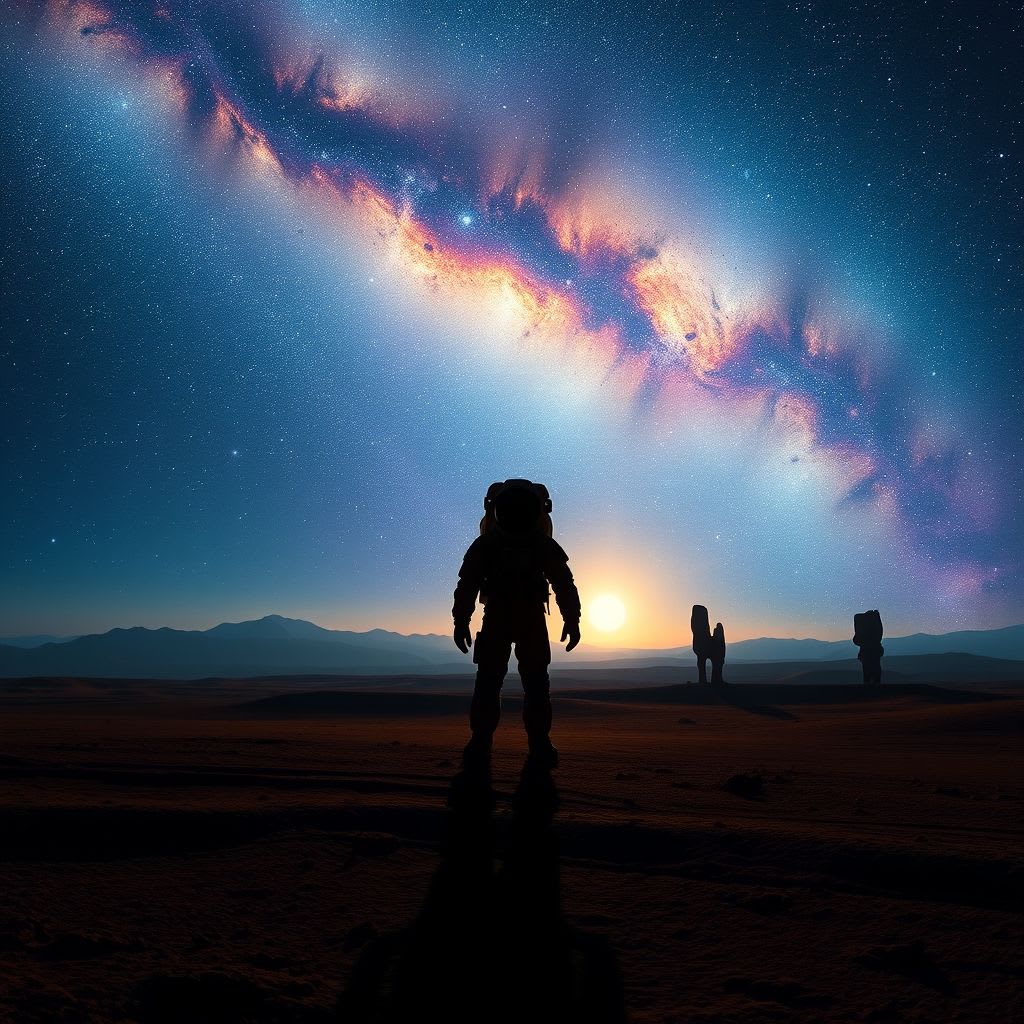
Scientists define life based on what we know: carbon-based organisms that depend on liquid water, complex molecules like DNA, metabolism, reproduction, and the ability to evolve. These are our checkboxes for what counts as living. But Earth is just one tiny speck in the endless darkness of space. What if our template isn’t universal, but exceptional?
Take, for example, how we search for exoplanets. We often look for Earth-like worlds in “habitable zones,” regions where liquid water might exist. But this approach assumes that life elsewhere must follow the same recipe as it does here. That’s a big assumption—and it might blind us to other, more exotic possibilities.
Alternative Forms of Life
Scientists are increasingly open to the idea of life not based on carbon. Could silicon, for instance, serve as a life-building element? Could ammonia or methane replace water as a solvent for biochemical reactions?
On Saturn’s moon Titan, for example, lakes of liquid methane and ethane stretch across the surface. It’s freezing cold—about -179°C—but some researchers believe this alien environment could host methane-based microorganisms. Meanwhile, Europa and Enceladus, moons of Jupiter and Saturn, may have subsurface oceans beneath icy crusts, warmed by tidal forces—potential homes for life in complete darkness.
Even more radically, life could exist in forms we wouldn't even recognize—tiny clouds of plasma, magnetic structures, or energy-based entities that challenge our basic understanding of what it means to be alive.
Signs of Life Across the Universe
If we zoom out to a cosmic perspective, life might not just be a collection of chemical reactions. It could be a broader principle: the tendency of matter to self-organize and maintain complexity. In this view, life isn’t limited to cells or DNA—it might manifest as any system that evolves, adapts, and persists in defiance of entropy.
This line of thinking has inspired wild, but increasingly serious, theories. Could entire planets, or even galaxies, be considered living systems? Could black holes or quantum fields play a role in some kind of universal intelligence? These ideas once belonged strictly to science fiction—but now they’re edging into the realm of speculative science.
Life: Rare or Inevitable?
One of the great cosmic questions is whether life is a rare fluke or a natural consequence of physics and chemistry. On Earth, life appeared relatively quickly—within a few hundred million years of the planet’s formation. That suggests life might emerge easily, given the right conditions.
Yet, despite the discovery of thousands of exoplanets—many in potentially habitable zones—we’ve found no clear sign of intelligent life. The famous Fermi Paradox looms large: Where is everybody?
Some argue that life is common, but intelligence is rare. Others say we’re simply looking for the wrong thing—or not looking hard enough.
Beyond Biology
Some thinkers go even further, proposing that life in the cosmic sense may not be biological at all. What if stars, black holes, or even galaxies are parts of a vast cosmic organism? This sounds mystical, but modern physics increasingly confronts mysteries that blur the line between living and non-living, conscious and unconscious, matter and information.
For instance, the idea of the universe as a kind of simulation or information-processing system raises profound questions. Could “life” exist as self-aware patterns in the fabric of spacetime itself?
Conclusion: Rethinking Life
Understanding life on a cosmic scale challenges not just our science, but our imagination. We search for alien organisms—but maybe the more urgent task is to redefine what life really is.
Life might not only be what breathes, grows, and reproduces. It could also be what thinks in unfamiliar ways, interacts through unknown means, or exists in forms we’ve yet to comprehend. The cosmos may already be full of life—just not as we know it.
As we gaze into the stars, hoping for signs of cosmic neighbors, perhaps the universe is already aware of us. Perhaps we are one of its many experiments in being alive.
About the Creator
Keep reading
More stories from Holianyk Ihor and writers in Futurism and other communities.
Earth’s Twins: Where in the Galaxy Are the Odds Highest?
In a universe filled with billions of stars and untold planetary systems, the idea of a “second Earth” is no longer just science fiction — it’s a real, pressing question in modern astronomy. Scientists call these potential look-alikes terrestrial exoplanets — worlds similar to Earth in size, atmosphere, and potential habitability. But where exactly in our galaxy are we most likely to find them?
By Holianyk Ihor8 months ago in Futurism
About Binding Prometheus
I want to start actively advocating on behalf of my own work, and the most valuable part of my canon is, without a doubt, Binding Prometheus, the play I have been working on since 2019 and only finished in 2023 as part of my MA. The play itself is an amalgamation of a million different inspirations. On one end, it evokes the Ancient Greek myth-play, deriving its own title from the earliest extant work of Western drama we have, Aeschylus’s Prometheus Bound. On the other end, it borrows significantly from the sci-fi bulwarks from over the years, namely Mary Shelley’s Frankenstein and Karel Capek’s Rossum’s Universal Robots. The play could be an episode of Black Mirror, I fear. I don’t know. I’ve only ever seen one episode of Black Mirror.
By Steven Christopher McKnight12 days ago in Futurism
Kitchen Appliances Industry: Smart Homes, Sustainability & Product Innovation Trends
According to IMARC Group's latest research publication, global kitchen appliances market size reached USD 242.96 Billion in 2024. Looking forward, IMARC Group expects the market to reach USD 353.96 Billion by 2033, exhibiting a growth rate (CAGR) of 4.82% during 2025-2033.
By Andrew Sullivan6 days ago in Futurism


Comments (1)
You raise some really interesting points. I never thought about how our search for exoplanets might be too narrow. The idea of life based on silicon instead of carbon is mind-blowing. And those moons with potential subsurface oceans? Fascinating. It makes me wonder what other strange forms of life could be out there that we haven't even considered yet. How do you think we could start looking for these more exotic possibilities?