
The Dawn of 2050: A World Reimagined
Subtitle: A Vision of 2050 – Where Innovation Meets Harmony

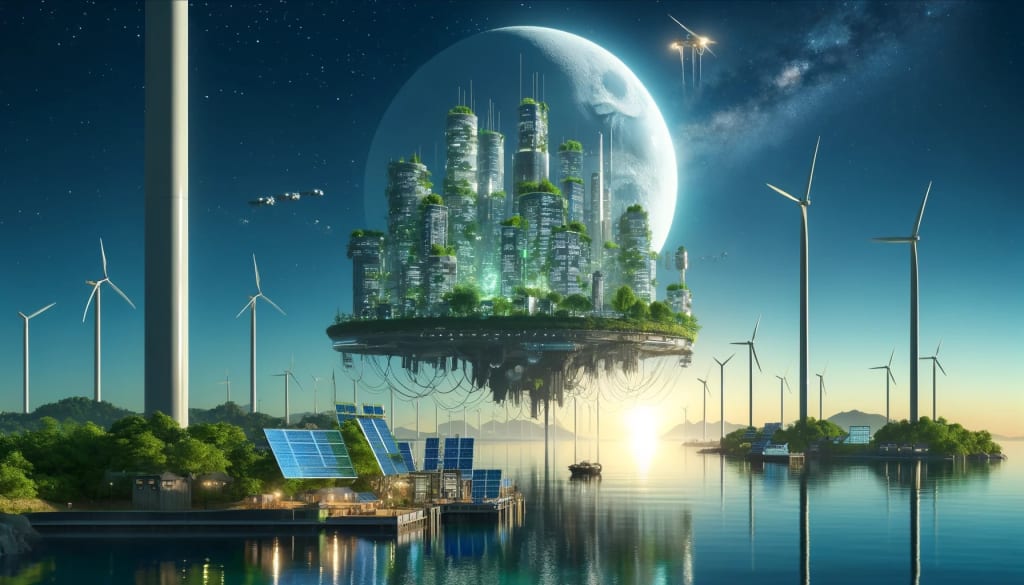
The year was 2050, and the Earth hummed with the rhythm of innovation and renewal. The scars of the early 21st century—climate crises, societal divides, and technological misuse—had not been forgotten. Instead, they had become the crucibles in which a brighter future was forged. Humanity had learned, adapted, and dared to dream again.
A City in the Sky
Lena Reyes gazed out of her office window in New Concordia, the world’s first sustainable floating city. Suspended over the Pacific Ocean, the city was a marvel of engineering, powered entirely by solar wind and oceanic turbines. New Concordia symbolized humanity’s ability to harmonize with nature rather than conquer it.
Lena, a bioengineer, worked on the cutting-edge Symbiosis Initiative, a global project that aimed to merge biotechnology with urban living. The city itself was alive—walls coated in photosynthetic materials, buildings infused with fungal networks that repaired microfractures, and air-purifying mosses cultivated on every rooftop.
But the highlight of Lena’s work was the Eden Grid: a sprawling network of genetically engineered plants that could store and transmit data, effectively serving as a living internet. What made the Eden Grid groundbreaking wasn’t just its technology but its philosophy—embracing interconnectedness, resilience, and a return to organic systems in the digital age.
A Message from Beyond
That morning, Lena received a peculiar message from Amal, a scientist stationed in the Lunar Settlement. The message was cryptic: "We need your expertise. Eden might hold the key."
The Lunar Settlement, established in 2035, had become a hub for space exploration and research. Its scientists had recently encountered a puzzling anomaly—a faint signal originating from beneath the Moon’s surface. Initial analysis suggested it wasn’t natural, but its origins defied current understanding.
Lena’s heart raced as she packed her belongings. Collaborating with lunar researchers was a rare honor, and the idea that her work could have extraterrestrial implications filled her with equal parts excitement and trepidation.
The Journey to the Moon
Traveling to the Moon in 2050 was no longer a feat reserved for astronauts. Orbital elevators, powered by carbon-nanotube tethers, and advanced fusion propulsion systems had reduced the trip to just a few hours.
As Lena approached the Lunar Settlement, she marveled at the sight of Earth hanging in the void—a vibrant, green-and-blue jewel that had been lovingly restored over decades of environmental recovery efforts. The image reminded her why humanity’s ingenuity mattered.
Upon arrival, Amal greeted her with a sense of urgency. "Lena, we’ve triangulated the signal’s source. It’s coming from what appears to be an underground chamber. We believe it’s artificial, but we can’t decipher the signal. That’s where Eden comes in."
The Unveiling of Truth
The underground chamber was breathtaking—an enormous cavern lined with crystalline structures that seemed to pulse with an otherworldly glow. The team had already deployed drones to map the area, but its full scale was beyond comprehension.
At the chamber’s center lay an object—a monolithic artifact covered in glyph-like patterns that shifted subtly when observed. Lena approached cautiously, her handheld Eden interface scanning the artifact’s surface.
What happened next was unexpected. As the Eden interface synchronized with the artifact, a burst of bioluminescent patterns rippled across the chamber walls. The artifact began emitting a series of harmonic tones, each resonating with frequencies that seemed to transcend hearing.
Suddenly, a projection filled the chamber: a star map, overlaid with streams of encoded data. Amal’s voice was barely a whisper. "It’s… a message."
Deciphering the Past, Shaping the Future
Over weeks, the team worked tirelessly to decode the message. It wasn’t a warning or an invitation; it was a repository—a cosmic archive of knowledge left behind by an ancient civilization that had achieved interstellar travel long before humanity’s existence.
The archive contained insights into energy systems that defied entropy, biological enhancements that harmonized life with its surroundings, and a philosophy of coexistence that emphasized mutual growth over conquest.
The Eden Grid became instrumental in understanding the archive. Its living networks translated the artifact’s data into comprehensible formats, revealing not only technological blueprints but also profound ethical teachings.
A New Hope
By the time Lena returned to Earth, the world had changed. The knowledge gained from the lunar artifact ignited a second Renaissance. New energy systems based on quantum coherence began to replace the last remnants of fossil fuels. Medical breakthroughs extended life expectancy while ensuring quality of life. Cities adopted biophilic designs inspired by the alien archive, creating environments that nurtured both humans and the planet.
But perhaps the greatest change was philosophical. The artifact’s teachings emphasized the fragility of life and the interconnectedness of existence. Nations began to collaborate on unprecedented scales, dissolving centuries-old barriers in favor of shared progress.
Lena’s work with Eden became a symbol of this new era. The Grid expanded, connecting ecosystems, urban centers, and even space habitats into a unified, symbiotic network. Humanity no longer saw itself as the master of its environment but as an integral part of it—a shift that promised lasting harmony.
Reflections on a New Era
As Lena stood on the balcony of her New Concordia home, she looked toward the night sky. The Moon, now a beacon of hope, shone brightly. She thought about how far humanity had come—from the brink of collapse to the cusp of a boundless future.
The year 2050 was not an endpoint but a beginning. A reminder that innovation, when paired with compassion and humility, could transform challenges into opportunities. The unexpected discovery on the Moon had taught humanity a vital lesson: hope often lies in the unknown, waiting to be found by those brave enough to seek it.
In the shimmering glow of New Concordia’s living lights, Lena smiled. The future was no longer something to fear—it was something to embrace.
About the Creator
The Last Fortress
The Final Frontier of Privacy For centuries, the human mind has been the only place where true freedom existed. No matter how oppressive a regime was, or how invasive a technology became, your thoughts were yours alone. They were the "Last Fortress"—a sanctuary of private dreams, silent rebellions, and unspoken loves.
By Alex Sterling 7 days ago in Futurism
Microencapsulation Market Outlook: Controlled Release Technologies and Application Expansion Opportunities
According to IMARC Group's latest research publication, the global microencapsulation market size reached USD 11.3 Billion in 2024. Looking forward, IMARC Group expects the market to reach USD 22.1 Billion by 2033, exhibiting a growth rate (CAGR) of 7.38% during 2025-2033.
By James Whitman6 days ago in Futurism



Comments
There are no comments for this story
Be the first to respond and start the conversation.