
The Cosmic-Scale Paradox: How Infinity Shapes Our Perception of Reality
Space


When we gaze up at the night sky, a sense of wonder often mixes with a quiet unease. The universe is vast breathtakingly silent, dazzlingly beautiful, and perhaps… infinite. This idea of infinity is not just a scientific curiosity. It’s a profound philosophical paradox that challenges our very perception of what is real, what is possible, and what it means to exist.
What Is Infinity and Why Might the Universe Need It?
Infinity isn’t just a really large number. It’s a concept that defies the boundaries of ordinary logic. If the universe is truly infinite, it has no edge, no center, and no limit in any direction. There could be an infinite number of stars, galaxies, and planets and here’s where things get really strange infinite versions of us. Somewhere out there, a version of you may be reading this article with a cup of coffee in your other hand… or with pink hair. It sounds like science fiction, but it’s a logical consequence of an infinite universe.
In such a cosmos, every possible combination of particles must exist somewhere. Every slight variation of reality you can imagine and even those you can't could be unfolding in parallel at this very moment.
The Boltzmann Brain Paradox: A Thought Experiment in Chaos
Here’s a mind-bender: in an infinite universe, with infinite time and particles constantly rearranging, order can emerge spontaneously by sheer chance. Physicist Ludwig Boltzmann proposed that under the right circumstances, a human brain could randomly form in the vacuum of space, complete with fake memories and false consciousness. This bizarre theoretical entity is known as a Boltzmann Brain.
Now comes the unsettling question: how do you know you’re not one of them? How can you be certain that everything you remember your past, your identity, even the act of reading this article isn’t just a fleeting fluctuation in a sea of entropy?
Infinity opens the door to these paradoxes. The more vast the universe becomes, the more likely it is that even the most absurd configurations of matter will appear somewhere.
The Paradox of Repetition: If Everything Exists, Does Anything Matter?
If the universe is infinite and combinations of atoms are finite, repetition becomes inevitable. Not only might there be another Earth, but an endless variety of alternate Earths: one where dinosaurs still roam, one where Napoleon conquered Russia, one where you became an astronaut.
But here's the philosophical twist if everything exists, does anything matter? The thought can be deeply unsettling. If all possible versions of your life are out there somewhere, does that make your choices here meaningless?
Not necessarily. This is where human meaning-making comes into play. The infinite doesn't strip life of its value it offers a canvas where meaning is something we create, not discover prewritten in the stars.
Facing the Infinite: A Psychological Challenge
Our brains evolved to navigate villages, not galaxies. We’re used to beginnings and endings, walls and borders. Confronting the infinite can induce a kind of existential vertigo a feeling of disorientation triggered by the realization of just how small and temporary we are in a cosmos without edges.
This reaction isn’t uncommon. Even seasoned astronomers admit to moments of existential discomfort when contemplating the depths of space. Yet others find comfort in the same thought. Infinity can mean we are not alone. It suggests that life may not be a fluke, but a natural outcome in an endless array of possibilities.
Each decision, each action, takes on significance not because it's unique in the cosmos, but because it's ours anchored in this version of reality, right now.
The Universe as a Mirror
Infinity is not just a scientific concept; it’s a mirror reflecting our inner world. Some see loneliness. Others, hope. Some find nihilism, while others discover boundless potential.
In this way, the question of infinity isn’t just cosmological. It’s emotional. Spiritual. Psychological. It invites us to confront our place in the universe not with fear, but with curiosity.
In the End… or Perhaps Without One
Maybe we’ll never know for sure whether the universe is infinite. But the very act of contemplating it expands us. It stretches the boundaries of our imagination and forces us to rethink our role in the cosmos.
And perhaps that is the true gift of infinity. It compels us to look wider, think deeper, and recognize ourselves not just as individuals living short lives on a small planet, but as conscious participants in a story too grand to be fully written or even fully understood.
So next time you look at the stars, don’t be afraid to get lost in their endlessness. Maybe that’s where we find the truest version of ourselves reflected in the infinite.
About the Creator
Keep reading
More stories from Holianyk Ihor and writers in Futurism and other communities.
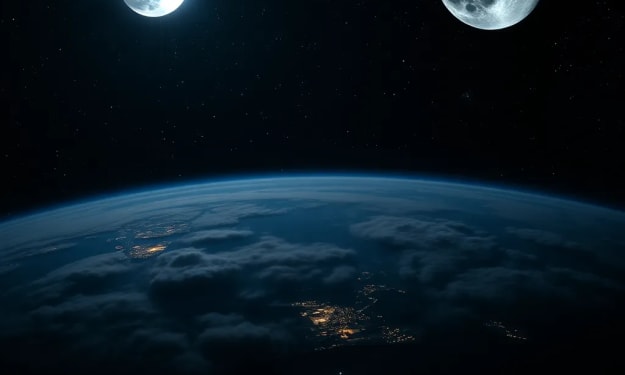
What If Earth Had Two Moons?
When we look up at the night sky and see the Moon glowing peacefully above us, everything seems just right. The Moon stabilizes Earth’s tilt, controls the tides, and has inspired poets, artists, and scientists for centuries. But what if there weren’t just one Moon what if Earth had two? How would that change our planet, our lives, and our future?
By Holianyk Ihor6 months ago in Futurism
About Binding Prometheus
I want to start actively advocating on behalf of my own work, and the most valuable part of my canon is, without a doubt, Binding Prometheus, the play I have been working on since 2019 and only finished in 2023 as part of my MA. The play itself is an amalgamation of a million different inspirations. On one end, it evokes the Ancient Greek myth-play, deriving its own title from the earliest extant work of Western drama we have, Aeschylus’s Prometheus Bound. On the other end, it borrows significantly from the sci-fi bulwarks from over the years, namely Mary Shelley’s Frankenstein and Karel Capek’s Rossum’s Universal Robots. The play could be an episode of Black Mirror, I fear. I don’t know. I’ve only ever seen one episode of Black Mirror.
By Steven Christopher McKnight17 days ago in Futurism
UAE Weight Loss Market: Rising Health Awareness, Lifestyle Shifts & Growth Outlook
According to IMARC Group's latest research publication, UAE Weight Loss Market size was valued at USD 1,210 Million in 2025 and is projected to reach USD 1,870 Million by 2034, growing at a compound annual growth rate of 4.93% from 2026-2034.
By Abhay Rajput3 days ago in Futurism



Comments
There are no comments for this story
Be the first to respond and start the conversation.