
The Cloud Chamber at CERN
How the Big European Bubble Chamber Transformed Particle Physics in the 20th Century

The Cloud Chamber at CERN
When we think of the great milestones in modern science, the mind often jumps to spacecrafts, satellites, and groundbreaking discoveries like DNA or the Higgs boson. Yet, hidden behind the spotlight lies a remarkable tool that quietly changed the way humanity studies the invisible building blocks of matter: the cloud and bubble chambers. Among them, one machine stood out in scale and impact — the Big European Bubble Chamber (BEBC) at CERN.
This massive detector was more than just steel and hydrogen. It was a technological bridge between theory and evidence, a device that allowed scientists to “see” particles that are otherwise too small and too fast to detect with the naked eye. From its construction in 1970 to its active years between 1973 and 1984, BEBC became one of the most important particle detectors in history.
The Vision Behind the Bubble Chamber
The idea of tracking invisible particles with bubbles began with Donald A. Glaser, who invented the first bubble chamber in 1952. The principle was elegant: when charged particles move through a superheated liquid, they leave behind trails of tiny bubbles along their paths. These tracks could then be photographed and analyzed to reconstruct the particles’ properties.
At CERN, the European Organization for Nuclear Research, the bubble chamber technique quickly became essential. However, the more scientists pushed the boundaries of particle physics, the bigger and more sophisticated the chambers needed to be. By the late 1960s, Europe embarked on building a detector of unprecedented scale: the Big European Bubble Chamber.
Arrival of the Giant: August 1970
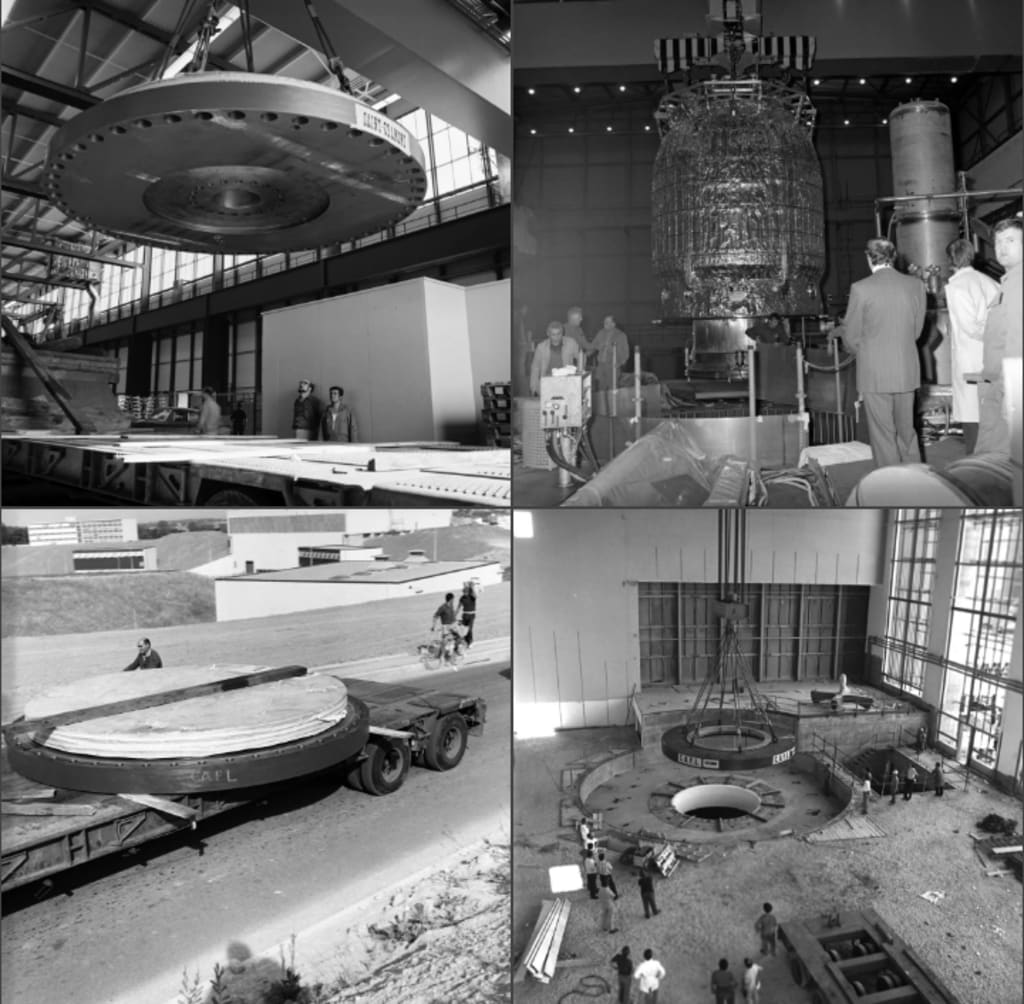
In August 1970, the first massive units of magnetic shielding for the BEBC arrived at CERN. They were manufactured in France by Forges et Ateliers de la Loire. These colossal pieces included a 48-ton lower disc, a reminder of just how ambitious the project was. The size and weight were not for show — the chamber needed powerful magnetic fields and heavy shielding to guide and measure the particle tracks with precision.
By 1973, the chamber was completed and filled with liquid hydrogen, though it could also use other cryogenic liquids such as deuterium or neon, depending on the experiment. It measured an impressive 3.7 meters in diameter and held about 35 cubic meters of liquid hydrogen — enough to make it one of the largest bubble chambers ever built.
How BEBC Worked
At its core, the BEBC functioned like other bubble chambers but on a much larger scale. Here’s how it worked in simple terms:
Filling with Liquid Hydrogen: The chamber was filled with hydrogen cooled to a liquid state. Hydrogen was chosen because of its simplicity — being the lightest element, it made particle interactions easier to study.
Superheating: The liquid hydrogen was kept in a delicate state, just at the edge of boiling. This made it ready to form bubbles whenever a charged particle passed through.
Particle Beams: High-energy particle beams, generated by CERN’s accelerators, were directed into the chamber.
Bubble Tracks: As the particles traveled through the liquid, they ionized atoms along their path, creating microscopic disturbances. These disturbances caused bubbles to form, tracing the invisible journey of the particles.
Photography: High-speed cameras surrounding the chamber captured the bubble trails from multiple angles. Scientists then studied these photographs to reconstruct the motion, energy, and interactions of the particles.
It was a technique that turned the abstract world of subatomic physics into something visible, almost artistic — a photograph of the invisible.
Scientific Achievements and Legacy
Between 1973 and 1984, the BEBC was at the center of many groundbreaking experiments in particle physics. Over the course of its operation, it produced millions of photographs of particle interactions. Among its key contributions:
Neutrino Physics: BEBC was heavily used to study neutrinos, the elusive “ghost particles” that barely interact with matter. Data from BEBC experiments improved our understanding of how neutrinos interact with protons and neutrons, contributing to the Standard Model of particle physics.
Weak Interactions: The chamber provided direct experimental evidence about the weak nuclear force, one of the four fundamental forces of nature.
Quark and Parton Models: By analyzing the deep inelastic scattering of particles inside BEBC, scientists gained insight into the internal structure of protons and neutrons, confirming aspects of the quark-parton model.
Hadron Interactions: It offered valuable data on how hadrons — particles made of quarks, like protons and pions — interact at high energies.
The chamber’s versatility also allowed for experiments with different target liquids, each giving unique insights into particle interactions.
From Photographs to Digital Data
One of the charming aspects of the BEBC era was its reliance on photography. Thousands upon thousands of images were taken of bubble trails, often requiring teams of researchers and technicians to painstakingly analyze them by hand. Students and scientists alike would spend hours using “measuring machines” to trace the bubbles and convert them into numerical data.
Today, this may sound slow compared to the instantaneous digital readouts of modern detectors like ATLAS or CMS at the Large Hadron Collider. Yet, it was this hands-on approach that trained generations of physicists and produced some of the most iconic images in the history of science.
The End of an Era
By the early 1980s, technology was moving fast. Electronic detectors, which could capture and process particle data more efficiently, began to replace bubble chambers. In 1984, BEBC was officially retired after more than a decade of service.
But retirement did not mean irrelevance. The knowledge gained from BEBC lives on in scientific literature and in the careers of countless physicists who worked with it. Its legacy also paved the way for the giant detectors we see today at CERN’s Large Hadron Collider, which continue the quest to understand the universe at its most fundamental level.
Why BEBC Still Matters Today
Although BEBC is no longer active, it remains a powerful symbol of what science can achieve when nations collaborate and when engineers and physicists push the limits of technology. The chamber was not only a tool for discovery but also a training ground for the global community of particle physicists.
Moreover, it stands as a reminder of the creative ways scientists have developed to “see” the unseen. Long before digital sensors and computer simulations, humanity relied on ingenuity — in this case, boiling hydrogen and high-speed photography — to make sense of the universe’s smallest secrets.
Conclusion
The Big European Bubble Chamber at CERN was more than an experiment; it was a monumental step in humanity’s exploration of the subatomic world. From its massive 48-ton components arriving in 1970 to its decade-long contribution to science, BEBC helped build the foundations of modern particle physics.
Today, as we admire the stunning complexity of detectors at the Large Hadron Collider, it’s worth remembering that these marvels stand on the shoulders of earlier giants like the BEBC. It was in chambers filled with bubbling hydrogen that physicists first captured the ghostly footprints of particles — a reminder that even the smallest bubbles can hold the biggest secrets of the universe.
Sources
CERN Courier. The Big European Bubble Chamber (BEBC): A Decade of Discoveries. CERN Publications, 1985.
Donald A. Glaser. The Bubble Chamber. Nobel Lecture, 1960.
Herve, A. The BEBC Experiments at CERN: Results and Legacy. European Journal of Physics, 1986.
Schopper, H. LEP – The Large Electron–Positron Collider: From Conception to Approval. Springer, 2009. (Context on CERN’s transition from bubble chambers to electronic detectors).
About the Creator
Mohamed hgazy
Fiction and science writer focused on physics and astronomy. Exploring the human experience through imagination, curiosity, and the language of the cosmos.
Keep reading
More stories from Mohamed hgazy and writers in Futurism and other communities.
Yacht Charter Market Insights: Adventure Tourism Growth, Premium Experiences & Industry Outlook to 2034
Rising wealth among high-net-worth individuals, an increasing trend toward experiential luxury travel, and significant technological advancements in vessel design are fueling the demand for yacht charters. This growth is further supported by the expansion of coastal tourism, the rising popularity of marine events, and the integration of digital booking platforms that offer seamless customer experiences. According to IMARC Group’s latest data, the global yacht charter market size reached USD 9.7 Billion in 2025. Looking forward, IMARC Group expects the market to reach USD 16.9 Billion by 2034, exhibiting a CAGR of 6.36% during 2026-2034.
By Andrew Sullivan4 days ago in Futurism
Faucet Market Trends: Commercial Infrastructure Growth, Efficiency Solutions & Industry Forecast to 2034
In the modern home and commercial space, the humble faucet has evolved from a basic utility into a high-tech centerpiece of design and sustainability. Driven by rapid urbanization and a global shift toward smarter, more hygienic living environments, the market is seeing a surge in demand for fixtures that blend aesthetic appeal with cutting-edge water-saving technology. According to IMARC Group’s latest data, the global faucet market size was valued at USD 31.03 Billion in 2024. Looking forward, IMARC Group estimates the market to reach USD 58.30 Billion by 2033, exhibiting a CAGR of 6.51% from 2025-2033.
By Andrew Sullivan6 days ago in Futurism
Pearl
1980 something. we all hung out at Pearl and you and i were nothing special, or so i thought. i mean we all danced, drenched in our own sweat, our own saline solution of fear, too many beers, shots, laughter, tears, fucks in the bathroom and i don't know when we began to be afraid. do you?
By ROCK aka Andrea Polla (Simmons)4 days ago in Fiction



Comments
There are no comments for this story
Be the first to respond and start the conversation.