
THE BIG CRUNCH THEORY
How our Universe will end?

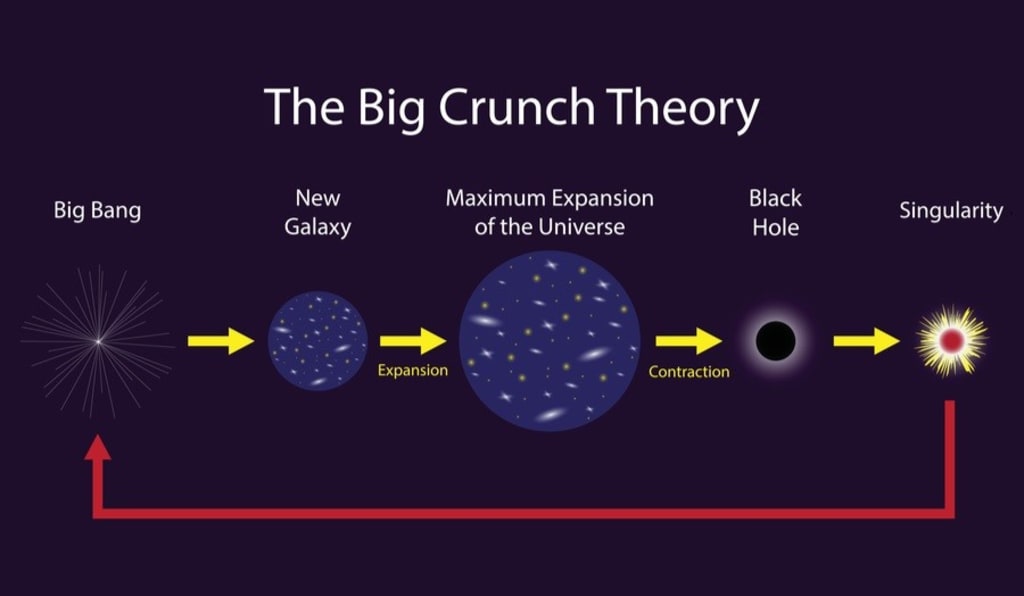
We've all heard about the Big Bang, and I am really sad that the series has ended. Well, here, of course, I'm talking about the Big Bang that actually started everything. Again, most people have heard of that, but what do you know about the Big Crunch? And no, I'm not talking about some random candy bar. While most scientists believe that our universe began with a massive burst of energy, opinions remain divided about how everything will one day come to an end. There's a range of theories, such as the Big Freeze and the Big Rip, but the one considered to be the most likely scenario is the Big Crunch.
So, what is the Big Crunch? The Big Crunch Theory has its roots in Einstein's theory of general relativity. Everything in life follows an ebb and flow. When one event occurs, the reverse is likely to occur after hitting the extreme. If the Big Bang causes the expansion of the universe, then eventually the opposite will become true. Once the universe has reached its largest size, as determined by the amount of energy that's present, it will begin to collapse in on itself and, in the end, form a massive black hole that contains all matter. Due to the conditions present in the singularity of this size, everything will be squashed down to a minuscule size, which is why it's called the Big Crunch.
So, probably not great news for all those of you who are a fan of bacon and tend to live billions of years! Well, here's the good news: while the math suggests that the Big Crunch is possible and even probable, there's a problem for those who dedicate their careers to understanding questions like this. We don't yet fully comprehend everything in the universe, and there are a couple of unknowns that will affect our ultimate fate.
First, the universe's expansion appears to be the interplay of two factors: density and outward momentum. Density has a direct correlation to the amount of gravity present; the denser the universe, the more gravitational forces at play. This on its own would mean that everything will eventually gravitate towards everything else, and the final Big Crunch becomes an inevitability. Although there's no friction in space, the effect of gravity would be more than enough to counteract the initial outward momentum caused by the Big Bang, and all matter would essentially return to where it came from.
The problem, though, is that observations of the universe have shown that things aren't behaving as simply as we would expect. The outer reaches appear to be expanding at a faster rate than those closer to us, and galaxies are actually moving further apart from each other. Scientists don't know why this is happening, but they have given a name to this unknown entity: dark energy. This extra element in the expansion of the universe means that there are two potential outcomes. The universe will either continue to expand forever, and objects will be so far apart from each other that everything will freeze, or we could still face a Big Crunch. The determining factor is how much dark energy there actually is. If there is enough, which some scientists believe could be the case, then everything will continue to expand. If there isn't enough, though, then the forces of gravity will once more eventually overcome and bring everything back together again.
Some believe the seeming prevalence of dark energy could signal the beginning of the Big Crunch. However, in a report released in 2015, it was suggested that the current increased rates of expansion are the last gasp of the expanding universe and that within tens of billions of years, the contraction will begin.
So, how would the Big Crunch happen? If we assume that there isn't enough dark energy and that the Big Crunch does take place, then it won't be as spectacular as the Big Bang was. The universe will begin to contract evenly because matter is more or less distributed consistently. It would be a slow process that would gradually pick up speed as galaxies got closer to one another and the forces of gravity had more of an effect. In about a hundred billion years from now, as things reach a climax, temperatures would significantly increase. This will result in stars exploding and vaporizing, and all objects will be broken down into their constituent atoms, which themselves will begin to break apart. In the final stages, as all matter from the universe compacts into a small space, things will become extremely chaotic. Some predictions suggest that space-time will become so warped that it will shatter into droplets, making all concepts of time, distance, and direction meaningless.
Of course, no living organism would be able to survive to this point, and we would have all been doomed a long time before this. So, with our lack of full understanding of the processes taking place in the universe, it's impossible to know for sure how everything will end. One scenario is the Big Crunch, which would see every piece of matter returning to where it originated, and all that would remain is an unimaginably large black hole. What happens at that point really is anyone's guess, and it could potentially see the birth of a new universe. It's also possible that this has all happened a number of times already and we're alive in just another in a long line of cyclical expansions and contractions. Again, only those of you planning to be alive for billions of years will really have to worry about this.
Thank you all for reading!
About the Creator
Richchik Bardhan
A MBBS student,Love to read and write about science facts and sometimes sci-fic too because Some sci-fic can later be proven into facts someday.....
Keep reading
More stories from Richchik Bardhan and writers in Futurism and other communities.
BERMUNDA TRIANGLE OF SPACE
I think you are all probably aware of and even intrigued by the North Atlantic Ocean's legendary Bermuda Triangle, which is supposedly the cause of many aircraft and ship disappearances under mysterious circumstances. But did you know that space also has its own bizarre Bermuda Triangle, nicknamed the South Atlantic Anomaly (SAA)? To understand this anomaly, the first thing you need to know, which is pretty obvious, is that outer space is not one of the friendliest zones. It is a new day with many familiar and often unfamiliar threats, such as harsh cosmic rays. These cosmic rays are comprised of high-energy particles that are powerful enough to wreak havoc on living beings and electronic devices.
By Richchik Bardhanabout a year ago in Futurism
About Binding Prometheus
I want to start actively advocating on behalf of my own work, and the most valuable part of my canon is, without a doubt, Binding Prometheus, the play I have been working on since 2019 and only finished in 2023 as part of my MA. The play itself is an amalgamation of a million different inspirations. On one end, it evokes the Ancient Greek myth-play, deriving its own title from the earliest extant work of Western drama we have, Aeschylus’s Prometheus Bound. On the other end, it borrows significantly from the sci-fi bulwarks from over the years, namely Mary Shelley’s Frankenstein and Karel Capek’s Rossum’s Universal Robots. The play could be an episode of Black Mirror, I fear. I don’t know. I’ve only ever seen one episode of Black Mirror.
By Steven Christopher McKnight20 days ago in Futurism


Comments (2)
Amazing
Thanks for sharing