
BERMUNDA TRIANGLE OF SPACE
The SOUTH ATLANTIC ANOMALY(SAA)

I think you are all probably aware of and even intrigued by the North Atlantic Ocean's legendary Bermuda Triangle, which is supposedly the cause of many aircraft and ship disappearances under mysterious circumstances. But did you know that space also has its own bizarre Bermuda Triangle, nicknamed the South Atlantic Anomaly (SAA)? To understand this anomaly, the first thing you need to know, which is pretty obvious, is that outer space is not one of the friendliest zones. It is a new day with many familiar and often unfamiliar threats, such as harsh cosmic rays. These cosmic rays are comprised of high-energy particles that are powerful enough to wreak havoc on living beings and electronic devices.
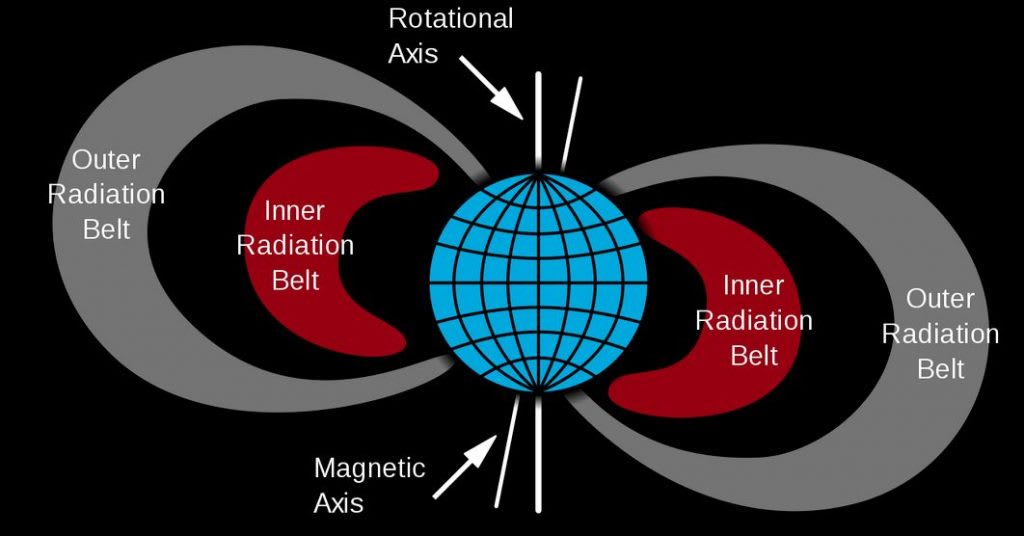
Thankfully, the Earth possesses its own force field, essentially a shield of protective radiation belts known as the Van Allen belts, which safeguard our planet's atmosphere from potentially damaging cosmic rays. At times, even additional transient belts may be created, as was the case in 2013 when NASA reported a third radiation belt, which was subsequently shattered by the Sun's powerful interplanetary shockwave. These radiation belts were first discovered in 1958 and are named after James Alfred Van Allen, an American space scientist who first established their existence using his Geiger-Müller tube instruments.
The inner doughnut-shaped Van Allen belt exhibits a high concentration of protons. It begins at an altitude of 1,000 kilometers and extends to 6,000 kilometers above the Earth's surface. In contrast, the outer Van Allen belt is dominated by electrons and extends from an altitude of 13,000 kilometers to 60,000 kilometers above the surface of the Earth, forming regions of intense radiation that encircle the Earth. The Van Allen belts are comprised of charged particles—electrons and protons—and are held in place by our planet's magnetic field. The source of most of these particles is attributed to the solar wind released from the Sun's upper atmosphere, or corona, and high-energy cosmic rays primarily produced outside the solar system and originating from remote galaxies situated beyond the Earth's atmosphere and in the inner region of its magnetosphere. These shielding Van Allen belts trap energetic particles hurtling towards our planet and essentially protect our atmosphere from these particles.
Now, what is the South Atlantic Anomaly? As I mentioned before, the SAA is the zone where the Earth's inner Van Allen radiation belt dips so low that it comes hazardously close to the planet's surface, at an altitude of approximately 200 kilometers (or 124 miles). This is the region where the inner mass of high-energy particles makes its nearest approach to the surface of the Earth, specifically over the South Atlantic and a few hundred kilometers above the coast of Brazil—areas where the planet's magnetic field is most feeble.
Because of the low altitude of the inner belt, many spacecraft and satellites orbiting in this area are exposed to magnified radiation levels due to the region's heightened flux of energetic particles. Essentially, these satellites are bombarded by the belt's stream of intensely high-energy electrons, protons, and atomic nuclei to such an extent that every square inch gets hit 3,000 times a second. This forceful pummeling can cause onboard electronics, such as laptop computers, to crash or malfunction and produce glitches in astronomical data. Moreover, a lack of preparation can cause unshielded spacecraft to shut down for weeks. Hence, shuttle astronauts who travel across this mysterious anomaly are forewarned of this imminent danger and advised to shut down their computer systems while passing through the belts to secure their crucial data. This area is so intense that even the Hubble Space Telescope and some other spacecraft are engineered to automatically switch off their delicate instruments during times when the satellite traverses this area of intense radiation.
The damaging impact of this area doesn't just affect instruments or machinery; the SAA also has a detrimental effect on astronauts, who find it nearly impossible to capture astronomical observations while navigating through this dangerous zone. This is due to disturbances in their fields of view caused by flickering, blinding streaks of light that produce no sound and resemble unusual shooting stars.
So now that we know there is indeed a zone in space where our planet's safeguarding internal belt turns against us, let's understand the reason behind the dipping of the inner Van Allen belt to such a low height. It turns out that, due to the Earth's equatorial bulge, its rotational and magnetic axes are not perfectly aligned with each other. In fact, they are slightly slanted at an angle of 11 degrees, which leads to a concurrent tilting of the Van Allen belts, causing the inner belt axis to fall to a dangerously low level above the Earth's surface. Because of this tilting, Earth's magnetic field is most forceful in the north and weakest at points above the South Atlantic and Brazil. According to an analysis of radiation data performed by Ricardo Kalpana, a researcher in astrophysics, the SAA is gradually drifting westward and its radiation levels are higher in its upper layers than in its lower layers. Kalpana and his colleagues are now on a mission to devise a space telescope that will orbit the relatively less studied lower part of the SAA. He says that most radiation models used in planning space missions are based on extrapolations from high-altitude, high-inclination observations. Studying the SAA is crucial because, with spacecraft becoming increasingly sophisticated and more reliant on computers, improving their resilience to the SAA's strong radiation exposure is of paramount importance. I mean, can you imagine flying to Mars on vacation and suddenly all the computers on your spaceship shutting down? That would pretty much ruin your whole intergalactic journey.
Thank you so much for reading!
About the Creator
Richchik Bardhan
A MBBS student,Love to read and write about science facts and sometimes sci-fic too because Some sci-fic can later be proven into facts someday.....
Keep reading
More stories from Richchik Bardhan and writers in Futurism and other communities.
ASTEROID COLLISION
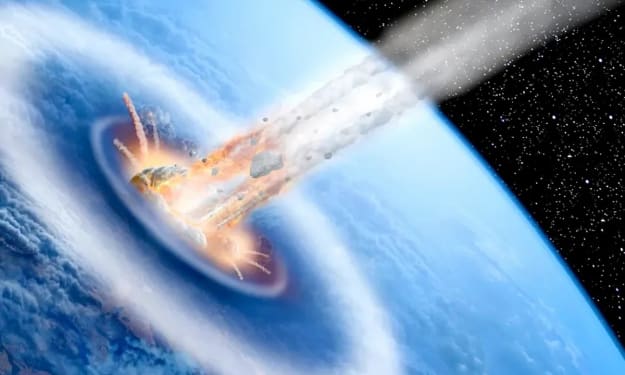
What would actually happen if an asteroid were on a collision course with our planet? We know that hundreds of pieces of space rock fall through our atmosphere every single year, but luckily, they burn up on entry. They are simply not large enough to have any noticeable impact. However, there's evidence to suggest that Earth has experienced several large strikes throughout its history, so there is every possibility that it could happen again.
By Richchik Bardhanabout a year ago in Futurism
About Binding Prometheus
I want to start actively advocating on behalf of my own work, and the most valuable part of my canon is, without a doubt, Binding Prometheus, the play I have been working on since 2019 and only finished in 2023 as part of my MA. The play itself is an amalgamation of a million different inspirations. On one end, it evokes the Ancient Greek myth-play, deriving its own title from the earliest extant work of Western drama we have, Aeschylus’s Prometheus Bound. On the other end, it borrows significantly from the sci-fi bulwarks from over the years, namely Mary Shelley’s Frankenstein and Karel Capek’s Rossum’s Universal Robots. The play could be an episode of Black Mirror, I fear. I don’t know. I’ve only ever seen one episode of Black Mirror.
By Steven Christopher McKnight19 days ago in Futurism
Biosensors Market: Electrochemical Sensors, High Sensitivity Detection & Analytical Accuracy
According to IMARC Group's latest research publication, global biosensors market size reached USD 30.9 Billion in 2024. Looking forward, IMARC Group expects the market to reach USD 57.0 Billion by 2033, exhibiting a growth rate (CAGR) of 6.97% during 2025-2033.
By sujeet. imarcgroupabout 2 hours ago in Futurism
The Devil's Cut
“Comrade, finally you’re awake.” The voice was smooth, sensual. A flickering incandescent bar was all that lit the white, sterile room. All Vladimir remembered was everything going black. He tried to move his arms and found them strapped to the gurney.
By Matthew J. Fromm6 days ago in Fiction


Comments
There are no comments for this story
Be the first to respond and start the conversation.