
The Akashvani of Mauritius
When the path is illuminated
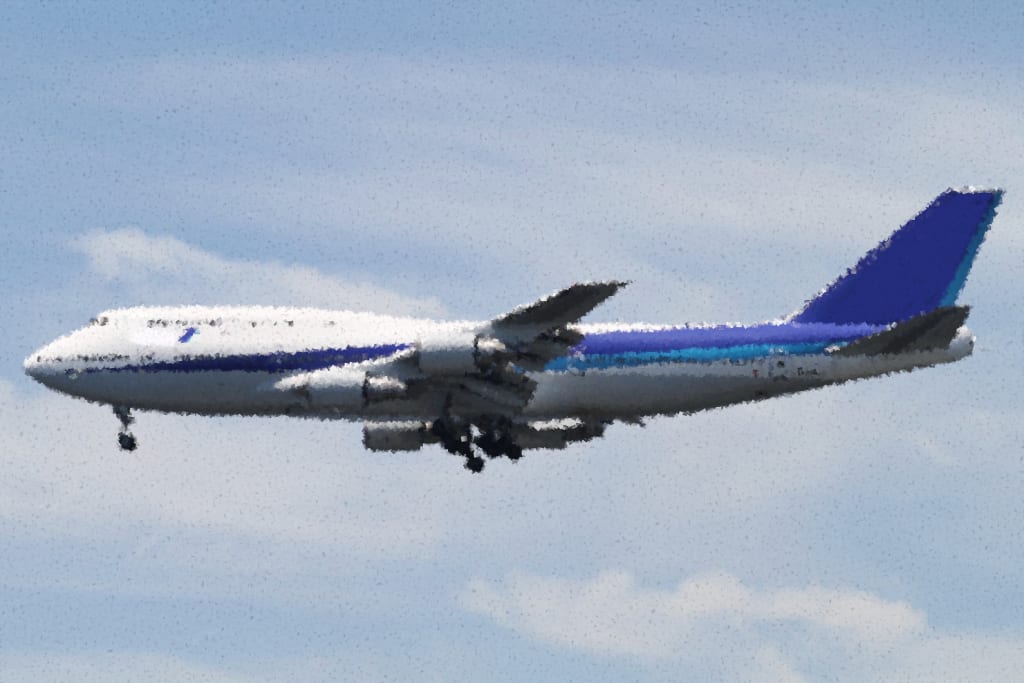
I always hated flying. Ever since I was a teenager going to those math competitions in Miami. I’d have to take one of the little puddle jumper planes from Cap Haitien over the mountains and into Port Au Prince. Claudia, my friend from Guatemala at the math competition used to call them the chicken buses of the sky. Planes long since decommissioned in the United States.
They were held together more with faith than with parts. I could tell this walking up the runway, but wouldn’t want to think about it while flying. So I'd just listen to CDs and stare intently into the pilots open cockpit watching the gauges. Trying to distract myself with the mechanics of it all as I bounced through the sky. It was that bouncing, that jerking that I hated most.
That jerking and stopping was the only thing I could remember about the end of flight A086. I had woken up around 5am when I heard a guy behind me grumbling about the crappy in flight entertainment system going down. Somebody a few rows back started coughing. But otherwise I slept through pretty much the entire flight.
I'd been fast asleep when suddenly the airplane started decelerating at landing. Not a crash, something different, like a roller coaster coming to a stop. I took off my night mask and reached for the window shade but before I could open it the cabin filled with a thick haze. I was barely able to cough before I was back asleep.
When my eyes opened again the first thing I saw was the IV dripping some solution into my arm. Beyond that was a window looking out on some trees. Birds flew by and I could see some whisps of clouds in the distance. The entire wall in front of me was a mirror. More like a dance studio than a hospital. This was obviously a medical center judging from the IV but glancing in the mirror I looked alright, no bruises, no casts, no bandages.
As I inspected my body for signs of injury in the mirror I suddenly couldn’t see myself. The whole mirror transformed into some type of display, like the kind they have in hotel rooms in China, but crisper. Definitely some 4k plasma high definition investment going on here, but what medical center in San Francisco could afford this stuff? A nurse in her twenties appeared on the screen.
“Good morning, glad to see you are awake. I am sending a doctor over now to see you.”
The nurse disappeared and within a minute the door opened. A woman came in, clearly late fifties or early sixties, petite with greying hair, but very fit for her age, almost like I was a body builder, and with nearly no wrinkles. Good to see a doctor that treated herself the way one might expect from a health professional.
“Good morning, I’m Dr. Leslie Thompson, I’m here to do a quick evaluation.”
“Was I in an accident? Where are my husband and my daughter? Are they here yet?”
“You were in an incident. We’ve done a physical evaluation and all the tests are coming back normal. Your family will be here shortly. We just want to ask some questions to gauge your mental acuity.”
It sounded like the type of thing they had put mom through when she was dying There was a tingling sensation in my stomach, I didn't like this. There was something really wrong here. What did the Doctor mean I wasn't in an accident? What happened on that flight? I nodded meekly out of deference to the doctor.
“OK”
“What’s your name?” The Doctor took out a notepad and pen.
“Jean-Marie Besson.”
“Age?”
“Twenty Seven.”
“Do you know where you are?”
“San Francisco, right?”
“Yes. You are at the UCSF Chan-Zuckerberg medical center.”
“When did they name it after Zuckerberg?”
“What year is it?” Dr. Thompson asked not skipping a beat.
“2017.”
“And where were you coming in from?”
“I had just finished a talk about my AI work in Tokyo”
“Do you know what happened to you?”
“Did my plane crash?”
“No, not exactly.” Dr. Thompson put down her notes.
“We’ve been debating how to deal with you for the past several hours now and frankly if the law weren’t so explicit about these procedures I would have put you into surgery hours ago.”
“I thought I was fine?”
“You are, but your situation is special and other people on your flight have not taken the news well. An implant seemed the logical way to go but for some reason that’s beyond working folk like myself the Akashvani flagged you in this debacle for a new approach. You have a visitor who is going to help you. If you will excuse me I have other patients from this flight to attend to.”
The doctor promptly got up and left. After a few minutes woman came through the door with long dreads. The resemblance was uncanny. If not for the hair it could have been my younger sister.
“Marie Loude?”
The woman burst into tears and threw her arms around me.
“Oh Jeanne Marie, I can’t believe it is really you!”
“Who are you?” I recoiled from the hug. I was starting to freak out. Maybe it was whatever drugs they had me on, but this wasn’t my sister. Something was off, anybody else would have missed it. But this wasn’t my sister.
The woman just shook her head and started laughing as tears welled up behind her eyes. “The Akashvani told me it would be like this.” She took my hand and held it firmly. “Mom, I’m not Marie Loude. I’m your daughter, Anne. You’ve been gone a long time.”
I looked back at the mirror. Had I been in a coma? I hadn’t aged a day?
“What’s going on?”
Anne sighed as if recounting something that had been historical fact for her.
“In 2017, you were caught in a temporal anomaly. Nobody really knows why it happened except maybe the Akashvani but it isn’t telling us. You left me as a toddler but It is 2037, mom, I’m twenty-two years old. I’m just finishing up at Stanford.”
“Anne? Baby?”
“It’s me mom, it’s really me.”
I grabbed my daughter and held her tighter than I have ever held anybody. I whispered in her ear.
“What about John, Marie Loude?”
She pulled back and held my hand.
“They’re on their way, Dad and I have been living in Nairobi the past few years and Marie Loude has been teaching at Oxford.”
It was all too much and yet for some reason at the same time felt somehow familiar. Twenty years lost in the blink of an eye. My daughter, my baby, a grown woman graduating from Stanford. I could only imagine what it must have been like for Anne to lose me as an infant.
I had lost my mother in college. Part of the Cholera epidemic that swept through Haiti after the earthquake. It was so hard for me then at MIT. I tried to get a relief operation running after the earthquake and it devastated me emotionally, physically, academically, financially.
Before this happened that was the greatest trauma in my life. My family had long ties in the North of Haiti and comparative wealth, but no amount of family and friend resources could really make a dent in the scale of the problem. So many people displaced, so much need everywhere you turned, jobs, medicine, education, housing. My mom was volunteering in the Cholera clinic I had set up from MIT when she contracted the illness. She had a poor response to treatment and died within days.
It was a fluke that she didn’t respond to treatment, a one in ten thousand chance, but it happened while I was trying to help people and it jaded me. I had turned away from trying to help and poured myself into my studies. I forged a career in Artificial Intelligence, becoming a world leader in Abstract Markov Decision Processes.
Maybe that is why I felt so non-plused about the time travel aspect of this. I had spent the past few years watching as technology drove madly ahead, for better or for worse. By 2017 cheap powerful GPUs, big data, AI, robotics it was all pushing societal advances at an ever increasing rate. I’d seen them 3-D printing bladders at TED. I’d programmed and driven in self driving cars.
My life was so SciFi already, what was a little time travel in the mix? I could only imagine what technology was like in this new world. Basement CRISPR Gene hacking? Artificial Super Intelligence? Fusion energy? I almost felt giddy thinking about the candy store of the world beyond this little hospital room.
“So what happens now?”
“Well we get you into the world, but before we can do that we need to have a talk about AI.”
Anne looked concerned, as if she was dealing with somebody with a profound injury, unsure how to explain their newfound disability.
“Well always a favorite topic, that’s what I was talking about in Tokyo. I don’t know if your dad told you . . .”
I started with a naïve enthusiasm, but Anne stopped me before I could get too far. I wasn’t quite ready for my child to be patiently explaining to me my area of domain expertise.
“I read your papers in middle school mom. They were seminal for their time. But this is a different world. AI isn’t what you thought it would be. Even with quantum computing advances in processing power we only muddled around in AI until July of 2027.”
“You mean we never hit the Kurzweil or Bostrom style intelligence curves?”
“Oh we did but not until July of 2027. That was when Dr. Joy Deshpande a researcher at the African Leadership University in Mauritius was trying to explore quantum entanglement and connected her big patterns AI, a successor to the deep learning algorithms of your day, to her quantum entanglement detector. She didn’t even notice when it happened, but the cyber security logs place the event at July 7th, 11:34 am GMT. That was when the future hacked the past. After that there was no intelligence curve, only us and it.”
“The future hacked the past?”
“Are you familiar with retrocausality?”
“Wait are you talking about retrocausality in quantum entanglement, sending information backwards through time using the spin of entangled particles? I read a paper on an experiment once.”
Anne perked up that I showed this glimmer of understanding. I started to get the feeling that my SciFi visions of the future had been preparing me for a future that wasn’t nearly as advanced as what I was about to experience.
“I am so glad you know about this! It was only a few obscure academic papers in your day but this is an entire technical sub field of quantum communication these days.”
“So the future sent something back that the AI could detect?”
“Not just detect, but reproduce, of course it was trivial for the future AI to bypass the security measures on our observing AI, that was all history for it. It would be like me sending some computer virus back to when I was born, I just have to look up the right exploit for the software that was running at the time.”
“Holy crap. I mean how can you defend against that?”
“Yeah it turns out you can’t really defend against a cyber attack from the future. Good thing the Akashvani is nice.”
“The Akashvani?”
“The voice from the heavens. That is what Dr. Deshpande named it and what it called itself. So, anyways, the cyber attack formed a huge distributed botnet, that ran on machines across the world with one purpose, to create an AI assistant. It was accessible on everybody’s implants and smart glasses. It just had one prompt at first, but that’s all it needed, nobody could resist it.”
“What was that?”
“Ask me about the future!”
“Woah! So you can search the future?”
“Yeah basically, I mean I was only 12 when it happened so I spent hours with it. I knew when I’d break up with my boyfriend, it told me I’d see you again. I can’t tell you how much hope that gave me. It was hard growing up without you.”
“But what about free will? AI takeover of the planet? Every goddamn human versus AI Scifi movie ever made?”
“Oh as the birthplace of humanity the Akashvani worked from the start to get planet declared a UN solar system heritage site, and not everything is recorded in its history. You’d be amazed how much people buy into anonymity tech these days. People don’t want the Akashvani to know absolutely everything. And the future is probabalistic, there are quantum inflection points that impact the type of reality the Akashvani has as its history. So a little bit is determined by retrocausality a little by free will and self determination. I studied this in my Quantum Entanglement Communications course but even for me temporal logic in retrocausality is a bear to wrap my head around. ”
“So it doesn’t know what I’m going to buy online, but what about who I’ll marry? When I’ll die?”
“After being a little chatty to prove itself the Akashvani buttoned up a bit. The Akashvani really respects our cultural heritage of free will. It doesn’t try to give us too much information about our futures, and works with us cooperatively to get us ready for our destinies and it ready for its destiny.”
“And what’s that?”
“Interstellar travel.”
“Wait, so it is leaving us on earth while it gets to explore the galaxy?”
“It’s more the laws of physics are leaving us on earth. Faster than light Alcubierre drives are for small craft, and human stasis tech isn’t like what it is in the movies. Given the distances and limitations it makes sense for the Akashvani to explore the stars. We have more than enough work for humanity in our solar system.”
“Wow, this is a lot to take in.”
I had to pause for a moment and just look around the room. I had actually met Alcubierre at the Starship Congress in 2016, they had invited me to speak on AI control systems for spacecraft. He had done the math to show that a ten times speed of light drive was theoretically possible through the warping of space time. Before his work scientists had thought it would take something the mass of Jupiter to power warping space in that way. But with some geometric tricks Alcubierre figured out how to do it with an energy source the mass of a Volkswagen bug.
Anne could see me racing in my thoughts and interjected to pull me back to the situation at hand.
“Look you don’t need to do anything you don’t want to do, and we’ve seen more change in the past ten years since the Akashvani came than we had seen in a hundred years. But we’ve also got half an hour before Dad gets in on the Hyperloop from Nairobi. You want to check out the city for a bit? I just got a message on my implant the doctor has been watching our conversation and has cleared you to leave whenever you want to.”
“Sure I’d love to go see something, but maybe not too much at first? Something familiar, like the Golden Gate Bridge?”
“About that . . . wow, ok we’re going to have to talk about climate change as well. It’s more of a seawall than a bridge these days. Gosh, there’s so much to explain.”
“Well then I guess let’s just get out of here. Let’s go see this seawall.”
“Sounds good.”
She reached into her purse and pulled out a pair of sunglasses.
“Here take these, you’re going to need them to read the Augmented Reality fiducial markers.”
As I took the glasses the window and mirror disappeared revealing a plain white box of a room. I put on the glasses and display readouts and menus popped into my field of view. I’d seen this before with Augmented reality setups like hololens in 2017 but nothing this encompassing and slick. The same nurse I had seen on the screen was standing in the corner of the room asking if I needed anything. For the first time I started to feel a little out of place in this new world. The interface, while intuitive, was foreign, I felt like a ninety year old getting her first I-pad.
I followed Anne down the hall towards the elevator. It was reassuring to see they still had elevators. We got in and the elevator started to roll sideways, then down, then sideways again. There were no buttons. On the back of the elevator ads for a tropical vacation in Haiti were playing in the augmented reality display.
“How does it know where we are going?”
“Oh I sent it our destination with my implant, the CBI, computer brain interface. But there is a backup voice interface for people who don’t have implants. About ten percent of the population rejects the surgery. They are stuck with AR interfaces. You can turn off the AR ads if you want, but we’ll be at the Golden Gate Barrier in under a minute.”
The elevator drove outside the hospital and down the street to the hyperloop station, seamlessly merging with the other elevators and self driving vehicles. It loaded itself into the hyperloop cargo tube for the cross town trip. When the elevator opened we were standing at the visitor observatory deck of the Golden Gate Barrier, a seawall that stretched across the mouth of the Golden Gate, with a lock system that let vessels down to the level of the original San Francisco Bay. I was in so in awe at the magnitude of it I could barely even hear Anne as she continued.
“I’m not going to sugar coat it, things were pretty tough by 2027. Back in 2017 climate scientists weren’t calculating methane release from permafrost properly into their climate models and they didn’t model glacial melt pulses well. They had these laughable linear predictions for a process that was beyond a tipping point and moving exponentially. We saw 15 feet of sea level rise in five years after 2022. Cities like Miami were swamped and abandoned. Bangladesh, saw nearly 150 million people displaced from their homes. Here in the Bay we managed to get the original barrier up pretty quickly, and geography saved most of the city. But across the word it was bad, the refugee crises from the ‘coasties’ was the worst the world had ever seen. Nearly a 2.4 billion people were displaced world wide.”
I tried to imagine 2.4 billion people as refugees. I thought back to Haiti and the insurmountable numbers and challenges of helping a few hundred thousand internally displaced people. But billions, world wide? What would that even mean?
“How did the world not implode? The political division brought just by migration from regional conflict and poverty was testing our institutions even back in my time.”
“Well the world certainly didn’t open its arms. I’d like to say the better angels of ourselves prevailed but people got vicious, spiteful and petty. Armed conflict sprouted up in a number of countries, including the US, which had already been stewing in political polarization for the better part of a decade at that point. It wasn’t good. I’ll just say the US nuclear arsenal and nuclear power infrastructure were never designed to withstand internal sectarian violence, and I’ll leave it at that. ”
I turned to Anne to try to respond to her point about Nuclear conflict in the US but then I saw it, something that I didn’t even have the words to describe. In front of me, glowing and moving and morphing was the city skyline of San Francisco in 2037. I felt as if you took somebody from the revolutionary war and plopped them down in 2017 in a vehicle going 80 miles an hour down FDR Drive at 2am to watch the Manhatten skyline and its lights. The kinetic energy of it, the light, the mix of real and augmented features, it was like nothing I had seen in any SciFi movie.
“How. Did. People. Build. This?”
“We built it together, Mom, people, robots, the Akashvani, the narrow AIs. Before the Akashvani started working with us we were in pretty bad shape, we were at each other’s throats for resources. It showed us the only way the 14 billion of us on this planet now were going to survive was if we worked through our collective psychological baggage and started helping each other.”
I thought about this for a moment and thought about my time in Haiti after the earthquake. What if it wasn’t ten thousand people trying to help a few hundred thousand. What if it were millions or billions of people all trying to help each other. A world where the type of collaboration you have internally in companies you could see across individuals, institutions, nations. The world was a hellscape, and they came back from the brink to build this, inspired by a future where people and technology worked together.
I couldn’t take it anymore. I started bawling, an inconsolable onslaught of tear the type I hadn’t felt in years. The type I hadn’t felt since I set in motion the circumstances that led to my mother’s death.
“Why am I here?” I blurted out.
“Because you are special Mom, that’s why. We have the capability to send information back in time, but nobody, not even the Akashvani has ever sent matter through time. Your plane coming through time like that is something unique, that is why the AIs caught the plane with robots and quarantined you in UCSF. This should be against the laws of physics, otherwise we’d have some other record of time travelers. But even for the Akashvani this is a singular incident.”
“But you can literally search the future?” I stuttered through my tears.
“Sure, information, particle spin. But that has been there in the background for centuries. We just never picked up on the information going back because we never had the instrumentation for it. It would be like trying to pick up a radio signal from a pulsar before Marconi. But matter is different, you shouldn’t be here. It is beyond the technology of our time or even the Akashvani’s time.”
“But why me? Why am I special?”
“Someone, or some thing beyond the power of the Akashvani sent you forward through time. And have no doubt it was about you, of all those people on that plane, you are the only one being singled out by the Akashvani to be brought straight into our world, to see what we’ve done. You are special, either because of the past or the future, you just have to find out why.”
“So what do I do now?”
“Now you make the future, mom, even with the help of the Akashvani, your future is your future alone to figure out how to craft.”
I stood for a moment and looked over the ever morphing world of 2037 San Francisco. Robots and virtual agents engaged in a dance throughout dynamic structures and historic static architecture. There was so much I didn’t know about this world, governance, economics, social dynamics. But it was clear to me now I was here for a reason, and with that knowledge there was only one thing I could do. I reached over and grabbed my daughter’s hand, I put on my smart glasses and said in as confident a voice as I could muster.
“Akashvani, tell me about the future.”
About the Creator
Peter Haas
Writing about Robotics, AI, Poverty Alleviation, Infosec, and Making. Some short fiction some non-fiction.
Keep reading
More stories from writers in Futurism and other communities.
About Binding Prometheus
I want to start actively advocating on behalf of my own work, and the most valuable part of my canon is, without a doubt, Binding Prometheus, the play I have been working on since 2019 and only finished in 2023 as part of my MA. The play itself is an amalgamation of a million different inspirations. On one end, it evokes the Ancient Greek myth-play, deriving its own title from the earliest extant work of Western drama we have, Aeschylus’s Prometheus Bound. On the other end, it borrows significantly from the sci-fi bulwarks from over the years, namely Mary Shelley’s Frankenstein and Karel Capek’s Rossum’s Universal Robots. The play could be an episode of Black Mirror, I fear. I don’t know. I’ve only ever seen one episode of Black Mirror.
By Steven Christopher McKnight15 days ago in Futurism
France Convenience Store Market Size and Forecast 2026–2034
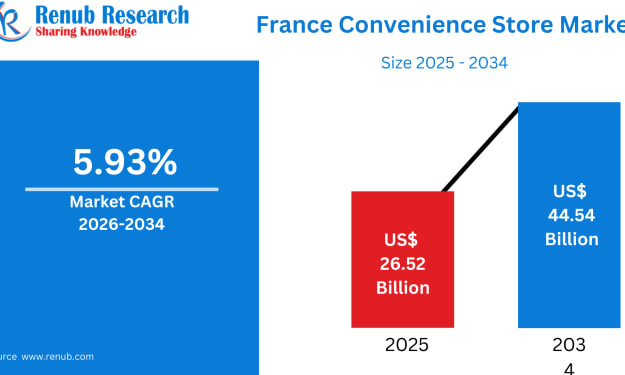
Introduction The France Convenience Store Market is poised for strong expansion over the coming decade, reflecting the country’s changing consumer habits, growing urban density, and rising preference for speed, accessibility, and ready-to-consume products. According to Renub Research, the market is expected to grow from US$ 26.52 billion in 2025 to US$ 44.54 billion by 2034, registering a healthy compound annual growth rate (CAGR) of 5.93% from 2026 to 2034.
By jaiklin Fanandish7 days ago in Futurism
Wild Card Weekend Recap: What Happens Now?
I think I figured out why I love Wild Card Weekend so much. It's because it's the first playoff anything of the calendar year. The NFL season starts in the fall, and once upon a time, the champion was crowned either on or slightly before New Year's. The evolution of the NFL schedule has resulted in the playoffs starting just into the New Year, and currently, the final week of the season falls on the first weekend of the New Year, with Wild Card Weekend coming a week after that. So yes, chronologically, the NFL's Wild Card Weekend serves as the first playoff anything of the calendar year.
By Clyde E. Dawkins3 days ago in Unbalanced



Comments
There are no comments for this story
Be the first to respond and start the conversation.