
Textbook Assassin
America, Videodrome, and the Feel of Celebrity Skin

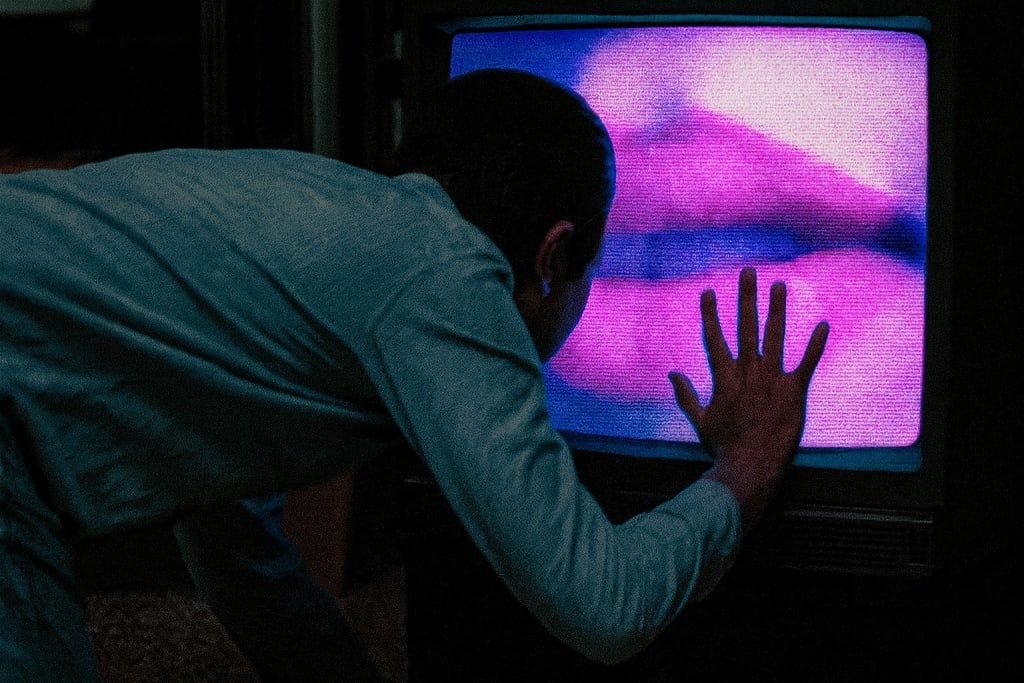
To read my first essay on Videodrome, written six years ago, click here: The (Old) New Flesh
"The cathode ray becomes the fallopian tube of the retina." — Brien O'Blivion, Media Prophet
"In the future, everyone will be living in a TV studio." J.G. Ballard, 1982.
I recently completed listening to an audiobook of Videodrome (by "Jack Martin", a pseudonym for horror writer Dennis Etchison), the novelization of Cronenberg's classic cyberpunk body horror (but it is so much more than that). The film, featuring James Woods and Debbie Harry, is a funneling narrative that follows a shady, sleazy television producer down a rabbit hole of insanity after he is exposed to the "Videodrome signal" — i.e., a hidden broadcast signal transmitted with a strange, sadomasochistic program that documents torture and execution with no narrative and no plot structure. Max Renn, who operates Channel 83, a kinky sex-and-violence public-access channel in Montreal, pushes the limit to try and hook his sensation-addicted audience.
Added to the mix of strangely noir-ish characters is the masochistic Nikki Brand (played by Debbie Harry in the film version, from which the novel was adapted), a woman who has a call-in show on C.R.A.M. radio, who addresses her callers in a sexy, come-hither phone-sex operator voice, calling them "lover." She likes to be cut, burned, and, when she hooks up with Max (or perhaps he with her), she demonstrates this proclivity while watching Videodrome; he assents to her will slowly, becoming engrossed in the hallucinatory world of S&M violence and sadism, as the Videodrome signal seems to mutate his mind, turning the envelope of reality inside out until he eventually becomes convinced his old-fashioned tube television and videocassette players are living entities, full of flesh and grue, and possessed by the image of Nikki and Brien O'Blivion, the "tele-prophet" commentator who runs the Hubbard-esque pseudo-cult of the "Cathode Ray Mission," a place where his daughter Bianca holds court over bums convinced to watch TV so they can get a free meal.
Harlan — his name an homage to Harlan Ellison perhaps — is a television tech and pirate, and it is through his aegis that Max discovers "Videodrome." Harlan is charming but cannot be trusted, and he wears a dual mask. The capstone, though — beyond the seemingly omniscient and forever-appearing-on-TV O'Blivion — is Barry Convex, an optician who seems to be at the forefront of a secret cabal, government or, as we would say in modern times, a "Deep State" operation, one where the Videodrome signal itself was discovered through a military experiment called the "Accumacon" helmet (I think I have that right).
Max imagines a living television following him; the characters of his life — Nikki, Masha, the foreign television producer who acts as a warning guide ("Max, Videodrome, what you see on that show, it's for real. They're not actors.") — and later the two television producers he guns down, appear as digital ghosts.
And also, of course, Brien O'Blivion.
"North America is getting soft, padrone, and the world is getting tough." — Harlan, Channel 83
Videodrome is stylistically dense; the plot is murky, and the happenings blend into an opaque shadow of body-horror mutation, hallucination, and conspiracy — is it all just paranoia? Who is wanting to replace the weakness of the present milieu (circa 1983 or so) with a new "tough" era of hallucinating drones, all living in their own fantasy of the "New Flesh" — i.e., the living reality exteriorized in the skin and sinew, the fractured bones and mosaic of facial wounds that will make up the "Video Smile" of tomorrow's mass-controlled, mind-controlled sadists, killers, assassins. When reality and hallucination merge into the literal flesh of the wearer, the experiencer, we have a deeper and truer allegory of our state of being than any other that could be posited.
We live in an entirely fictional world; indeed, everyone, everywhere, is living in their own bubble of propaganda, their own little circle of delusion and self-deception. The New Flesh is a digital flesh, applied like a grafted skin, a slithering digital snake-skin, daily. People are simply shifting collections of video uploads — a televised reality that is now constant: sex, violence, stimulation, anger, aggression. X is a good example of this, a constant flow of dopamine hits and manipulated rage; Nikki Brand thought we "live in overstimulated times." And this was forty years ago.
VIDEODROME "Come to Nikki" Clip (1983) David Cronenberg Body Horror
Max's arm grows into a gun, a biomechanical horror that allows him to become the armed assassin of the Videodrome cabal. He goes gunning for Barry. We won't give away the ending here. It isn't necessary.
Who is the assassin working for? Is this all his hallucination? The novel, as well as the film, begs the question.
And it is one that is left hanging.
Assassination as Modern Media Spectacle
Eleven days ago, we had the public assassination of political activist Charlie Kirk, an act that has polarized the nation and even the world. Kirk lived his life in the modern media spotlight, on social media, that "second skin," the "New Flesh," of hopes, dreams, desires, fantasies, and untruths, as well as constant diversion and fraud. People are now abstractions that exist as collections of video clips, soundbites, and social media posts. The New Flesh is a giant hallucinatory machine, redefining our neural landscape in a fashion Videodrome foresaw in 1984. "In the future,u" J.G. Ballard once told Re/Search magazine's V. Vale, "we'll all be living in a TV studio." This was decades before YouTube, and even the internet.
Kirk is now eulogized and scorned, deified and damned. What of the actual person? I could never prove he existed except as a signal, an image on screen.
In the grip of AI, in the age of Neuralink, Videodrome will be supplanted by a shifting, prismatic world of illusions offered as generative images and "new realities" brought about by our symbiosis with AI. This will be beamed directly into our cerebral cortex via the chip implant — and it will offer sex and violence, outrage and "overstimulation" to those who can afford the presumably tiered system. But control will be a two-way street. How will this utterly transform the scope of human evolution, the manifestation of our world and society in the dense, physical sphere we think of as meat-space — the place we enjoy and imagine we occupy conjointly?
Is it true? Is it anything more than another received "signal," decoded and downloaded by our sense-perceptors, and registered as "reality" and truth by our own conscious awareness? Everything is simply a flicker in the electrical field of the human mind, hidden behind the virtual-reality helmet of the skull.
In the future, programmed "textbook" assassins may proliferate like abscessed wounds across the surface of the human skin, whether the flesh be New Flesh, Old Flesh, or otherwise.
ABFTD #10
My book: Cult Films and Midnight Movies: From High Art to Low Trash Vol. 1
Ebook
My book: Silent Scream! : Nosferatu. The Cabinet of Dr. Caligari, Metropolis, and Edison's Frankenstein--Four Novels.
About the Creator
Tom Baker
Author of Haunted Indianapolis, Indiana Ghost Folklore, Midwest Maniacs, Midwest UFOs and Beyond, Scary Urban Legends, 50 Famous Fables and Folk Tales, and Notorious Crimes of the Upper Midwest.: http://tombakerbooks.weebly.com
New Energy Vehicle (NEV) Taxi Market Outlook: Urban Electrification and Sustainable Mobility Growth Opportunities
According to IMARC Group's latest research publication, The global new energy vehicle (NEV) taxi market size reached USD 106.0 Million in 2024. Looking forward, IMARC Group expects the market to reach USD 736.5 Million by 2033, exhibiting a growth rate (CAGR) of 22.83% during 2025-2033.
By James Whitman7 days ago in Futurism
Saudi Arabia Fire Fighting Chemicals Industry: Industrial Fire Protection, Innovation & Infrastructure Expansion
Rising health awareness, busy lifestyles, and preference for convenient, nutritious foods are driving healthy snack demand, supported by clean-label trends, product innovation, and expanding retail and online distribution channels. According to IMARC Group's latest data, The Saudi Arabia fire fighting chemicals market size reached USD 25.7 Million in 2025. Looking forward, IMARC Group estimates the market to reach USD 34.8 Million by 2034, exhibiting a CAGR of 3.45% from 2026-2034.
By Kishan Kumarabout 22 hours ago in Futurism




Comments
There are no comments for this story
Be the first to respond and start the conversation.