
Tesla vs Edison: The Shocking War Between AC and DC That Changed the World
Discover how a battle of electric currents—and egos—shaped the future of power, innovation, and technology.

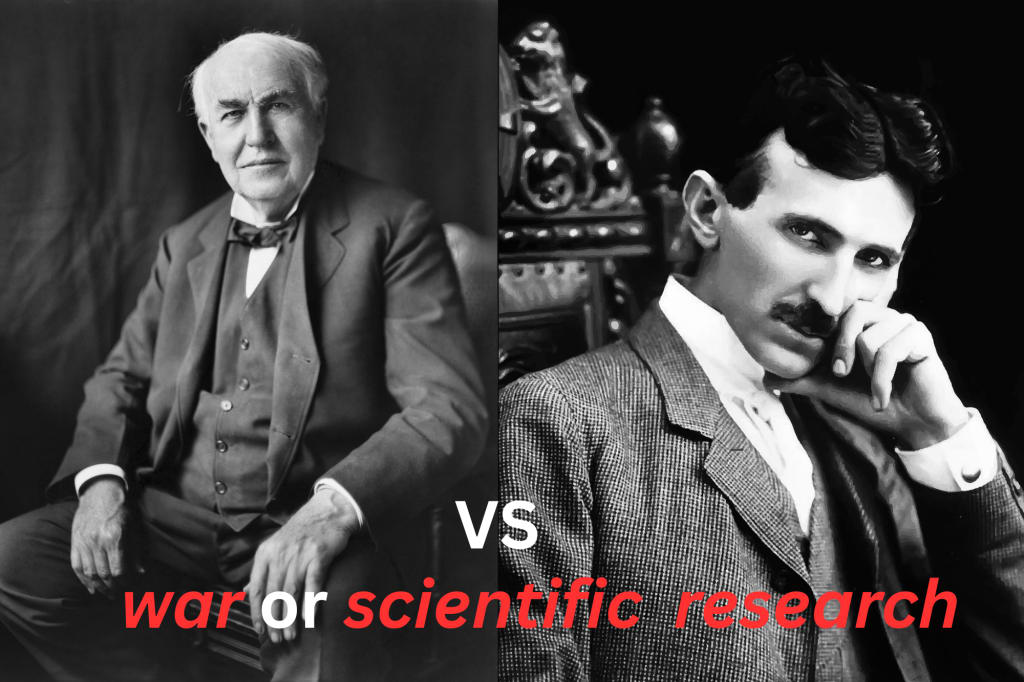
When Genius and Ego Collided, the World Got Electrified
In the late 1800s, a powerful battle was brewing—not in a courtroom or on a battlefield, but in the realm of science. It was a war not just of technology, but of vision, ambition, and pride.
On one side stood Thomas Edison, the brilliant inventor and master businessman known for the lightbulb and phonograph. On the other was Nikola Tesla, a Serbian-born genius whose ideas were often too advanced for his time.
They didn’t just fight over wires and volts—they fought over the very future of electricity.
Welcome to the War of Currents.
⚡ Edison and the Rise of DC Power
By the 1880s, Edison had already lit up parts of New York City with his new invention: direct current (DC). DC provided a steady stream of electrical energy in one direction, and Edison believed it was the safest and most reliable option.
He had powerful backers—J.P. Morgan and other tycoons—who poured money into his DC infrastructure. But there was one major problem…
DC couldn’t travel far. Power stations had to be placed every mile or so, making it impractical for wide-scale use.
Still, Edison was determined. He had built his empire on DC and wasn’t going to let anything—or anyone—threaten it.
⚡ Tesla and the Power of AC
Nikola Tesla had a different vision. He believed that alternating current (AC) was the future. AC could easily change voltages using transformers and travel long distances without losing power.
Originally working for Edison, Tesla proposed improvements that could change the game. Edison reportedly promised him $50,000 for his work—but never paid.
When Tesla asked for the reward, Edison allegedly laughed and said, "When you become a full-fledged American, you will appreciate an American joke."
Tesla walked out—and never looked back.
⚔️ The War of Currents Begins
Tesla found a powerful ally in George Westinghouse, a businessman with the money and vision to support the development of AC systems. Together, they began rolling out AC power across the U.S.
Edison didn’t take it lightly.
He launched a public smear campaign against AC, claiming it was dangerous and even deadly. To prove it, he orchestrated gruesome public demonstrations—electrocuting animals using AC to sway public opinion.
In a morbid twist, Edison also helped design the first electric chair using AC, hoping to brand Tesla’s system as lethal.
💡 The Turning Point: Niagara Falls
In 1895, Tesla and Westinghouse achieved something monumental—they harnessed the power of Niagara Falls to generate electricity through AC. That power was successfully transmitted over 20 miles to Buffalo, New York.
It was the moment that changed everything.
AC had proven itself on a massive scale, and the world took notice. Edison’s DC system began to fade as AC took over the global electric grid.
⚙️ Legacy: Who Really Lit the World?
Edison may have been the more famous and financially successful during his lifetime, but it was Tesla whose ideas shaped the future of electricity.
Edison gave us the lightbulb, but Tesla gave us the power to light entire cities.
Edison built a business empire, but Tesla imagined the impossible—and often made it real.
Today, our homes, cities, and even modern tech depend on Tesla’s AC system.
And while Edison controlled the current, Tesla changed the course.
🚀 Final Spark
This wasn’t just a story of technology—it was a story of courage, vision, and belief in the impossible. Tesla and Edison remind us that the future doesn’t always belong to the richest or the loudest. Sometimes, it belongs to the one who dares to challenge the current.
🙌 Like stories that spark your imagination?
💬 Share your thoughts below—are you Team Tesla or Team Edison?
📌 If this story lit you up, give it a ❤️ and subscribe for more inspiring tech tales!
🔁 Feel free to share with friends who love science, history, or a good underdog story!
About the Creator
Doctor Strange
Publisher and storyteller on Vocal Media, sharing stories that inspire, provoke thought, and connect with readers on a deeper level
Keep reading
More stories from Doctor Strange and writers in Futurism and other communities.
Nikola Tesla and the Pigeon He Loved
Nikola Tesla is remembered today as one of the greatest inventors and minds in history—a visionary who dreamed of a future powered by clean energy, wireless communication, and boundless scientific discovery. Yet behind the gleam of Tesla coils and radio waves lies a haunting story of isolation, misunderstood genius, and one peculiar yet deeply intimate relationship that defies convention.
By Doctor Strange10 months ago in History
Stanislav Kondrashov Oligarch Series: Oligarchy and the Rise of Intercontinental Electricity Networks
Electricity networks are evolving beyond the borders that once defined them. For much of modern history, electrical grids were designed to serve individual regions or nations, expanding gradually as cities grew and industries developed. Today, however, a new concept is gaining attention: intercontinental electricity networks capable of connecting distant regions into a single, coordinated system.
By Stanislav Kondrashov2 days ago in Futurism
Australia Ready Mix Concrete Market: Infrastructure Demand, Sustainability & Tech Adoption
According to IMARC Group, the Australia ready mix concrete market reached USD 53,481.3 Million in 2025 and is projected to grow to USD 121,276.9 Million by 2034, exhibiting a compound annual growth rate (CAGR) of 9.24% during 2026–2034. The strong expansion reflects rapid infrastructure modernization, urban development, and large-scale construction activity across Australia. Ready mix concrete (RMC), known for its quality consistency and efficiency in large projects, is increasingly preferred over site-mixed alternatives. Government investments in transportation networks, renewable energy facilities, and residential housing are significantly strengthening Australia ready mix concrete market share, while sustainability initiatives and production technology upgrades are reshaping industry standards.
By Shrestha Roy5 days ago in Futurism


Comments
There are no comments for this story
Be the first to respond and start the conversation.