space
Space: The Final Frontier. Exploring space developments and theorizing about how humans fit into the universe.
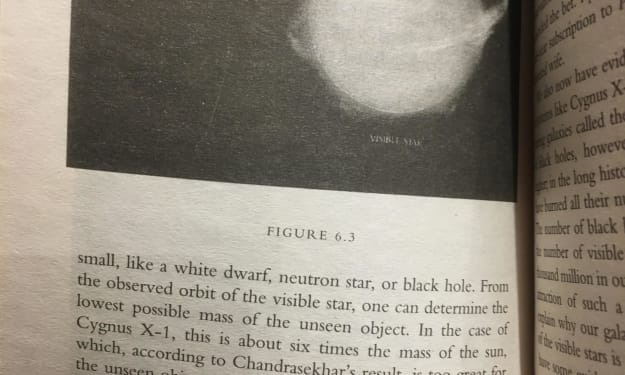
Black Cat in a Coal Cellar
Reading Stephen Hawking it is obvious that he and his colleagues are very intelligent people. In the science and math aspects. But in the end, a theory is a theory. It takes a very intelligent person to know when they know nothing at all. Reading up on black holes is fun because of the simple fact that scientists are trying to prove something they cannot see. Even in the field of physics, of physical science, we still have no idea how things work or why. We just know they do. In the case of a black hole, it is a force you can't see but that has a gravitational pull strong enough to suck the light from neighboring stars. It is essentially a black spot in the universe where light cannot escape. Sounds terrifying, right? Hawking says that if an astronaut were to venture inside of one, there would be a great chance that he be stretched out from the tips of his toes to the top of his head in a long, excruciating disappearance. Or perhaps if he could maneuver his way through this dark wormhole, he'd possibly be able to travel distances and time across the universe that we have so far only seen in Sci Fi movies.
By Beloved Natarí Kaelum7 years ago in Futurism
The Interstellar Visitor
New analyses of the different observations made show that his behavior is closer to that of a comet. Eight months ago, astronomers detected an object in space with a very strange shape and path. Resembling a cigar, this star, called Oumuamua, seemed to come from another solar system—at first.
By Matthew Evans7 years ago in Futurism
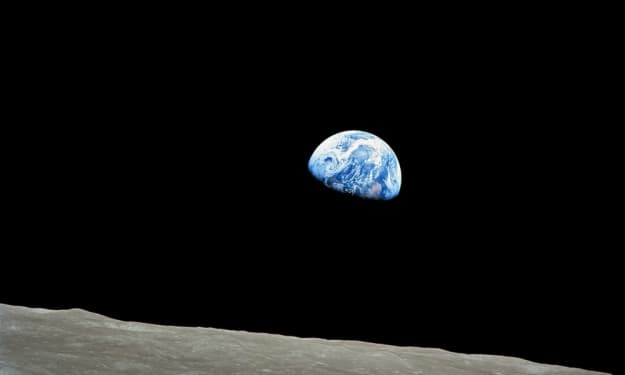
1968: The Successful Journey of Apollo 8
Dates: Dec. 21, 1968 – Dec. 27, 1968 The second manned spaceflight mission in the United States Apollo space program, Apollo 8, was launched on December 21, 1968. It became the first manned spacecraft to leave low Earth orbit, reach the Earth's moon, orbit it and return safely to Earth.
By Shandi Pace7 years ago in Futurism
A Novel Solution for Efficient and Durable Deep-Space Electronics
For all of recorded human history, we've dreamed of what was beyond the sky. It's a topic that has intrigued us for millennia, and as a species, we've deemed it central to answering our most fundamental questions:
By Andrea Dawson7 years ago in Futurism
The Multiverse Chronicles
Welcome to the first entry to the Multiverse Chronicles series. My name is Richard Johnston and the idea behind this series is to help writers come up with ideas for any story where they want to explore the possibilities of a reality where an infinite amount of universes exist. It has been done and over done many times, but this is my personal take on the idea. Please feel free to use any of these ideas to help you write your stories, and if you do, please let me know so I can read them.
By Richard Johnston7 years ago in Futurism
Arctic Circle and Space
Venture far enough north in the freezing climate of Norway, Finland and Sweden and you may be a little surprised to come across satellites and facilities located in the middle of nowhere. Stumbling upon this would arise suspicion for most. Who could blame them? I for sure, would be skeptical with the arrangement.
By Steven Altman7 years ago in Futurism
When Our Earth Stops Spinning
If our Earth stopped spinning quickly, two important elements of our planet would continue their movements: The crust of the Earth can move hundreds of miles a day and would continue this pattern, and our atmosphere (jet stream, oceans, weather) would wipe the surface of our planet with enormous intensity. Both would clear the landscape and kill all life—or most of it, anyway! I wonder if there's a possibility that this is why there's no Atlantis and Egypt is no longer a jungle. Have we ever swiftly slowed down before? Scientists don't believe so.
By Lady Sunday7 years ago in Futurism
Galaxy Simulations Are at Last Matching Reality
Since the earliest days of computers, scientists have looked into their potential for simulating the cosmic processes that led to the creation of the near limitless amounts of galaxies in the observable universe. The shortcomings of previous computer technology limited their practical applications in this regard. However, thanks to the levels of processing power offered by modern computer hardware, along with refinement in algorithm scripting, simulations are reaching a point where they can begin to accurately replicate the mathematical values involved with the development of an individual galaxy. What’s more is that computer technology is advancing exponentially, meaning that progress is accelerating at a truly impressive rate.
By Alice Turner8 years ago in Futurism
Something That Stargazers Would Notice
This article is food for the mind decorated with thoughts that will make you wonder about what exactly is above your head. The past few years when looking in the sky I have noticed that some new stars shining in the sky. These are not just ordinary stars but shine in different colors. It is a known fact that some stars with different colors that shine brightly and sometimes shine with a fading to them. What makes these stars so noticeable is a simple fact that they are different.
By Shelly Bartley8 years ago in Futurism