science
Topics and developments in science and medicine, presented by Futurism.
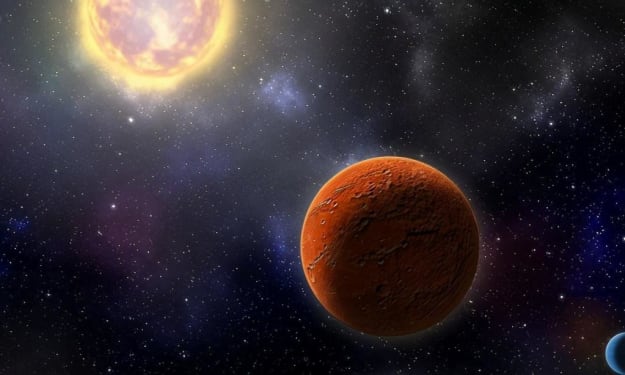
36 light years away, scientists have discovered a "super-Earth".
Some time ago, scientists reportedly discovered a "super-Earth" orbiting a red dwarf star 36 light-years away from Earth, with a mass about three times that of Earth and a rotation period of about 2.4 days.
By Alessandro Algardi3 years ago in Futurism
The bizarre "mirage"
There are many natural landscapes and amazing natural phenomena in the world, and from the perspective of spectacular scenery, a "mirage" is undoubtedly a strange and spectacular sight. Most people may have never seen a "mirage" in their lives.
By Copperchaleu3 years ago in Futurism
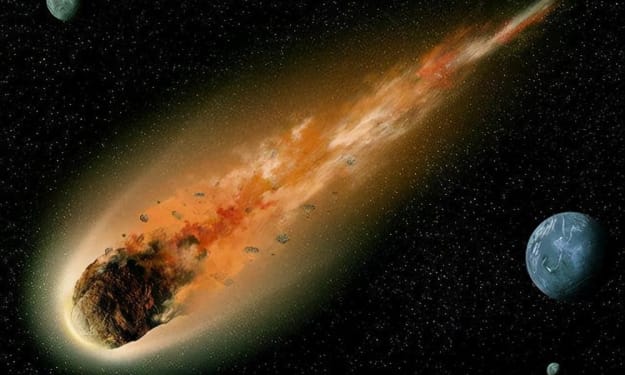
Why are meteorites able to burn in space?
Why are meteorites able to burn in space? The sky and earth are vast, mysterious, and desirable. As we all know, there are countless galaxies in the universe, and our solar system is just one of them. As the planet of intelligent life in the solar system, the Earth was born at the beginning of mankind, and after millions of years of evolution and growth, today's mankind has embarked on the road of rapid technological development, stepped out of the Earth and started to explore the universe.
By Many A-Sun3 years ago in Futurism
How many secrets of the universe remain unsolved?
One day in 2019, Anna Kandinsky of the University of Western Sydney's Faculty of Science was observing the Australian Square Kilometer Array Pathfinder (ASKAP) when she suddenly spotted a very mysterious object. As a female scientist, she couldn't help but say, "WTF!"
By Cindy Dory3 years ago in Futurism
How was the Earth formed?
Scientists have detected more than 5,000 planets beyond our solar system, and it is estimated that at least 25 percent of the stars have planets. However, astronomers have yet to definitively find an Earth-like planet with life. The history of Earth's formation and composition has been an unsolved human puzzle. Recent studies have found that the Earth's current, the recent composition would not be entirely consistent if it were composed of only the most primitive rocky meteorites. The chemical composition of the Earth's crust has changed over time due to the numerous impacts of smaller rocky bodies.
By Copperchaleu3 years ago in Futurism
How much do you know about the dangers of a trip to Mars?
Astronauts to Mars journey is not like tourists to Switzerland so easy, relaxed, and comfortable, but a journey full of uncertainties and unknown risks of adventure. Astronauts on Mars exploration missions will have to fight for a long time against the stresses of deep space radiation, microgravity, claustrophobic space, and isolation.
By Alessandro Algardi3 years ago in Futurism
There are creatures on Mars?
The Curiosity rover is approaching its 10th anniversary of landing on Mars, and after 10 years of operation, it is still traveling on the lowland edge of the Martian Elysium Plain, having traveled a cumulative distance of 28 kilometers.
By Mao Jiao Li3 years ago in Futurism
The ice of the Arctic gone to the sky?
In recent years, many jaw-dropping things have happened in the Arctic, for example, the temperature in some parts of the Arctic reached 38°C in 2020! The cold Arctic is surprisingly experiencing thunderstorms (the appearance of thunderstorms requires air to produce thermal convection), and the number is on the rise. Some seas are surprisingly almost free of sea ice coverage in summer. Recently, scientists have discovered a strange phenomenon - while the Arctic sea ice is rapidly decreasing, there is more ice over the Arctic! What's going on?
By Many A-Sun3 years ago in Futurism