science fiction
The bridge between imagination and technological advancement, where the dreamer’s vision predicts change, and foreshadows a futuristic reality. Science fiction has the ability to become “science reality”.
Life and Production: S3 E9: Against Azure Blue
The Flying Machine After exiting from the Goulding Automotive lot, Lesane went straight home to his other prized motorized possession: a robot driven golf cart. Just as he was turning onto the compound, a rumble overhead drew his attention. What looked like a small jet put Lesane in a brief state of puzzlement. Rarely did he not know what particular aircraft took to the skies. Against azure blue above him, Lesane could make out the personalized tag on the flying machine with the aid of a robot.
By Skyler Saunders7 years ago in Futurism
Pending
"We all have grown tired watching the countless individuals out there on our front lines fall! Being gutted as we sit here perfectly safe and sound! Safe as they bite dust," the man is pulled off stage as another, better dressed, man in a tux takes his place. He goes on for about three hours about the royal community leaders and how they'll "shape the world of tomorrow," acting as if we have any say in it. A lady in the front actually calls him out on it, though she is the only one as we all know what happens when you speak out.
By Raahim Ahmed7 years ago in Futurism
Life and Production: S3 E8: Citizens on Patrol
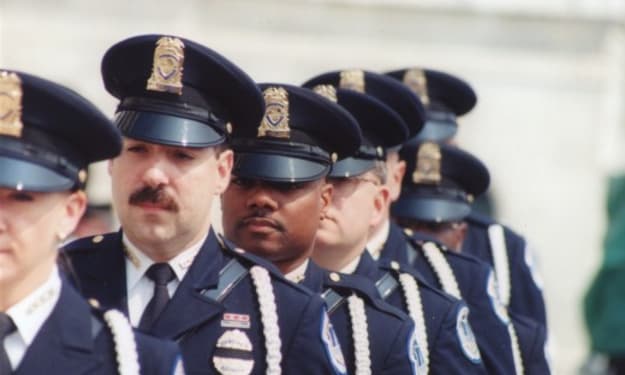
Within the Department A tweed jacket with leather elbow patches bespoke the speaker at the podium. He was thirty-ish, but he had specks of grey in his beard. His gait was that of an emperor from some far gone time. His bald head shone like wooden floors beneath fluorescent lights. He was tasked with introducing the speaker of the hour, Minister Myleecia Tessmer. As former chaplain for the Wilmington Police Department, Myleecia addressed over 250 officers. This speech marked the fourth time that Myleecia would touch on the necessity for God to be on the Force. But with the Great Transition in place, his role was no longer recognized as separation of State and ideas (including faith) eliminated her position within the department. Yet she continued to petition. The bald, bearded introducer stepped to the microphone as any master of ceremonies would do.
By Skyler Saunders7 years ago in Futurism
Anja (Ch. 3)
In an unfamiliar realm, the landscape stretched endlessly, punctuated only by the vibrant hue of an amethyst sun. Amaranth’s voice, filled with surprise and a tinge of fear, broke through the otherworldly serenity. "This isn't home!" She pressed her fingers into the soft grass beneath them, as if the tangibility of the blades could offer some comfort.
By Dan-O Vizzini7 years ago in Futurism
Life and Production: S3 E7: Goulding Automotive
Declared On a brisk Saturday in October, Lesane woke up and remembered that he was due for an oil change on the Goulding. A robot swished its way toward him as he rose from the bed. It declared the message straight from the dealership.
By Skyler Saunders7 years ago in Futurism
Life and Production: S3 E6: A Fresh Code
Influence Though the New Sweden Kids (NSK) were old compared to their teenage and 20-something students, these 30 and 40-year-old professors of economics were on the vanguard for the revolution known as the Great Transition. Professor Connor Mettle ensured that the trio would gain political exposure by asserting his scholarly influence upon the Delaware legislative body. And Professor Milo Kiln became the mouthpiece for the group. With grey eyes and coal black skin, this gentleman forged ahead in the fight for the United States government to recognize Delaware as not only the first state to ratify the Constitution, but the initiator of all liberties granted to citizens.
By Skyler Saunders7 years ago in Futurism
Life and Production: S3 E5: A Green Audience
Addressing Splinters of light poured through stained glass windows of the Continually Faithful, Always True Nondenominational Church in Wilmington. Pastor Emory Donovan set aside his notes for the Sunday sermon. His gangly hands pushed letters past the margins. He stood up, addressing his office plants (the only living things in the room besides him) as a green audience. His preparedness allowed him to strike out run-on sentences, correct split-infinitives, and clarify, always clarify. His congregation of about twelve on a good day remained. Since the Great Transition, freedom of ideas resonated amongst the populace. Pastor Donovan had struggled to fill pews as most congregants opted to forego faith and support reason. Parishioners flocked by the hundreds of thousands to understand philosophy rather than dogma.
By Skyler Saunders7 years ago in Futurism
Life and Production: S3 E4: Variables
Chief Importance Demarcus Montgomery Elementary School lacked rolling green lawns. In their place, great slabs of grey concrete covered the grounds. There was no pool, or botanical garden, or lavish tennis and basketball courts. It featured a modest gymnasium, an art studio, a library and a quaint café. But it was, like every school in Delaware, private. What it lacked in resources for making the grounds and interior more attractive and engaging, most of the staff made up for in their instruction. Here, the interior of the young students’ heads was of chief importance. Saffron Lesane recognized this.
By Skyler Saunders7 years ago in Futurism
Life and Production: S3 E3: Egretta Garzetta
Attractions No national park ever existed in Delaware. And under the Great Transition, that fact remained. The state parks were all auctioned off to private individuals or charitable organizations. Regardless of whose hands the lands were transferred to, the privatization of property once run by the government allowed for cleaner parks and more interesting tourist attractions. From the standpoint of visitors to the state, the draw of plants and animals and walking trails and campsites was heightened as the owners went through painstaking processes to ensure that their own parks were pristine and inviting. The green leaves glistened and the gravel trails beckoned bicyclists and walkers to tread those grounds.
By Skyler Saunders7 years ago in Futurism
Life and Production: S3 E2: The Night's Contest
The Mint The colors of the professional major league football team in Delaware were fittingly green, gold, and black. Fittingly because the name of the team was the Mint and represented the hue of United States dollar, the specific standard on which that currency was based, and the positive ledger balance, respectively. The team’s quarterback, Corey Rayful, signed a four year 250 million dollar deal to play with Delaware. Vick Knight took offense to this fact.
By Skyler Saunders7 years ago in Futurism
Sahasrara (Ch. 2)
Emerald High School was alive with post-school chatter and the rattle of lockers being closed for the day. Students in various stages of extracurricular activities spilled from classrooms, filling the hallways with the symphony of teenage life. Amidst them was Adrien, his mind preoccupied, barely noticing the excited hum around him.
By Dan-O Vizzini7 years ago in Futurism
Life and Production: S3 E1: Contributions
Way of Existence This day was not marked by big government pulling out semiautomatic rifles and training them at the citizens saying, “Pay up or prison!” No. April 15th marked the time when Delawareans’ rights remained intact. They were not out of the powers that be coercing them to trade their income for liberty. But that they donated their dollars in a willing way. Lesane used his smartphone to transmit his funds. He also checked the website of the list of names that showed the non-payers. On that list for the tenth year in a row was Holtzclaw Wert. Lesane paid as much attention to Wert as you would a fly: Enough to destroy him at least in a fiscal sense. Because of the list of non-payers, most names represented people who were barred from banks to barbershops. With a few swipes of his fingers and some quick voice commands, Lesane observed the list of names with whom he refused to do business. Though the list was quite short, it was exact and final for that year. By sending in a donation to the State, each Delawarean enjoyed rights of being free American citizens. Every working man, woman, and a scant amount of children before the age of 18 filled out the tiny, digital form, which proclaimed that they had paid for this wonderful way of existence.
By Skyler Saunders7 years ago in Futurism