book review
Books reviews of the best science fiction stories, texts, educational texts, and journals.
Flicker World
Flicker World by Brian Cramer is a lovely romance novel. It is about a newlywed couple who are just starting out in life with a new house. The husband gets a new job with an old friend which pays very well. However, his new job has a secret which turns his whole world upside down and messes with the timeline of the story. It is a Sci-Fi romance novel with time travel involved.
By Tangerinehippiestudios5 years ago in Futurism
Review of ‘Graceling’
Katsa has been able to kill a man with her bare hands since she was eight—she’s a Graceling, one of the rare people in her land born with an extreme skill. As niece of the king, she should be able to live a life of privilege, but Graced as she is with killing, she is forced to work as the king’s thug. She never expects to fall in love with beautiful Prince Po. She never expects to learn the truth behind her Grace—or the terrible secret that lies hidden far away . . . a secret that could destroy all seven kingdoms with words alone. With elegant, evocative prose and a cast of unforgettable characters, debut author Kristin Cashore creates a mesmerizing world, a death-defying adventure, and a heart-racing romance that will consume you, hold you captive, and leave you wanting more.
By Cyn's Workshop5 years ago in Futurism
Help me solve my book mystery?
I’m asking you for help, I need you to come and assist me with something that will hopefully get us both a LOT of money, or fame, or both. For this to make sense, I really must tell you what happened to me the other day, as it was so strange and, frankly, I don’t even believe it myself.
By Christian Wickham5 years ago in Futurism
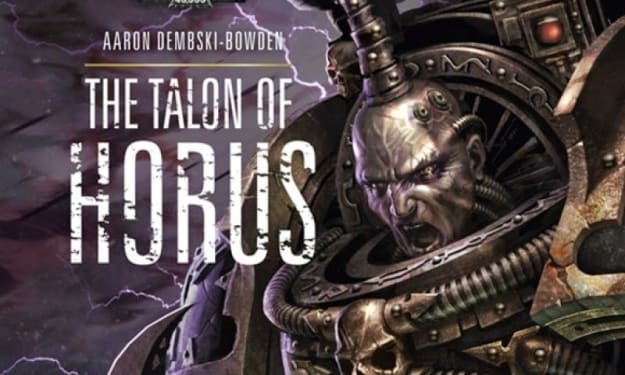
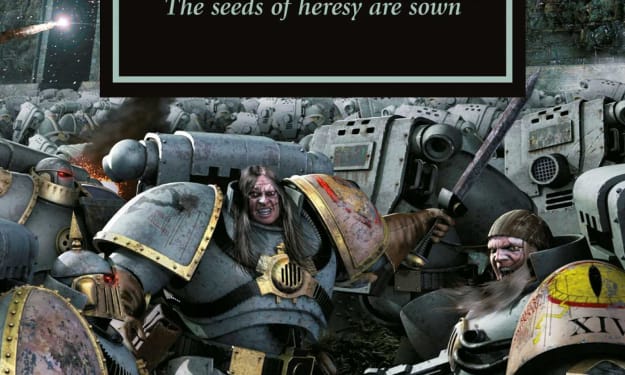
The Talon of Horus by Aaron Dembski-Bowden
The Talon of Horus is a worthy addition to the Warhammer 40,000 universe of literature and is book one of two (thus far, there have been hints at a third) in the ‘Black Legion’ series. As the series name might suggest, it focuses on the formation of said legion and the events leading up to the rise of Abaddon as Warmaster. If this is the first time you are hearing about any of these people or terms, allow me to enlighten you a little -
By David Heyman5 years ago in Futurism
The Hidden King - Conjurer's Counsel & Critique (Book Reviews of Indie Authors)
The Hidden King by E.G. Radcliff "Aed dreams of escaping the misery of the Maze, the dismal city of his birth, but his love for his makeshift family – his partner, Ninian, and an orphaned boy named Ronan – compels him to stay.
By Scaylen Renvac5 years ago in Futurism
A Brooklynite Author Who Gives Neil Gaiman and Terry Pratchett a Run for Their Money
I’m delighted to have read The Devil and the Wolf — a dark comedy fantasy by Richard L Pastore. It’s worth a read if you love Christopher Moore, Neil Gaiman, or the late Terry Pratchett — and who doesn’t love them?
By James Garside5 years ago in Futurism
Skyland: Islands in the wind
Skyland. In the year of 2251, earth has been ripped apart and water is one of the most preciouse possessions you can have. David Carlyle decided to take us to a steampunk world where people are devided by Seijin (humans with certain powers) and Jinsei (ordinary people). A rebellion is uprising. An intelligent girl and a slender boy try to survive
By Ewout Stouffs5 years ago in Futurism
Klass Reviews
Father of Contention BY LANIE MORES W.S. Klass | Book Review | 01/20/2021 FATHER OF CONTENTION Father of Contention, this book is written artistically by Lanie Mores, using knowledge of science and creative writing to boot in order to weave her intellectually dictated story. Mores introduces us to a supernatural tale that readers are sure to enjoy, beginning in a time of history shortly after World War II in a European setting. If you are fan of the supernatural; have a passion for science-fiction or fantasy; or perhaps you have a fetish for the devil, this book is certain to tease your every “Desire.”
By W.S. Klass5 years ago in Futurism
Let's Read: Red Claw
“Red Claw” by Philip Palmer, is something I picked up at a Half Price Books years ago. I was sitting at my desk, wondering what book should I choose for a review, when this fun science fiction book that entertained me for some odd number of weeks all those years ago beckoned to me. “Red Claw” was such an entertaining book to read, and frankly a lot of the criticisms of it were the reasons I loved it so much. Claiming it reads like a video game is an injustice to this book (as well as video games by the way). It’s action, joke, gore, and social commentary packed. If it’s a video game in book form, then it stands with the likes of “Bioshock Infinite” and “The Last of Us”, albeit with a lot more clever and dark humor. Can I be blamed and shamed for laughing out loud when the militant leader of a survivor group pretends to be dead, but the scientist strangling him knows better so he keeps choking him? Or when we are introduced to a character who lives his entire life over in his head, sees the signs that he was destined for greatness, to be a God among men, and save the day, only to be immediately killed when his thought is finished? That is top tier humor, the only kind that can be made for an ultra violent science fiction novel of such proportions.
By T.L Oberheu5 years ago in Futurism
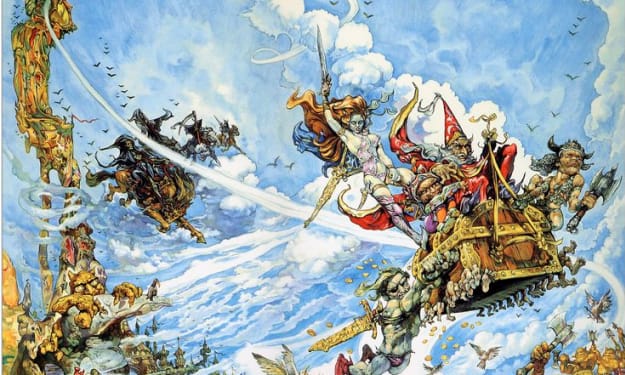
Nolan Reviews: 'The Light Fantastic' (1986) by Terry Pratchett
One man, one goal, 41 absurdist fantasy novels. Join me in my quest to spend this year reviewing each and every novel in the Discworld series. If this is the first review you're seeing, here is the previous review.
By NB Nightingale5 years ago in Futurism