astronomy
Celestial objects and the phenomena that surrounds them. What lies above the earth forever out of reach. From moons, to stars, galaxies, and beyond.
Joint NASA/ESA Mission Proposed to Search for Life on Europa
Europa is one of the most fascinating places in the Solar System, and is considered to be at or near the top of the list of worlds to search for possible evidence of life. Beneath its outer ice crust lies a deep and dark salty ocean, thought to be quite to Earth's own oceans. Could that ocean be inhabited, even if just by microbes? Scientists want to know, and now a new proposal calls for a joint orbiter/lander mission between NASA and ESA (European Space Agency), to try to answer that question.
By Paul Scott Anderson9 years ago in Futurism
Nearby 'Super-Earth' Exoplanet May Be Best Place Yet to Search for Alien Life
Just recently, an exo-planetary system called TRAPPIST-1, with seven known planets close in size to Earth, was announced by astronomers. Some of those planets are in the star's habitable zone, meaning that they could potentially be habitable for some kind of life. Then, another Earth-sized world was found orbiting the star GJ 1132b, and may have water and methane in its atmosphere. Now, another similar planet has been found orbiting another nearby star. It is also close in size to Earth and resides in the star's habitable zone. According to scientists, it is another prime candidate in the search for alien life and may even be the best one yet.
By Paul Scott Anderson9 years ago in Futurism
New Findings from Two 'Ocean Moons' Increase Possibility of Finding Alien Life
For those who are hoping to find evidence of life somewhere else in the Solar System, there was some exciting news this week. Two moons, Europa and Enceladus, were already thought to be among the best places to search, since both have liquid water oceans beneath their outer icy shells. And now, new data from the Cassini spacecraft and the Hubble Space Telescope has increased the potential for some form of living organisms to be found.
By Paul Scott Anderson9 years ago in Futurism
Space The Final Frontier
Since the dawn of man, mankind has always looked up to the heavens and pondered that ageless question whether we are alone or are there other life forms some where out there in the Universe. From the first time man noticed those shining stars above we have become fascinated by what is really out there.
By Dr. Williams9 years ago in Futurism
Oasis
Webster defines an Oasis as a fertile tract of land that occurs in a desert wherever a permanent supply of fresh water is available. In the universe an Oasis is a planet that has all the elements necessary to support life. It is impossible not to fathom that there are other planets our scientists term are in habitable zones making them an Oasis in the vast cosmos of space. For thousands of years man has looked up into the heavens and asked the eternal question are we alone or are there brothers of man somewhere out there far beyond our own know realm of reality inhabiting another Oasis?
By Dr. Williams9 years ago in Futurism
Atmosphere Detected on Nearby 'Super-Earth' Exoplanet
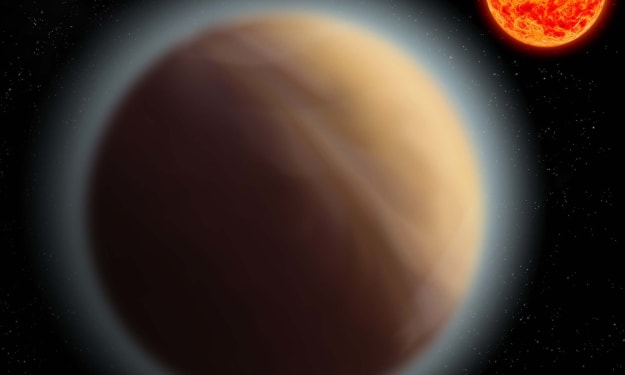
For the first time, astronomers have detected an atmosphere surrounding a "super-Earth" exoplanet which is close in size to Earth, another key step towards finding a world similar in size to ours that is also habitable. It's not Earth 2.0 just yet, but it's another indication that we are getting closer to finding a world that reminds us of home.
By Paul Scott Anderson9 years ago in Futurism
Researchers Identify Four Possible Candidates in Search for Planet 9
The search for a possible ninth planet in our Solar System has intensified in recent months, with more astronomers as well as amateurs joining in the hunt. Previous studies have hinted at its existence, but actually finding it has remained an elusive task. Now, astronomers from The Australian National University (ANU) are investigating four unknown objects in the outer Solar System that could be viable candidates for the mystery planet.
By Paul Scott Anderson9 years ago in Futurism
Mars May Have Once Had Rings, and Could Have Them Again in the Future
Saturn is, of course, famous for its exquisite ring system, but other planets have rings as well - Jupiter, Uranus and Neptune all have them, they just aren't nearly as prominent. Now it turns out that Mars may also have once had rings, and could have them again in the future.
By Paul Scott Anderson9 years ago in Futurism
Bright 'Tower' in Mars Orbiter Image: Anomaly or Natural Formation?
With thousands of images taken by various probes sent to Mars, it would seem inevitable that unusual or puzzling objects might be seen in some of them. And of course, there have been, most notably the famous "Face on Mars" first seen in low-resolution Viking orbiter images in the 1970s. Higher-resolution images taken later by other orbiters with better cameras showed it, and nearby interesting formations, to be just natural hills and mesas. Despite that, other curious things are seen in both orbital and ground images from time to time, although they almost always have a simple prosaic explanation. Another such oddity was just recently seen in an image taken by the Mars Reconnaissance Orbiter (MRO), which has attracted some attention. Most likely it is a natural rock formation, but it's also not, as described by the tabloid Daily Mail, a "spherule" either.
By Paul Scott Anderson9 years ago in Futurism
Titan's Lakes and Seas May Be Fizzy With Patches of Nitrogen Bubbles
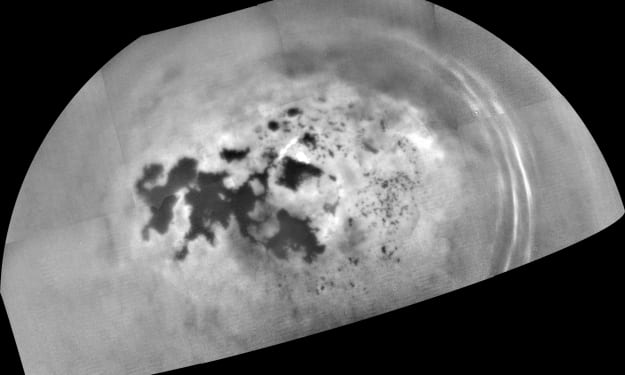
Saturn's moon Titan is the only other body in the Solar System besides Earth known to have liquids on its surface. In Titan's case, they are rivers, lakes and seas of liquid hydrocarbons (methane/ethane) instead of water. There is even methane/ethane rain, which further mimics Earth's hydrological cycle. For the most part, the lakes and seas are fairly smooth, with only small amounts of wave activity. But now, new research suggests that those lakes and seas might be quite fizzy at times - with periodic bursts of nitrogen bubbles.
By Paul Scott Anderson9 years ago in Futurism
NASA's New Europa Mission Formally Named 'Europa Clipper'
It's been a long time coming, but NASA's new mission to Jupiter's moon Europa now has a formal name: Europa Clipper. The spacecraft, to be launched in the early 2020s, will conduct multiple close flybys of the moon, with the goal of determining just how habitable it actually is. With a global salty ocean just beneath its icy crust, Europa is thought to be one of the best places in the Solar System to search for possible alien life.
By Paul Scott Anderson9 years ago in Futurism