astronomy
Celestial objects and the phenomena that surrounds them. What lies above the earth forever out of reach. From moons, to stars, galaxies, and beyond.
Aliens or Comets? Has the 'Wow!' Signal Mystery Finally Been Solved?
The search for evidence of extraterrestrial intelligence is one of the most exciting pursuits in astronomy today. Needless to say, there is a lot of controversy and debate surrounding the topic, partly due to an event which happened in 1977 - the famous "Wow!" signal. The brief but unusual radio transmission was detected only once, and the debate over its origin has continued to this day. Now, a group of astronomers are claiming to have finally solved the mystery. According to their new study just published, the signal came not from aliens, but comets.
By Paul Scott Anderson9 years ago in Futurism
NASA: Juno Delivers First Jupiter Data
Jupiter, it turns out, is even more wonderfully complicated than earth's scientists had previously imagined. NASA's Juno Mission has resulted in the first flurry of research papers that look to find clues to the beginnings of our galaxy in a better understanding of the solar system's largest planet.
By Anya Wassenberg9 years ago in Futurism
The Woodstock of UFOs, and You Missed It
Joshua Tree, California - Last weekend, among the ancient and gnarled joshua trees and placed gently under the firmament of the Milky Way galaxy, was an event that you probably missed. It's been touted as "The Woodstock of UFOs" and indeed you should be bummed you missed it this year, but not for the reasons you think.
By Jeremy Kenyon Lockyer Corbell9 years ago in Futurism
Bizarre Boyajian’s Star (‘Alien Megastructure’ Star) is Dipping Again!
The weird star called Boyajian's Star (aka Tabby's Star or KIC 8462852) has been fascinating astronomers and people in general because of its weird behaviour of experiencing sudden, unusual dips in brightness which all current theories have so far had difficulty explaining. Now, the star has started dipping again after a long period of "normal" activity.
By Paul Scott Anderson9 years ago in Futurism
Quantum Stills of a Thin-Spun Life-Part 5
Zennor strode through the doorway into the Command Center and found Algon at the Astrogator’s post. He slowed his steps as he approached her. But his concern for her was momentarily startled away when he saw all the active screens; panels dancing with energy pulses. “What’s all this?”
By Theresa McGarry9 years ago in Futurism
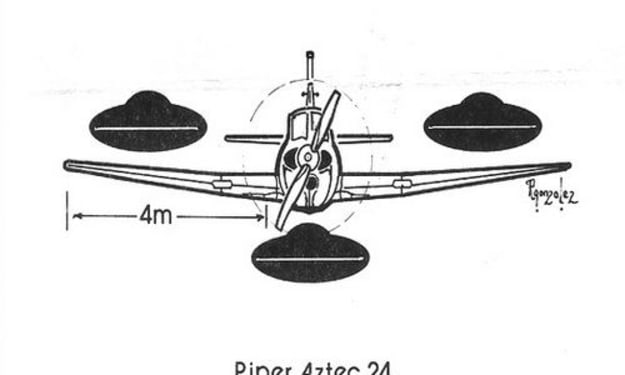
I'm Surrounded. Mayday!
It was the morning of May 3rd, 1975. Upon returning from a routine flight from Zihuatanejo to Mexico City, twenty-three-year-old pilot, Carlos de Santos, prepared his Piper PA-24 plane and was soon in the skies, heading for the Benito Juárez International Airport.
By Ryan Sprague9 years ago in Futurism
Symbiote Chapter 3
The office of the Minister of War was spartan and utilitarian, as was befitting a high level Bruish bureaucrat. Though they felt no need for any kind of decoration, visiting dignitaries of other species were more comfortable when there was at least a wall pick. Since they could care less either way, there were some picks. All the wall displays were neutral nature scenes from their home world: a jungle moon orbiting a gas supergiant in a binary star system, with one spectral “M” red giant and one “F” type main sequence. Though the scenes were as varied as jungles could be, there were no depictions of animals. The few furnishings in the barren, sad, cold, space, were cold metal and near unbreakable glass.
By daniel morris9 years ago in Futurism
A Primer for Dark System
Astronomy tells us that planets orbit stars, stars hang out in clusters and these clusters orbit the supermassive black hole in the center of the galaxy, and the galaxy is zooming away from some center, some big bang. These same astronomers say that, at times, planets are kicked out of their family systems to travel the dark alone. What if some of these outcasts formed their own system? These dark systems would be near impossible to detect with our current tech, but we couldn’t travel there anyway…
By daniel morris9 years ago in Futurism
The Physiological and Psychological Aspects of Sending Humans to Mars
Abstract The body is an extraordinary and complicated system that automatically detects, and responds to, dramatic environmental changes around it, particularly in an environment of weightlessness. The entire body is involved in the complex and rapid response to micro- or zero gravity, and space science is just beginning to form a picture of what is happening inside the body under these conditions. When an astronaut goes into space, as will be the case during an eventual mission to Mars, his or her body will immediately begin to experience a multitude of changes, causing the astronaut to feel and look slightly different. The crew would succumb to massive bone and muscle loss as a direct result of long-term exposure to micro- or zero gravity, and would suffer cell damage from ionizing cosmic radiation, potential permanent vision problems, and psychological and sociological deterioration due to isolation. Nonetheless, past space flight experiences from crews in the United States and the former Soviet Union have demonstrated that humans can survive space flights of several months, or even up to a year in duration. This study identifies the psychological and physiological aspects of a manned mission to Mars and will recommend countermeasures and prevention strategies designed to combat many of the problems associated with long-term exposures in space. The International Space Station (ISS), moreover, has an enormously vital role in assessing the health dangers of sending humans to Mars. Thus, a recommendation to place a crew on the ISS to simulate a flight to Mars is addressed.
By Antonio Paris9 years ago in Futurism
Star Quest
Fly me to the moon, let me play among the stars, let me see what spring is like on Jupiter and Mars in other words, let's reach our true destiny. A take on Frank Sinatra's hit. But, that movie "Interstellar" points out some very real possibilities that could play out in reality sooner than we think. When Tsiolokovsky, the pioneering Russian scientist, remarked that Earth is the cradle of mankind but one cannot live in the cradle forever he understood the vital importance that man must seek out new life forms and to literally go where no man has go before. Now, as the summer winds of the worlds discontent fast approach aided by the prolific findings of Stephen Hawking about the fate of mankind we really need to put our house in order and look to the stars if we have any hope of saving the human race. And, we better do it quick. Mankind has always wondered could there actually be a better world out there? We'd have better hope so.
By Dr. Williams9 years ago in Futurism
Quantum Stills of a Thin-Spun Life - Part 4
For uncounted minutes Parke looked down at the Captain’s chair from which he personally accessed the Core. And he knew he was postponing the private interface for myriad reasons, but primarily because he wouldn’t be able to unknow once he knew. Was that one of the reasons that previous captains had stopped interfacing? To remain unknowing? To be ignorant purposely? Because to know would mean taking action, rather than going on as they had been. He shook his head slowly, a gleam of tears in his eyes for his father, because it negated everything that a captain should be to refuse to understand, to refuse the responsibility of knowledge, even if it was unpalatable.
By Theresa McGarry9 years ago in Futurism