
Sustainable Computing: Top Best Practices for a Greener Data Center
As the issue of climate change gains more attention and urgency, adopting sustainable best practices can aid in making your data center more environmentally-friendly while also benefiting your business.


Achieving greater environmental sustainability in a data center requires a comprehensive evaluation of the facility's power and resource consumption, followed by identification of potential areas for improvement. This may entail upgrading outdated technology assets with more energy-efficient alternatives, or collaborating with eco-friendly IT vendors to establish a more eco-conscious data center.
The energy consumption of data centers is substantial, as per the U.S. Department of Energy. They consume anywhere from 10 to 50 times more energy than a typical office building of the same size and are responsible for approximately 2% of the country's total electricity utilization. The International Energy Agency's September 2022 report estimated that data centers consumed up to 1.3% of the world's electricity consumption in 2021. Furthermore, the IEA stated that data centers and data transmission networks contributed to a combined 0.9% of all energy-related greenhouse gas emissions in 2020.
In response to the growing global issue of climate change and the increasing importance of environmental, social, and governance (ESG) initiatives for customers, investors, and employees, data center owners are being urged to take an active role in reducing their carbon footprint. Implementing green computing practices to decrease the environmental impact of data centers is not only beneficial from an environmental standpoint, but also from a business perspective by minimizing energy and IT expenses and contributing to broader sustainability efforts.
The development of green data centers is currently a top priority for companies worldwide, irrespective of their industry or location. Adopting sustainable computing practices can help make data centers more energy-efficient and environmentally friendly, while also yielding significant business benefits. In this context, we present eight such practices that you can implement to enhance the sustainability and efficiency of your data center.
As part of your organization's efforts to be more environmentally responsible and cost-effective, there are several strategies you can implement to optimize your data center's energy usage. These include tracking your base energy usage to establish a baseline, right-sizing your servers to ensure they are not over- or under-utilized, modifying the temperature to maintain optimal conditions, rearranging your data center layout to improve airflow and reduce hot spots, replacing older assets with more energy-efficient models, investing in smart facilities management tools to monitor and control energy usage, investigating green energy technologies such as renewable sources, and partnering with green IT vendors and organizations to further enhance your sustainability efforts.
By implementing these practices, you can achieve greater energy efficiency and cost savings, while reducing your organization's environmental footprint.
To conclude, incorporating sustainability best practices in your data center is not only necessary for the environment but also a valuable advantage for your business. By optimizing energy efficiency through measures such as virtualization, server consolidation, and cooling system upgrades, you can significantly reduce your carbon footprint and lower energy costs. As the urgency of climate change increases, it is important to prioritize sustainable practices in all aspects of our lives, including the technology industry. By taking action now, we can create a more sustainable future for generations to come.
Further reading: Best Practices for Green Computing in Data Centers to Maximize Energy-efficiency and Sustainability
About the Creator
Alex Lim
Writing about data and emerging technologies topic, Solution Consultant, Technology (pupuweb.com) and Marketing/Business (paminy.com) Blogger, Photographer (pimodi.com), Husband, and Father of 2
Australia Private Equity Market: Capital Inflows, Deal Activity & Strategic Exits
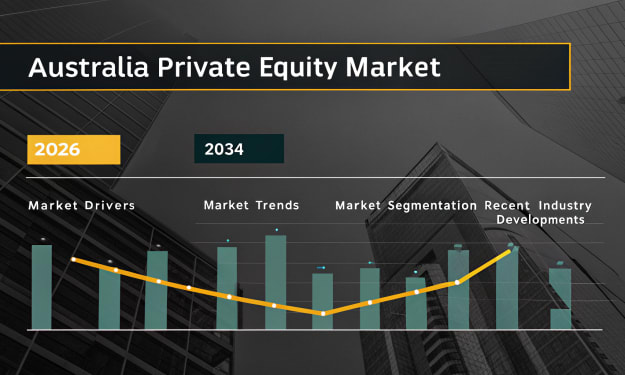
According to IMARC Group, the Australia private equity market reached USD 23.9 Billion in 2025 and is projected to grow to USD 48.5 Billion by 2034, exhibiting a compound annual growth rate (CAGR) of 8.21% during 2026–2034. The market’s expansion reflects increasing capital inflows, rising institutional participation, and strong deal-making activity across key sectors in Australia. Demand for buyout funds, venture capital investments, and infrastructure-focused portfolios is accelerating as investors seek higher returns and portfolio diversification. With strong opportunities in technology, healthcare, renewable energy, and real estate, Australia private equity market share continues to expand within both domestic and cross-border investment ecosystems.
By Kevin Cooperabout 18 hours ago in Futurism
Australia Robotics Market: Industrial Automation, AI Integration & Application Expansion
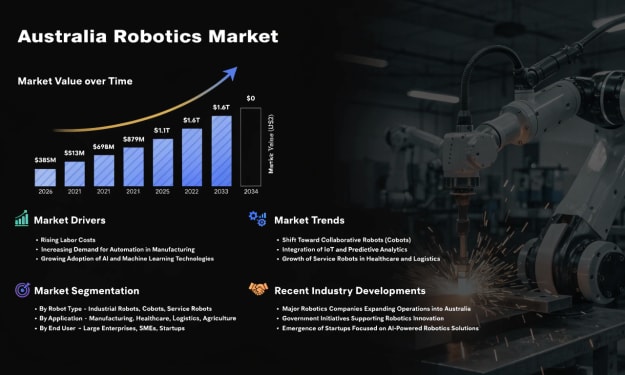
According to IMARC Group, the Australia robotics market reached USD 1.5 Billion in 2024 and is projected to expand to USD 6.7 Billion by 2033, exhibiting a robust compound annual growth rate (CAGR) of 16.20% during 2025–2033. This remarkable growth underscores Australia’s accelerating transition toward automation and intelligent systems across Australia. Robotics—spanning industrial arms, autonomous vehicles, service robots and AI-enabled collaborative systems—has evolved from niche industrial tools into critical infrastructure for manufacturing, mining, healthcare, agriculture and logistics. As businesses prioritize efficiency, productivity and safety, robotics adoption is becoming central to Australia’s digital and industrial transformation strategy.
By Shrestha Roy7 days ago in Futurism
A Planetary Alignment will coincide with Mercury Retrograde
Double phenomena in the heavens Some people say in jest that the planets have aligned in their favor when life works the way they desire. Were you aware that there are seasons when things do line up in the heavens? There will be a planetary alignment AKA a planet parade, on February 28, 2026.
By Cheryl E Preston5 days ago in FYI


Comments
There are no comments for this story
Be the first to respond and start the conversation.