
Space Crystals and the Materials of Tomorrow: How Orbit Transforms Matter
Space

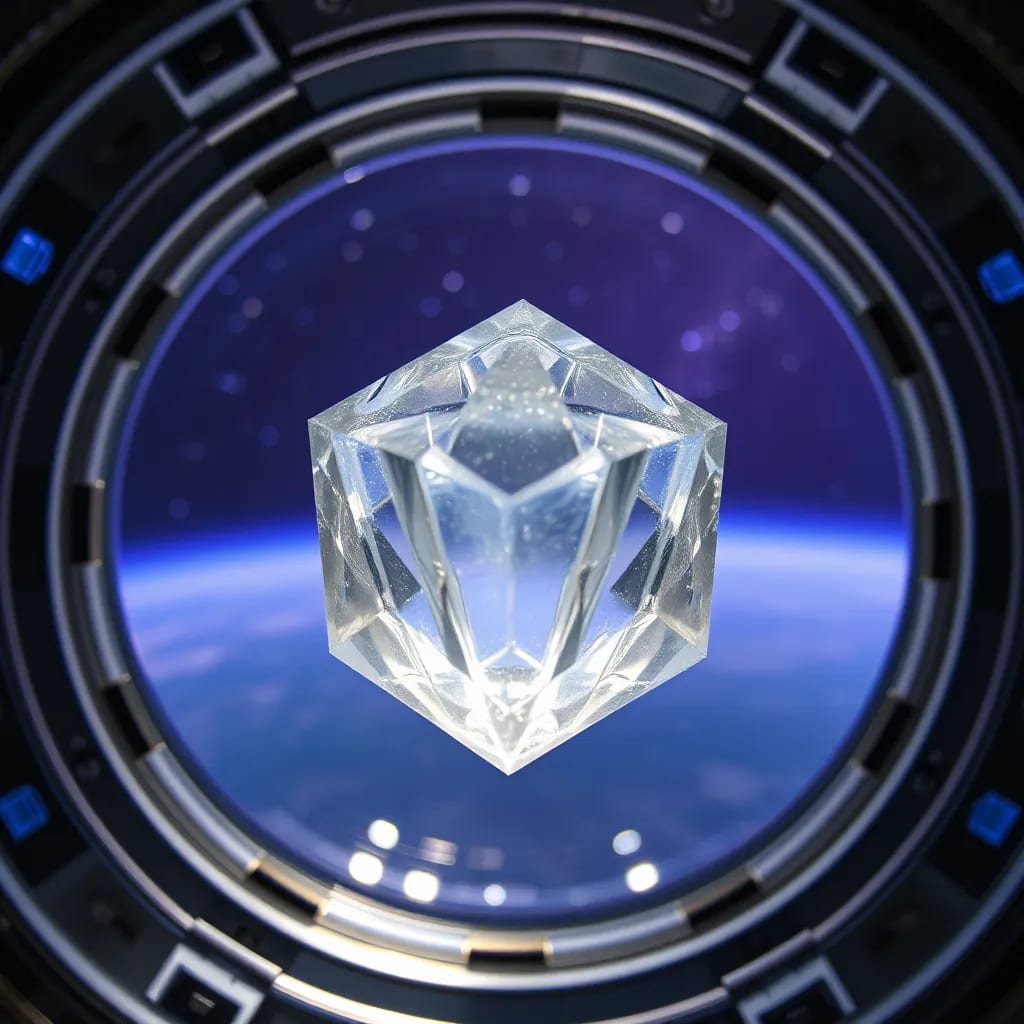
In the silence of Earth’s orbit, something extraordinary takes shape crystals that cannot be grown on Earth. In the absence of gravity, the familiar rules that govern material formation begin to shift. Atoms move differently, convection vanishes, and sedimentation no longer disrupts delicate structures. These unique conditions offer a rare opportunity: the ability to grow materials with near perfect internal structures. Today, scientists and engineers are looking to these “space grown” crystals as the key to breakthroughs in medicine, electronics, and even the construction of future space habitats.
Why Space?
The biggest difference between Earth and space is microgravity a near weightless environment where gravity's influence is minimal. On Earth, gravity causes molecules in liquids to rise and sink due to convection, pulling particles out of solution or causing irregular growth patterns in crystals. In microgravity, those processes are dramatically reduced, allowing for slow, stable, and symmetrical growth.
Since the 1970s, researchers aboard Skylab, Mir, and later the International Space Station (ISS), have conducted hundreds of experiments focused on growing crystals in orbit. The results have been nothing short of astonishing. Materials grown in space show fewer defects, greater purity, and in many cases, entirely new properties not replicable on Earth.
Protein Crystals: A Revolution in Medicine
One of the most exciting areas of space crystallization is protein crystallography the study of how proteins fold and interact. Protein crystals help scientists map out the intricate 3D structure of these complex molecules, which is essential for designing effective medications. But here’s the catch: the better the crystal, the clearer the structural data.
On Earth, protein crystals are notoriously difficult to grow. They often form with irregularities, limiting the accuracy of structural analysis. In space, however, the absence of sedimentation and convection allows for the formation of large, highly ordered crystals. These have enabled researchers to better understand diseases like cancer, Alzheimer’s, and various rare genetic disorders. The development of precision drugs tailored to these conditions has already been accelerated by insights gained from space grown proteins.
For example, scientists working with the Japan Aerospace Exploration Agency (JAXA) used ISS-grown protein crystals to develop new inhibitors for the enzyme responsible for Duchenne muscular dystrophy a breakthrough impossible with ground based samples alone.
Electronics from Orbit: Semiconductors Reimagined
Another field being revolutionized by orbital laboratories is semiconductor development. One of the most promising materials is gallium arsenide, a compound that could someday outperform silicon in electronics due to its superior speed and efficiency.
In space, gallium arsenide crystals can be grown with fewer impurities and nearly perfect lattice structures. These ultra pure semiconductors are already used in high efficiency solar panels aboard satellites, laser systems, and telecommunication devices. As space manufacturing matures, these components may find their way into everyday electronics on Earth enabling faster computers, more reliable networks, and even quantum level sensors.
Next-Gen Materials: Fibers, Alloys, and More
Space isn't just about crystals it's about entirely new classes of materials. In orbit, scientists can precisely control how polymers and alloys form on the molecular level. This has led to the development of advanced composite materials with remarkable durability, heat resistance, and flexibility.
A standout example is ZBLAN, a fluoride based optical fiber. On Earth, ZBLAN tends to form with microbubbles and internal flaws that scatter light. But in microgravity, these defects are minimized or eliminated, resulting in fiber optic cables that transmit data up to 100 times more efficiently than traditional silica based fibers. These are already being tested in next-generation internet infrastructure and could dramatically improve global communications.
Manufacturing Off-World: The Next Frontier
So far, most space based crystallization has occurred in small batches for research. But that’s about to change. Agencies like NASA, ESA, and JAXA, along with private companies like Axiom Space and Vast, are actively exploring the creation of autonomous space factories. These would operate either in low Earth orbit or on the Moon, continuously producing high value materials that are difficult or impossible to manufacture on Earth.
The long-term goal? To establish self sufficient production chains beyond Earth. Imagine growing perfect crystals in orbit, 3D-printing electronics on the Moon, and assembling habitats with materials formed in the vacuum of space. These innovations could support long term missions to Mars, or even lay the foundation for permanent human settlements in space.
Conclusion: A Crystal Clear Future
Space crystals are no longer science fiction they are becoming the building blocks of our future. Whether it's curing diseases, building faster computers, or enabling deep space exploration, the materials created in microgravity are poised to transform multiple industries.
In the weightlessness of space, matter behaves differently. Atoms align in ways nature rarely allows on Earth. And from this elegant order, new possibilities are born technologies more efficient, precise, and powerful than anything we’ve seen before.
As humanity ventures beyond Earth, these cosmic crystals may be the quiet heroes of our next great leap.
About the Creator
Keep reading
More stories from Holianyk Ihor and writers in Futurism and other communities.
Neutrino Communication: Sending Messages Through Earth and Stars
Imagine sending a message that can pass straight through mountains, oceans even the Earth itself without losing signal. Sounds like science fiction, right? Not anymore. Welcome to the cutting edge world of neutrino communication, a rapidly evolving field that may soon revolutionize how we connect across the planet and possibly the cosmos.
By Holianyk Ihor7 months ago in Futurism
About Binding Prometheus
I want to start actively advocating on behalf of my own work, and the most valuable part of my canon is, without a doubt, Binding Prometheus, the play I have been working on since 2019 and only finished in 2023 as part of my MA. The play itself is an amalgamation of a million different inspirations. On one end, it evokes the Ancient Greek myth-play, deriving its own title from the earliest extant work of Western drama we have, Aeschylus’s Prometheus Bound. On the other end, it borrows significantly from the sci-fi bulwarks from over the years, namely Mary Shelley’s Frankenstein and Karel Capek’s Rossum’s Universal Robots. The play could be an episode of Black Mirror, I fear. I don’t know. I’ve only ever seen one episode of Black Mirror.
By Steven Christopher McKnight15 days ago in Futurism
Pyridine Market Outlook 2025–2033
Pyridine Market Overview Pyridine, with the chemical formula C₅H₅N, is one of the most important heterocyclic organic compounds in industrial chemistry. Structurally, it consists of a six-membered aromatic ring where one carbon atom is replaced by nitrogen, conferring distinctive reactivity and solvent properties. Pyridine is a colorless, flammable liquid, miscible with water and many organic solvents, and is widely recognized for its pungent odor.
By Marthan Sir4 days ago in Futurism


Comments
There are no comments for this story
Be the first to respond and start the conversation.