
Pyridine Market Outlook 2025–2033
Rising Demand from Agrochemicals, Pharmaceuticals, and Specialty Chemicals Reshapes a Core Heterocycle Industry

Pyridine Market Overview
Pyridine, with the chemical formula C₅H₅N, is one of the most important heterocyclic organic compounds in industrial chemistry. Structurally, it consists of a six-membered aromatic ring where one carbon atom is replaced by nitrogen, conferring distinctive reactivity and solvent properties. Pyridine is a colorless, flammable liquid, miscible with water and many organic solvents, and is widely recognized for its pungent odor.
Industrial demand for pyridine stems from its role as both a solvent and a chemical building block. It is a foundational intermediate in the synthesis of agrochemicals, pharmaceuticals, vitamins, dyes, and specialty solvents. Compounds such as herbicides, insecticides, niacin (vitamin B₃), and pharmaceutical intermediates rely on pyridine derivatives. As global industries increasingly prioritize performance chemicals, precision agriculture, and high-purity drug manufacturing, pyridine continues to occupy a critical position within the specialty chemical value chain.
Pyridine Market Size and Forecast (Renub Research)
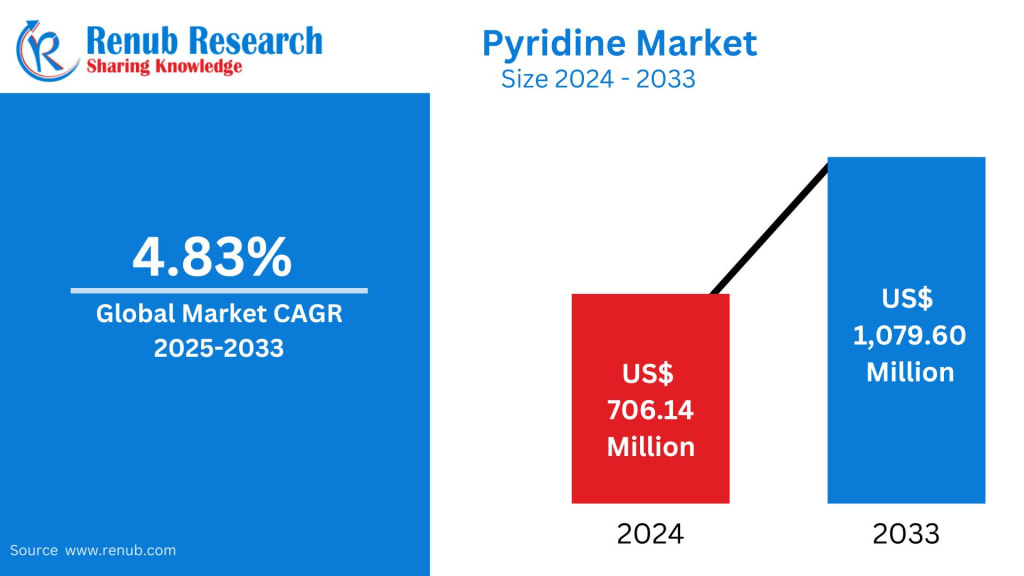
According to Renub Research, the international pyridine market was valued at US$ 706.14 million in 2024. The market is expected to expand at a compound annual growth rate (CAGR) of 4.83% from 2025 to 2033, reaching approximately US$ 1,079.6 million by 2033.
This steady growth reflects sustained demand from pharmaceuticals, agrochemicals, and specialty chemicals, combined with increased industrialization in emerging economies. While pyridine is a mature chemical, the continued innovation in downstream applications—especially in high-value derivatives—ensures its relevance in future chemical manufacturing.
Historical Trends in the Pyridine Industry
Historically, pyridine production was closely tied to coal tar processing, but modern industrial synthesis now relies primarily on ammonia–aldehyde reactions and advanced catalytic processes. Over the last two decades, the industry has transitioned from bulk solvent use to higher-value applications in agrochemicals, pharmaceuticals, and electronics.
During the early 2000s, the rise of crop protection chemicals drove large-scale demand for pyridine intermediates such as picolines, lutidines, and chlorinated derivatives. In the 2010s, pharmaceutical growth and increasing global healthcare spending strengthened the market for high-purity pyridine used in APIs and fine chemical synthesis. More recently, environmental regulations and sustainability targets have encouraged manufacturers to invest in cleaner production technologies, shifting the competitive focus from volume to quality, compliance, and efficiency.
Market Drivers and Growth Factors
1. Expansion of Agrochemicals and Food Security
Pyridine derivatives are essential intermediates in the production of herbicides, fungicides, and insecticides. With global food demand increasing due to population growth and climate-related yield pressures, agricultural productivity remains a top priority. Governments and agribusinesses continue to invest in crop protection solutions, supporting long-term demand for pyridine-based compounds.
2. Rising Pharmaceutical Manufacturing
Pyridine plays a critical role in pharmaceutical synthesis, particularly in vitamin production, anti-infectives, and specialty APIs. As healthcare access expands across Asia, Africa, and Latin America, pharmaceutical manufacturing capacity is increasing, driving demand for reliable and high-purity pyridine derivatives.
3. Specialty Chemicals and Fine Chemical Applications
Beyond agriculture and healthcare, pyridine derivatives are used in catalysts, dyes, polymer additives, and electronic materials. The shift toward high-performance materials and functional chemicals has elevated the importance of heterocyclic compounds in modern manufacturing.
4. Technological Advancements and Green Chemistry
Innovation in catalytic processes, solvent recovery, and continuous manufacturing has improved yields while reducing environmental impact. Cleaner production methods are enabling compliance with stricter environmental regulations, particularly in Europe and North America.
Market Share and Competitive Landscape
The global pyridine market is moderately consolidated, with leading producers in Asia—particularly China, India, and Japan—supplying both domestic and international demand. Chinese companies dominate high-volume production for agrochemicals, while Indian and Japanese firms are increasingly specializing in pharmaceutical-grade and specialty derivatives. Global distributors and specialty chemical firms play a critical role in bridging regional supply chains with end-user industries.
Top Companies in the Pyridine Industry
Jubilant Life Sciences Ltd. (India) – Strong presence in pharmaceutical APIs and intermediates.
Resonance Specialties Limited (India) – Leading producer of pyridine, picolines, and value-added derivatives with GMP-compliant facilities.
Shandong Luba Chemical Co., Ltd. (China) – Integrated agrochemical producer and one of the largest global manufacturers of pyridine-based compounds.
Koei Chemical Company, Limited (Japan) – Focus on fine chemicals, pharmaceutical intermediates, and functional chemical applications.
Nippon Steel & Sumikin Chemical Co., Ltd. (Japan) – Active across chemicals and advanced materials with a global industrial footprint.
Lonza Group Ltd. (Switzerland) – Specialty chemicals and life sciences leader with strong sustainability integration.
Barentz International B.V. (Netherlands) – Distributor expanding its life sciences and specialty ingredient portfolio.
Novasyn Organics Pvt. Ltd. (India) – Niche manufacturer specializing in customized pyridine derivatives.
Vertellus Holdings LLC (Aurorium, USA) – Specialty chemicals company with pyridine and downstream product focus.
Nanjing Red Sun Co., Ltd., Hubei Baoxie Group Co., Ltd., Chang Chun Petrochemical, Hubei Sanonda, Junsei Chemical, Alkali Metals Ltd. – Regional leaders contributing to global capacity.
SWOT Analysis of the Pyridine Market
Strengths
Essential intermediate in pharmaceuticals, agrochemicals, and fine chemicals.
Stable demand from multiple end-use industries.
Technological maturity ensures consistent quality and scalability.
Weaknesses
Dependence on regulated sectors sensitive to environmental compliance.
Price volatility of feedstocks and energy.
Limited differentiation for bulk pyridine products.
Opportunities
Expansion into high-value pharmaceutical and electronic-grade derivatives.
Growth in contract development and manufacturing (CDMO) services.
Adoption of green chemistry and sustainable manufacturing technologies.
Threats
Increasing environmental regulations on chemical manufacturing.
Competition from alternative synthetic pathways or substitute intermediates.
Trade barriers and regional supply chain disruptions.
Sustainability in the Pyridine Industry: Case of Lonza Group Ltd.
Sustainability has become a defining factor in chemical manufacturing, and Lonza Group Ltd. exemplifies how ESG principles are shaping the industry. Lonza aligns its operations with the United Nations Sustainable Development Goals (SDGs) through climate action, responsible sourcing, and community engagement.
The company has committed to net-zero greenhouse gas emissions by 2050 and a 42% reduction in Scope 1 and 2 emissions by 2030, supported by renewable energy adoption, energy-efficient infrastructure, and advanced waste management systems. Water conservation, solvent recycling, and sustainable packaging further reduce environmental impact across its operations.
From a governance perspective, Lonza emphasizes transparency, ethical sourcing, and supplier sustainability audits. Social initiatives focus on workplace safety, diversity, and community engagement. Through its sustainable biomanufacturing and specialty chemical solutions, Lonza demonstrates how pyridine and its derivatives can be integrated into responsible, future-ready production ecosystems.
Recent Developments in the Pyridine Industry
January 2025 – Barentz International B.V.: Expanded its specialty ingredients distribution network through the acquisitions of NCD Ingredients GmbH and Anshul Life Sciences Group, strengthening its presence in life sciences and specialty chemicals.
September 2024 – Nanjing Red Sun Co., Ltd.: Entered a strategic partnership with Zhejiang Avilive Chemical to enhance integrated agrochemical and pyridine-based production.
March 2023 – Vertellus Holdings LLC (Aurorium): Acquired CENTAURI Technologies in Texas, expanding its specialty chemicals portfolio and reinforcing its position in pyridine and derivatives.
These developments highlight ongoing consolidation, capacity expansion, and strategic positioning aimed at capturing higher-value segments of the market.
Company Analysis Framework (Applied Across Key Players)
For each leading company—including Lonza Group Ltd., Resonance Specialties, Shandong Luba Chemical, Koei Chemical, Nippon Steel & Sumikin Chemical, Barentz International, Novasyn Organics, Vertellus Holdings, Nanjing Red Sun, Hubei Baoxie Group, Chang Chun Petrochemical, Hubei Sanonda, Junsei Chemical, and Alkali Metals Ltd.—the following analytical structure is applied:
1. Market & Forecast
Positioning within the global pyridine value chain.
Exposure to high-growth end-use sectors.
2. Historical Trends
Evolution of production capabilities and geographic expansion.
3. Business Model and Operations
Manufacturing scale, vertical integration, and distribution strategies.
4. Workforce and Leadership
Executive leadership, operational management, and governance frameworks.
5. Strategic Developments
Mergers, acquisitions, partnerships, and capacity investments.
6. Sustainability Analysis
Renewable energy usage, waste reduction, water conservation, and circular economy initiatives.
7. Product Portfolio
Pyridine derivatives, quality standards, and pipeline innovation.
8. SWOT Assessment
Competitive strengths, operational risks, and growth opportunities.
9. Revenue and Market Share
Contribution of pyridine-related products to overall corporate performance.
This standardized approach enables clear benchmarking across companies and highlights how strategic focus, sustainability alignment, and product innovation shape competitive advantage.
Future Outlook: Where Is the Pyridine Market Headed?
The global pyridine market is expected to maintain moderate but resilient growth through 2033. While bulk pyridine production will remain essential for agrochemicals, the fastest value creation is likely to occur in specialty and pharmaceutical-grade derivatives.
Emerging markets in Asia, Africa, and Latin America will continue to drive demand for agrochemicals and healthcare products, reinforcing the importance of pyridine intermediates. At the same time, sustainability and regulatory compliance will become key differentiators. Companies that invest in cleaner production technologies, digital manufacturing, and integrated supply chains will be better positioned to secure long-term contracts and premium pricing.
Innovation in downstream applications—such as electronic materials, advanced catalysts, and nutraceuticals—will further diversify demand, transforming pyridine from a traditional solvent into a strategic building block for future chemical technologies.
Final Thoughts
The pyridine market exemplifies how a classic chemical compound can remain strategically relevant in a rapidly evolving industrial landscape. With a projected rise from US$ 706.14 million in 2024 to US$ 1,079.6 million by 2033, the industry is set for steady expansion, driven by agrochemicals, pharmaceuticals, and specialty chemicals.
More importantly, the next phase of growth will be shaped not only by volume, but by quality, sustainability, and innovation. Companies that combine technical expertise with environmental responsibility and global partnerships will define the future of the pyridine industry—transforming a foundational molecule into a cornerstone of modern, sustainable chemical manufacturing.
About the Creator
Marthan Sir
Educator with 30+ years of teaching experience | Passionate about sharing knowledge, life lessons & insights | Writing to inspire, inform, and empower readers.
Keep reading
More stories from Marthan Sir and writers in Futurism and other communities.
North America Textile Market Size & Forecast 2025–2033
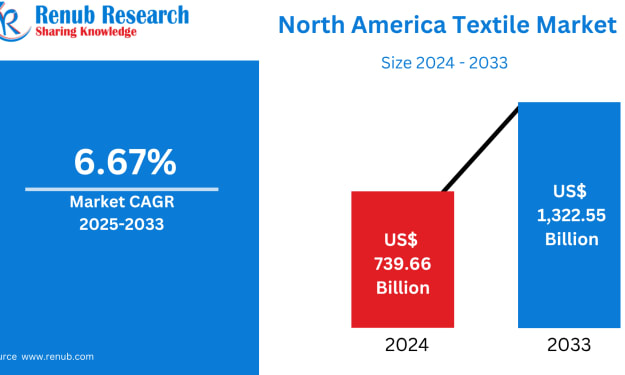
North America Textile Market Overview The North America Textile Market is entering a transformative phase marked by innovation, sustainability, and technological advancement. According to Renub Research, the market is expected to grow significantly, increasing from US$ 739.66 billion in 2024 to US$ 1,322.55 billion by 2033, registering a Compound Annual Growth Rate (CAGR) of 6.67% between 2025 and 2033. This expansion is being driven by rising consumer demand for innovative fabrics, environmentally responsible manufacturing, and the rapid integration of digital and automation technologies.
By Marthan Sir2 days ago in Futurism
About Binding Prometheus
I want to start actively advocating on behalf of my own work, and the most valuable part of my canon is, without a doubt, Binding Prometheus, the play I have been working on since 2019 and only finished in 2023 as part of my MA. The play itself is an amalgamation of a million different inspirations. On one end, it evokes the Ancient Greek myth-play, deriving its own title from the earliest extant work of Western drama we have, Aeschylus’s Prometheus Bound. On the other end, it borrows significantly from the sci-fi bulwarks from over the years, namely Mary Shelley’s Frankenstein and Karel Capek’s Rossum’s Universal Robots. The play could be an episode of Black Mirror, I fear. I don’t know. I’ve only ever seen one episode of Black Mirror.
By Steven Christopher McKnight11 days ago in Futurism
Pizza Market: Quick-Service Growth & Consumer Demand Trends
According to IMARC Group's latest research publication, The global pizza market size reached USD 155.2 Billion in 2024. Looking forward, IMARC Group expects the market to reach USD 226.2 Billion by 2033, exhibiting a growth rate (CAGR) of 4.27% during 2025-2033.
By James Whitman4 days ago in Futurism


Comments
There are no comments for this story
Be the first to respond and start the conversation.