
Solar Cycles and Their Impact on Planets: The Invisible Hand of Our Star
Space

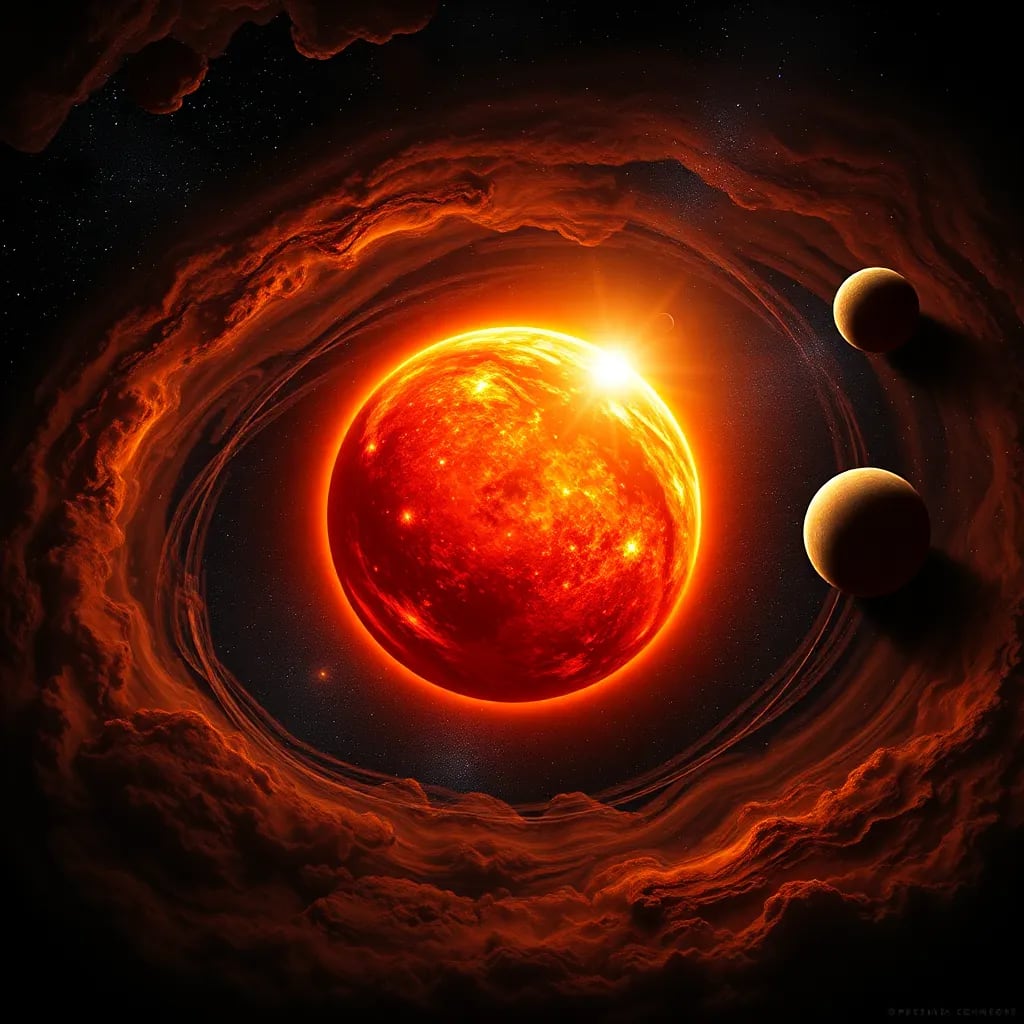
The Sun is far more than a glowing ball of plasma lighting up our skies. It’s a living, dynamic star, constantly shifting and evolving. One of the most fascinating manifestations of its activity is the solar cycle—a recurring pattern in which the Sun’s magnetic field changes direction approximately every 11 years. These cycles bring with them fluctuations in sunspot numbers, powerful flares, and massive eruptions of solar material. But how exactly do these solar rhythms affect not just Earth, but other planets in our solar system as well?
What Is a Solar Cycle?
A solar cycle consists of alternating periods known as the solar maximum and solar minimum. During a maximum, the Sun's surface becomes a bustling hub of activity with numerous dark sunspots, intense solar flares, and coronal mass ejections (CMEs). In contrast, during a solar minimum, the Sun appears calmer, with fewer sunspots and eruptions.
This behavior is driven by the Sun’s magnetic field, which undergoes a complete reversal roughly every 11 years. The cause of this flip lies in the turbulent motion of plasma within the solar interior, producing complex magnetic dynamics that reach all corners of the solar system.
Earth and Solar Cycles: When Space Weather Hits Home
Earth is particularly sensitive to the ebbs and flows of the solar cycle. During periods of high solar activity, Earth’s magnetic field can be buffeted by charged particles from solar storms. These disturbances, collectively known as space weather, can cause geomagnetic storms that interfere with satellite operations, disrupt GPS and radio communication, and even damage power grids.
Beyond technology, solar cycles also influence Earth's upper atmosphere. The ionosphere—the region filled with charged particles—is directly affected by increased solar radiation. Its density changes during solar maxima, which can alter the behavior of radio waves and affect satellite trajectories.
Historically, long-term solar patterns may have even impacted Earth’s climate. For example, during the Maunder Minimum in the 17th century—a time when sunspot activity nearly disappeared for 70 years—Europe experienced what became known as the Little Ice Age, marked by unusually cold winters and crop failures. While the relationship between solar activity and climate is still debated, the possibility underscores how influential our star truly is.
Other Planets Under the Sun’s Spell
Although Earth gets the spotlight when discussing solar cycles, the entire solar system feels the Sun’s magnetic heartbeat—each planet experiencing it in its own way, depending on distance, atmospheric conditions, and magnetic fields.
Mercury
As the closest planet to the Sun, Mercury lacks a substantial atmosphere and has a weak magnetic field. This makes it highly vulnerable to solar radiation. During solar maximum, the planet’s surface is relentlessly bombarded with charged particles, which could have dramatic effects on surface chemistry and temperature.
Mars
Mars has a thin atmosphere and only remnants of a magnetic field, leaving it exposed. When the Sun is active, Mars can lose parts of its atmosphere through ion escape—a process monitored closely by NASA’s MAVEN spacecraft. This ongoing atmospheric loss may have played a role in transforming ancient Mars from a once-habitable world into the cold desert it is today.
Jupiter and Saturn
These gas giants are equipped with powerful magnetic fields and vast radiation belts. When solar winds intensify, so do the auroras on Jupiter and Saturn—massive displays of light even more spectacular than Earth’s northern lights. These interactions help scientists study the deep magnetic structures of these enormous planets.
Uranus and Neptune
At the solar system’s outer edges, solar energy is significantly weaker, yet not absent. Even here, solar activity can trigger subtle shifts in magnetospheres and ionospheres, offering clues about the planets' hidden dynamics. The effects are faint but still traceable with sensitive instruments.
Satellites, Missions, and the Solar Factor
Understanding solar cycles is not just about protecting our home planet—it’s also crucial for space exploration. During solar maxima, spacecraft electronics are at greater risk from radiation damage. Engineers often design missions with radiation-hardened components and adjust spacecraft schedules based on predicted solar behavior.
For example, interplanetary probes, rovers, and even the International Space Station (ISS) rely on space weather forecasts to stay safe and operational. A single miscalculation during a solar flare could mean critical damage to equipment or danger to astronauts.
Life Under the Sun’s Pulse
Solar cycles are far more than just fluctuations in brightness. They’re the metronome to which our solar system dances. From driving Earth’s space weather and atmospheric changes to shaping planetary evolution across billions of kilometers, the Sun’s cycles represent a powerful force in the cosmic balance.
By decoding the rhythms of our star, we not only safeguard our technologies and missions, but we also gain deeper insight into the past, present, and future of every planet that orbits it. After all, we are all children of the Sun, and its invisible hand reaches farther than we ever imagined.
About the Creator
Keep reading
More stories from Holianyk Ihor and writers in Futurism and other communities.
Exploring the Cosmic Vacuum: The Mysteries of Absolute Emptiness
When we think about space, images of dazzling stars, swirling galaxies, massive planets, and enigmatic black holes typically come to mind. But beyond these celestial wonders stretches something far more mysterious — the cosmic vacuum. At first glance, it might seem like a vast and silent void, completely empty of matter, air, and sound. But in truth, the vacuum of space is far from simple. Modern research reveals that this “nothingness” plays a fundamental role in the structure and evolution of the universe.
By Holianyk Ihor7 months ago in Futurism
About Binding Prometheus
I want to start actively advocating on behalf of my own work, and the most valuable part of my canon is, without a doubt, Binding Prometheus, the play I have been working on since 2019 and only finished in 2023 as part of my MA. The play itself is an amalgamation of a million different inspirations. On one end, it evokes the Ancient Greek myth-play, deriving its own title from the earliest extant work of Western drama we have, Aeschylus’s Prometheus Bound. On the other end, it borrows significantly from the sci-fi bulwarks from over the years, namely Mary Shelley’s Frankenstein and Karel Capek’s Rossum’s Universal Robots. The play could be an episode of Black Mirror, I fear. I don’t know. I’ve only ever seen one episode of Black Mirror.
By Steven Christopher McKnight17 days ago in Futurism
Australia Iron Ore Market: Global Supply Leadership, Steel Demand & Resource Security
In 2024, Australia iron ore market reached USD 8.34 Billion. Looking ahead, the market is projected to expand to USD 12.23 Billion by 2033, exhibiting a compound annual growth rate (CAGR) of 3.90% during 2025–2033.
By Kevin Cooper6 days ago in Futurism
The Devil's Cut
“Comrade, finally you’re awake.” The voice was smooth, sensual. A flickering incandescent bar was all that lit the white, sterile room. All Vladimir remembered was everything going black. He tried to move his arms and found them strapped to the gurney.
By Matthew J. Fromm4 days ago in Fiction


Comments
There are no comments for this story
Be the first to respond and start the conversation.